
Principal Engineer vs Chief Software Engineer Roles
As engineering organizations scale, the need for high-level individual contributor (IC) roles becomes critical. Defining the principal engineer software position and the chief software engineer role allows companies to retain top talent while driving technical excellence across multiple teams.
- Engineering Leadership
- Technical Scaling
- IC Career Path
- Staff Plus Roles
Defining the Principal Software Engineer
A principal engineer software professional typically operates at the level of a business unit or a large product domain. Their focus is on the long-term technical health and architectural integrity of a significant portion of the company's codebase.
- Cross-team technical coordination and mentorship
- Ownership of complex architectural decisions
- Bridging the gap between product requirements and technical feasibility
- Identifying and mitigating systemic technical debt
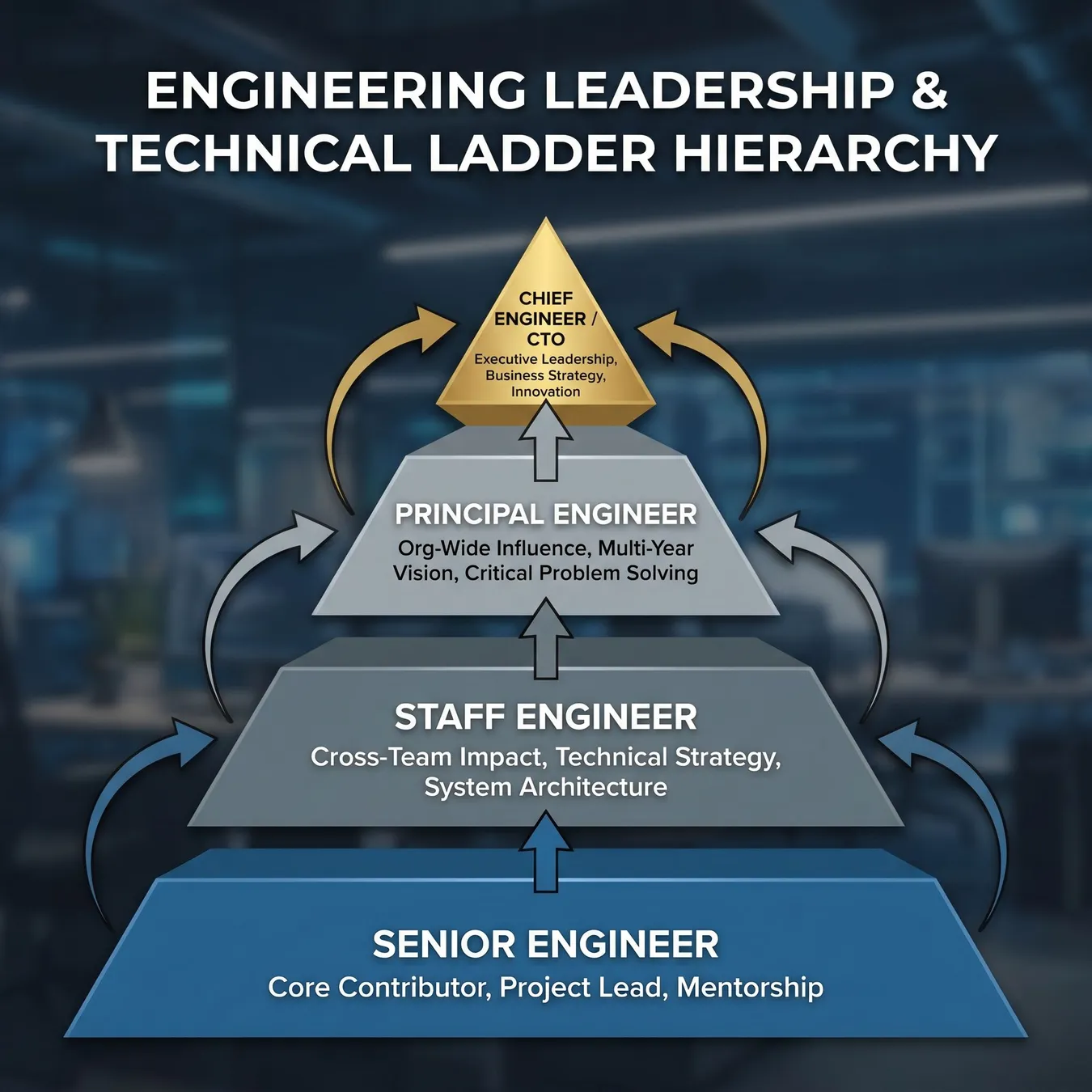
The technical leadership ladder beyond the Senior Engineer level.
The Role of the Chief Software Engineer
The chief software engineer is often the highest technical IC role in an organization, focusing on company-wide technical strategy. While a Principal might focus on a domain, the Chief looks at the entire ecosystem, ensuring consistency across all engineering departments.
Info.
// Strategic Peerage
Key Differences: Principal vs. Chief
Understanding the nuances between these roles is essential for proper organizational design. Often, a software engineering architect will focus on specific system designs, whereas these leadership roles focus on organizational technical leverage.
| Attribute | Principal Engineer | Chief Engineer |
|---|---|---|
| Scope | Business Unit / Domain | Entire Organization |
| Focus | Architecture & Delivery | Technical Strategy & Standards |
| Time Horizon | 1-2 Years | 3-5 Years |
Core Responsibilities of High-Level ICs
Both roles are responsible for ensuring that the engineering roadmap is technically sound and achievable. They serve as the ultimate escalation point for technical blockers that span multiple squads.
- 01
Setting global coding and documentation standards
- 02
Reviewing high-impact architectural changes
- 03
Mentoring Staff and Senior engineers
- 04
Evaluating new technologies for company-wide adoption
When to Hire a Principal Engineer
Most startups don't need a Principal Engineer until they reach approximately 30-50 engineers. At this stage, the coordination overhead between teams becomes a bottleneck for shipping speed.

Principal engineers facilitate technical alignment across growing teams.
When to Appoint a Chief Software Engineer
This role is typically reserved for large-scale enterprises or high-growth companies with deeply complex technical challenges, such as multi-cloud migrations or massive AI integrations.
The Impact on Engineering Culture
Having clear IC leadership roles prevents 'management creep,' where talented developers feel they must become people managers to advance their careers. This keeps your best technical minds focused on the code.
A great Principal Engineer doesn't just solve problems; they build the systems that prevent those problems from ever occurring.
Alex Rivers · CTO
Specialized Senior Roles
In some organizations, these roles are further specialized. For instance, a senior platform engineer might take on Principal-level responsibilities specifically for infrastructure and developer experience.
Common Pitfalls in Role Definition
Define clear impact areas for each role
Involve them in business-level planning
Give them autonomy over technical standards
Treat them as 'super-senior' ticket takers
Force them into people management tasks
Isolate them from the day-to-day reality of the codebase
Measuring Success for Technical Leaders
40%
Reduction in Tech Debt
2x
Faster Onboarding
99.99%
System Uptime
The Path to Principal and Chief
Advancing to these levels requires more than just coding skill; it requires high emotional intelligence, the ability to influence without authority, and a deep understanding of business goals.
Structuring Your Technical Ladder
A well-structured ladder provides transparency. If your internal team is struggling to define these levels, a software engineering consultant can help benchmark your roles against industry standards.
Principal Engineer Hiring Checklist
Proven track record of multi-team technical leadership
Deep expertise in the company's core technology stack
Ability to communicate complex technical concepts to non-technical stakeholders
Experience managing large-scale architectural migrations
Frequently Asked Questions
Scaling Technical Excellence with Studio 402
Defining these roles is only the first step in scaling your engineering organization. At Studio 402, we partner with technical leaders to audit their systems, refine their architectures, and build the durable foundations required for growth.
Whether you are rescuing a prototype that has outgrown its initial design or planning the technical roadmap for a new SaaS platform, our senior engineering team provides the high-level expertise your project needs to succeed.

Studio 402 provides the senior technical leadership to scale your product.
Next Steps for Engineering Leaders
If your current team is hitting a ceiling on technical velocity or system reliability, it may be time to formalize your senior technical roles or bring in an external partner to bridge the gap.
Build a Scalable Engineering Foundation
Need senior technical guidance to scale your engineering team or harden your product? Let's discuss how Studio 402 can help.
Explore More Resources
Related Categories
Index
Related categories
Keep reading
More in Engineering Leadership & Scaling
Defining the right roles at the right time is the difference between a team that scales and a team that stalls. By empowering Principal and Chief engineers, you ensure your technical strategy remains as ambitious as your business goals.
Trusted by venture-backed startups to scale engineering from MVP to production.
Studio 402 Engineering Excellence
Summary of Technical Leadership Levels
01 / 04
phase 01 / 04
Senior Engineer
phase 02 / 04
Staff Engineer
phase 03 / 04
Principal Engineer
phase 04 / 04
Chief Engineer
As of 2026, the demand for these high-level IC roles continues to grow as software systems become increasingly distributed and complex. Organizations that fail to define these paths risk losing their most valuable technical assets.
Final Thoughts on Technical Growth
The transition from a senior developer to a principal engineer software leader is a shift in mindset from solving problems to building the environment where problems are solved efficiently.

Principal engineers drive quality through rigorous standards.

Chief engineers oversee the entire technical ecosystem.
Thank you for reading our guide on defining senior technical roles. For more insights on scaling your engineering organization, explore our related articles or reach out to our team.