
AI Team Structure Roles for Financial Services Company
Building an AI engineering organization within a regulated financial services environment requires more than just hiring data scientists. It demands a specialized team structure that balances rapid innovation with the rigorous demands of compliance, security, and auditability.
- Fintech Strategy
- AI Engineering
- Compliance-First
- Team Scaling
To succeed, leaders must define clear roles that bridge the gap between model development and production-grade software engineering. This guide outlines the essential ai team structure roles for financial services company success in 2026.
The Core AI Engineering Pod in Finance
A high-performing AI team in a bank or fintech usually operates in a cross-functional pod. This ensures that every model developed is also deployable and compliant from day one.
- AI Lead Architect: Oversees system design and model selection.
- Machine Learning Engineer: Focuses on model training and optimization.
- Data Infrastructure Engineer: Manages the pipelines and data quality.
- Compliance & Risk Liaison: Ensures every model meets regulatory standards.
- Product Manager (AI): Translates business needs into technical requirements.
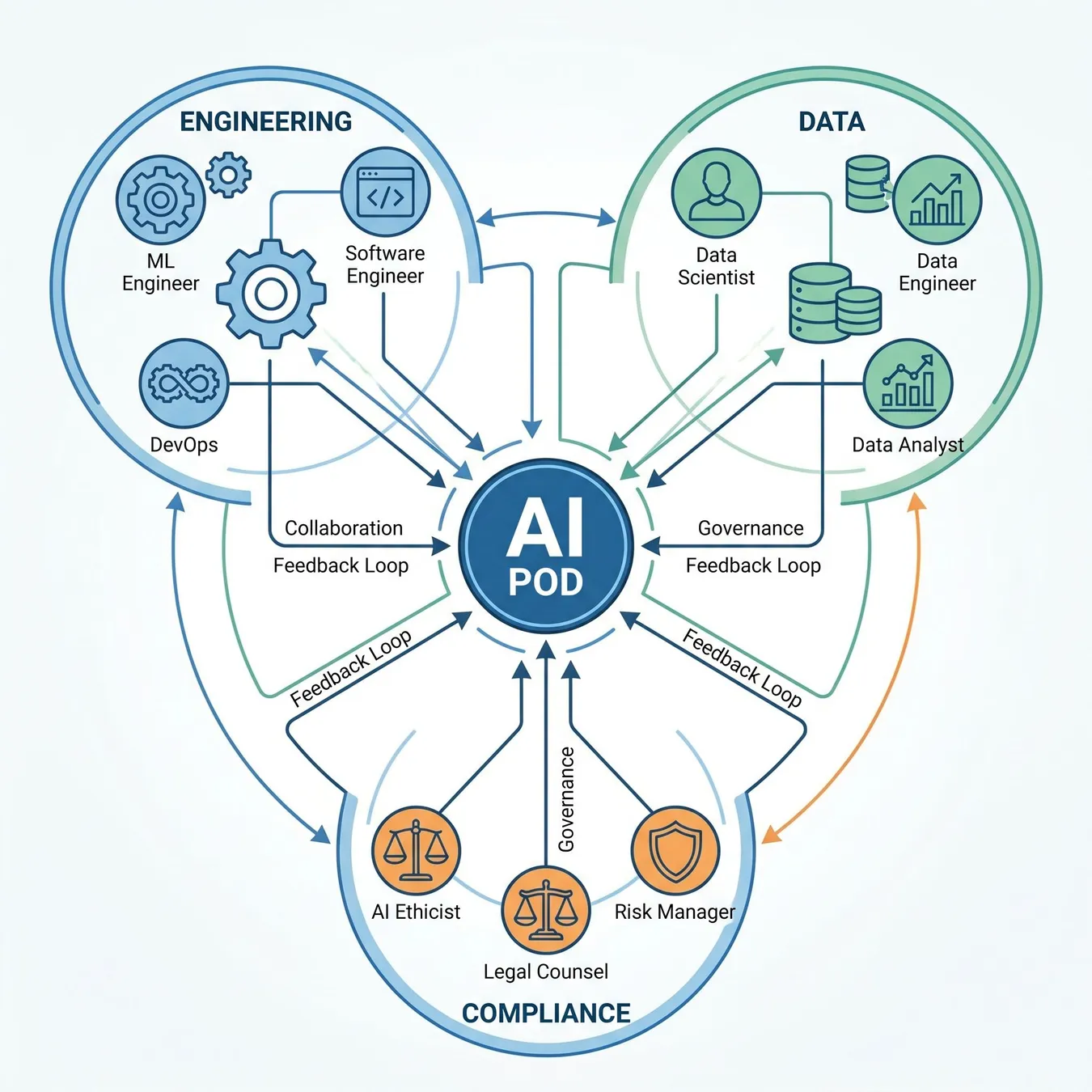
The cross-functional AI pod model for regulated environments.
Defining Specialized AI Roles for Compliance
In financial services, the 'Compliance & Risk Liaison' is not just a consultant but a core part of the engineering lifecycle. They work alongside engineers to implement intelligent automation in finance while maintaining a clear audit trail.
| Role | Primary Responsibility | Regulatory Focus |
|---|---|---|
| MLOps Engineer | Deployment & Monitoring | Model Drift & Reproducibility |
| Data Privacy Officer | PII Masking & Access | GDPR/CCPA & SOC2 Compliance |
| AI Security Analyst | Adversarial Testing | Threat Modeling & Data Integrity |
Infrastructure Support: The Foundation of AI Teams
AI teams cannot operate in a vacuum. They require a specific platform engineering team structure to provide the compute, storage, and CI/CD pipelines necessary for large-scale model deployment.
Info.
// Efficiency Gap
Software Engineering Standards for AI Models
Many AI projects fail because they lack the rigor of traditional software engineering for ai. In finance, this means implementing unit tests for data, versioning for models, and automated rollbacks.
Treat model code like production application code.
Automate the validation of data quality at the ingestion layer.
Implement human-in-the-loop for high-stakes financial decisions.
Allow 'black box' models without explainability documentation.
Store sensitive customer data in plaintext within training sets.
Deploy models without a dedicated monitoring and alerting plan.
Scaling the AI Organization
As your institution grows, you may need to move from a single pod to a multi-team structure. Understanding different engineering team structures is vital to avoid silos between AI and core banking engineers.
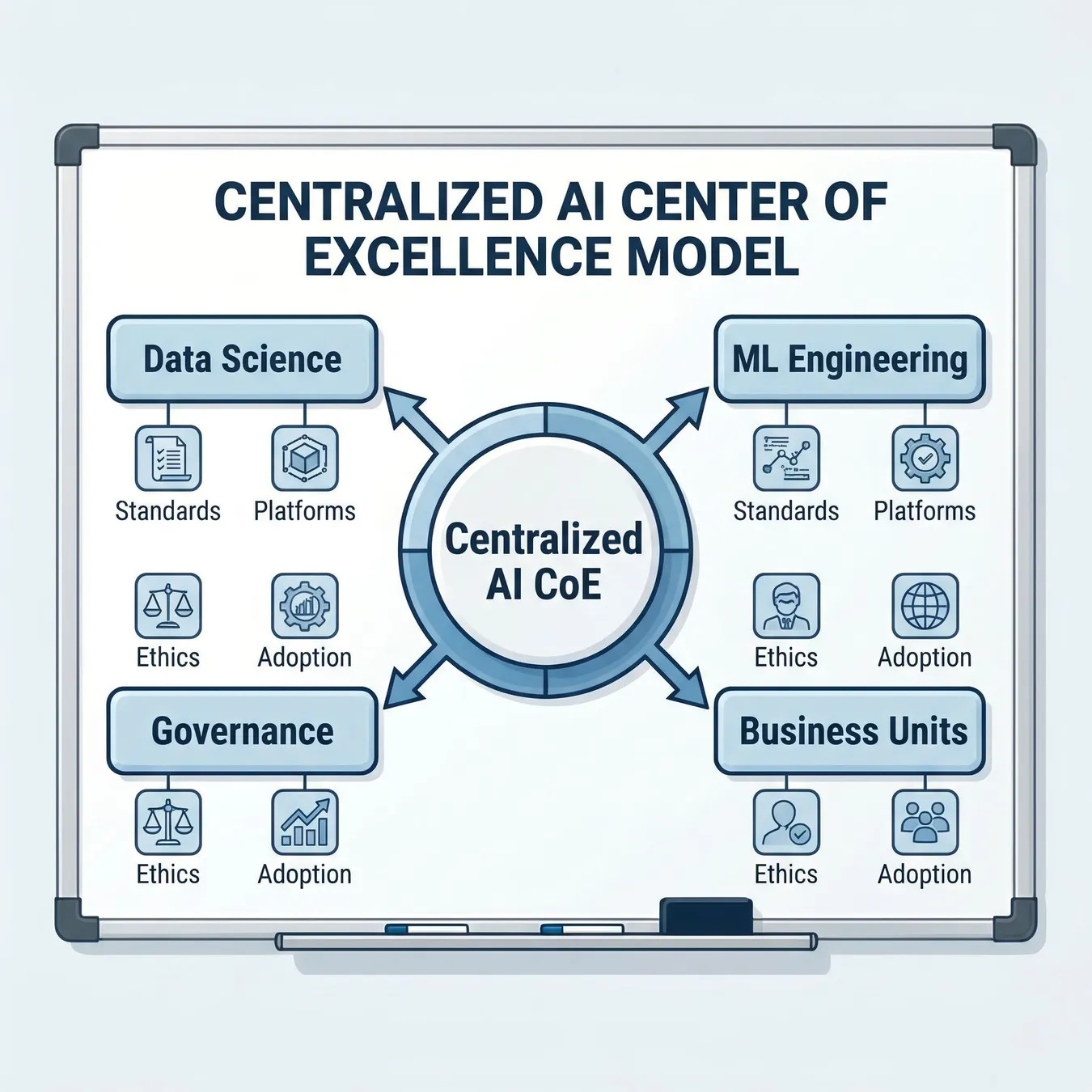
Centralized AI Center of Excellence (CoE).
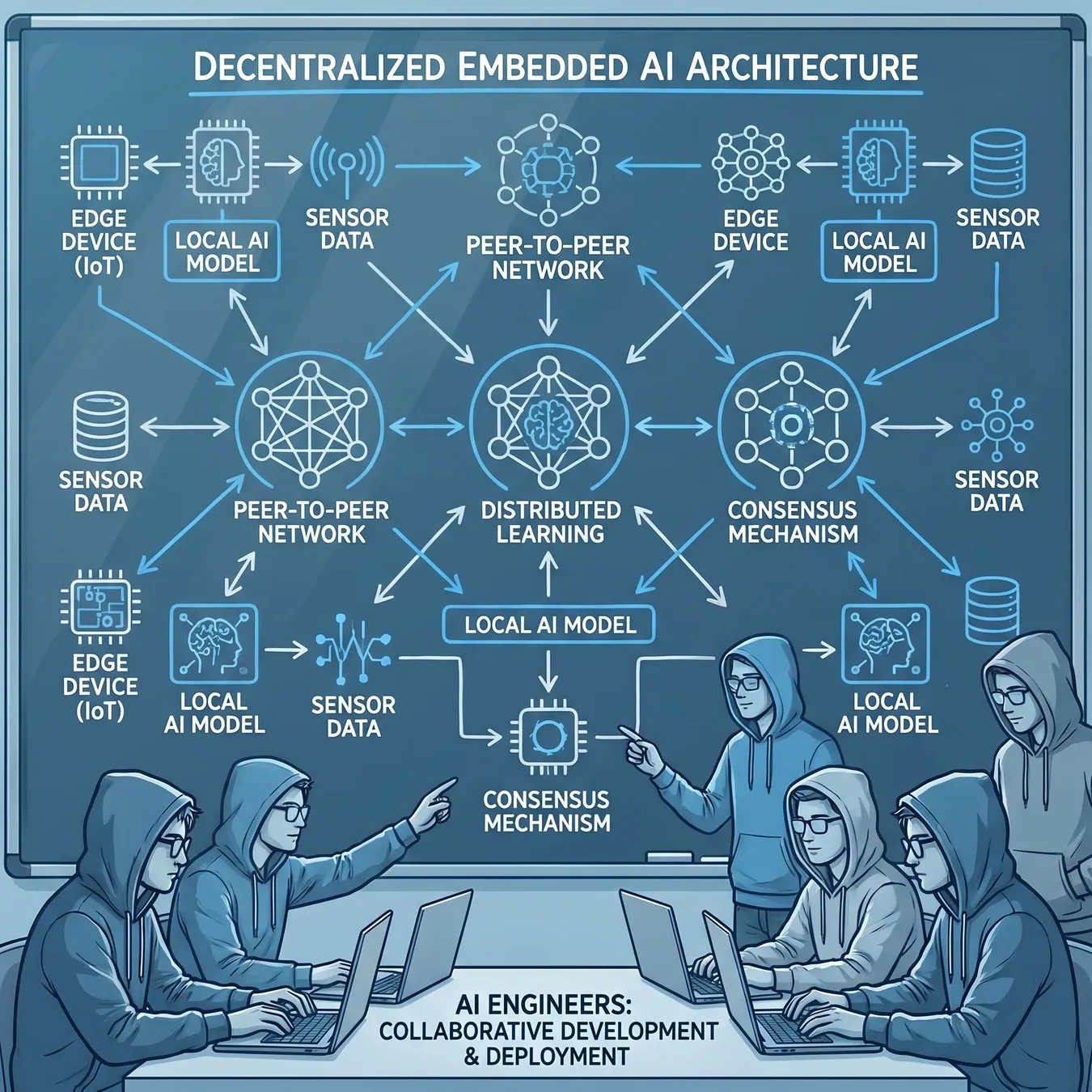
Decentralized Embedded AI Model.
Key Metrics for AI Team Success
< 4 Weeks
Time to Production
99.9%
Model Accuracy
100%
Audit Pass Rate
Common Challenges in Fintech AI Hiring
The Role of the AI Product Manager
An AI Product Manager in finance must understand the nuances of probabilistic outputs. Unlike traditional software, AI doesn't always give a binary answer, which requires a shift in how product requirements are written.
Implementing MLOps for Auditability
- 01
Establish a centralized model registry.
- 02
Automate data lineage tracking for every training run.
- 03
Implement real-time monitoring for feature drift.
- 04
Schedule regular bias and fairness audits.
Bridging Data Science and Production
The friction between 'the lab' and 'the app' is where most financial AI projects die. Successful structures prioritize the 'hand-off' by making it a collaborative integration phase rather than a cold transfer of code.
Security Roles in the AI Lifecycle
AI introduces new attack vectors like prompt injection and data poisoning. A dedicated AI Security Engineer is becoming a mandatory role for any financial institution handling sensitive customer data.
The Evolution of the Data Engineer
In the AI era, data engineers in finance are moving from simple ETL tasks to managing vector databases and real-time embedding pipelines to support RAG (Retrieval-Augmented Generation) architectures.
Ensuring Model Explainability
Regulators often require banks to explain why a specific decision was made. This has led to the rise of 'Explainable AI (XAI) Specialists' who ensure models remain transparent and defensible.
The Future of AI Leadership in Finance
As AI becomes core to the business, the Head of AI role is evolving into a strategic position that sits between the CTO and the Chief Risk Officer, balancing growth with institutional safety.
Checklist for Building Your AI Team
Define clear ownership for model compliance.
Hire a lead with production engineering experience.
Establish a shared infrastructure platform.
Integrate security reviews into the AI lifecycle.
How Studio 402 Supports AI Scaling
At Studio 402, we help financial services companies move past the 'vibe-code' phase of AI development. We don't just build models; we design the engineering systems and team structures that allow those models to survive in production.
Whether you are building your first AI pod or restructuring a scaling engineering organization, we provide the technical advisory and hands-on building required to ship compliant, high-performance AI systems.
In finance, AI is an engineering challenge first and a data challenge second. If the system isn't durable, the model doesn't matter.
Technical Director · Studio 402
Case Study: Modernizing Fintech AI Ops
We recently partnered with a growth-stage fintech to rebuild their AI deployment pipeline. By introducing a dedicated MLOps role and automating compliance checks, we reduced their time-to-production from three months to two weeks.
Trusted by fintech leaders to build production-ready AI systems.
Studio 402 Engineering Excellence 2026
Next Steps for Your AI Strategy
Ready to structure your team for the next generation of financial services? Start by auditing your current engineering capabilities and identifying the gaps in your compliance and infrastructure layers.
Build a Durable AI Organization
Get expert advisory on structuring your AI engineering team for compliance and scale.
Related Insights & Strategies
Keep reading
More in Engineering Leadership & Scaling
Index
Related categories
Frequently Asked Questions
Structuring an AI team is a continuous process of refinement. As technology evolves, your roles must adapt to ensure you are leveraging the latest in agentic workflows and automated infrastructure.
For more information on how to scale your engineering leadership and technical operations, explore our comprehensive guides on organizational models and platform engineering.