
Balancing Feature Delivery with Long-Term System Health
Engineering leaders often face a binary choice: ship features today or fix the codebase for tomorrow. However, sustainable growth requires a strategic framework for managing agile and technical debt simultaneously.

Balancing speed and stability is the core challenge of modern engineering leadership.
The Relationship Between Agile and Technical Debt
In an agile environment, debt is not always a sign of failure; it is often a deliberate trade-off made to validate a market hypothesis. The risk arises when this debt is not tracked or remediated systematically.
Without a clear plan, the accumulation of shortcuts leads to a significant drag on delivery. Leaders must focus on quantifying technical debt to make the cost of inaction visible to non-technical stakeholders.
23%
Average time developers spend managing technical debt.
42%
Reduction in velocity when debt is left unmanaged for 12 months.
Strategies for Balancing Feature Delivery and Technical Debt
Effective strategies for balancing feature delivery and technical debt involve moving away from 'cleanup sprints' and toward a continuous integration of health tasks into the daily workflow.
- The 20% Rule: Dedicate one day a week or 20% of every sprint to refactoring.
- Debt-to-Feature Ratio: Track the volume of health-related tickets against new capabilities.
- Definition of Done: Include automated testing and documentation as non-negotiable requirements.
- Architectural Decision Records (ADRs): Document why shortcuts were taken and how to reverse them.
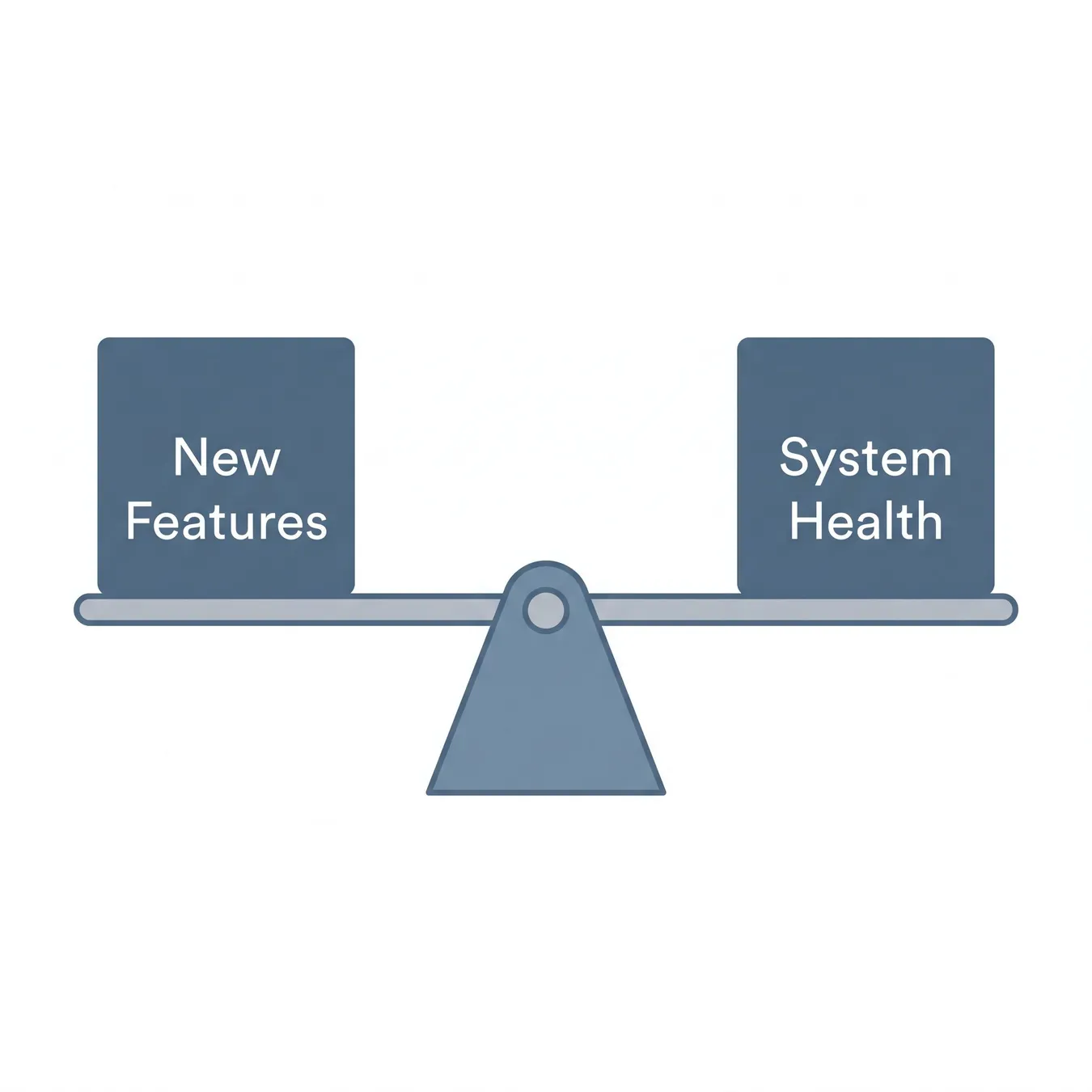
Equilibrium is achieved through consistent, small-scale remediation.
Identifying Systemic Workflow Bottlenecks
Often, the inability to ship features isn't just about the code—it's about the process. Leaders should look for workflow bottlenecks that exacerbate the impact of existing debt.
Info.
// The Hidden Cost of Friction
Managing Infrastructure Technical Debt
Application code is only half the story. Outdated CI/CD pipelines, manual deployment steps, and brittle cloud configurations represent infrastructure technical debt that can paralyze a scaling team.
Trade-off
3 pros · 3 cons
Pros
Faster time-to-market for initial MVP
Immediate feedback from real users
Lower initial capital expenditure
Cons
Higher long-term maintenance costs
Increased risk of system outages
Lowered developer morale and retention
Aligning Engineering Health with Product Strategy
Technical debt is a business risk, not just an engineering annoyance. Successful leaders ensure that product management and strategy are aligned with engineering realities to prevent burnout.
The Role of the CTO in Debt Communication
The CTO must translate 'refactoring' into 'risk mitigation' and 'scalability' for the rest of the executive team. This shifts the conversation from technical preference to commercial necessity.

Communication is the most effective tool for managing technical debt.
Framework for Prioritizing Remediation
Not all debt is created equal. Use this hierarchy to decide what to fix first when your roadmap is crowded.
- 01
Critical Path Stability: Fix bugs in the core revenue-generating flows.
- 02
Developer Experience: Resolve issues that slow down every single PR.
- 03
Security and Compliance: Remediate vulnerabilities that pose existential risks.
- 04
Future-Proofing: Refactor areas where significant new features are planned.
Common Anti-Patterns to Avoid
Track debt in the same backlog as features
Empower teams to make local health decisions
Celebrate refactoring as much as shipping
Schedule 'refactoring months' that never happen
Blame individuals for legacy code decisions
Ignore debt until the system crashes
Measuring Success in System Health
You cannot manage what you do not measure. Use a combination of DORA metrics and qualitative developer surveys to track the health of your systems over time.
| Metric | Healthy Target | Debt Signal |
|---|---|---|
| Change Lead Time | < 24 Hours | Increasing wait times for reviews |
| Deployment Frequency | Daily | Fear-driven release cycles |
| Change Failure Rate | < 15% | Frequent rollbacks and hotfixes |
The Cultural Aspect of Technical Debt
A culture that ignores technical debt will eventually lose its best engineers. High-performing talent wants to work in codebases that are maintainable and logical.
Technical debt is like a high-interest credit card. It's fine for a weekend in Vegas, but it's a terrible way to fund a 10-year mortgage.
Senior Engineering Advisor · Studio 402
How Studio 402 Solves the Delivery Tension
At Studio 402, we don't just build features; we build systems that survive reality. We help growth-stage companies bridge the gap between aggressive shipping and production-grade stability.
Whether you are recovering from a 'vibe-coded' prototype or scaling a legacy monolith, our engineering leadership provides the tactical refactoring and architectural oversight needed to unlock velocity.

We partner with leaders to turn technical debt into technical leverage.
Our Approach to System Hardening
01 / 04
phase 01 / 04
Audit
phase 02 / 04
Stabilize
phase 03 / 04
Refactor
phase 04 / 04
Scale
Frequently Asked Questions
Take Control of Your Engineering Velocity
Don't let yesterday's shortcuts dictate tomorrow's roadmap. Balancing system health with feature delivery is a skill that can be mastered with the right partner and framework.
Trusted by venture-backed startups to scale from MVP to Series B.
Studio 402 has rescued and hardened over 50 production codebases.
Ready to Hardened Your Systems?
Stop fighting your codebase and start shipping with confidence. Let's audit your debt and build a path to scale.
Deep Dives on Engineering Excellence
Keep reading
More in Engineering Leadership & Scaling
Index
Related categories
- Engineering Leadership
- Agile Strategy
- Technical Debt
- Scaling
- CTO Advisory
Maintaining a high-velocity engineering organization requires more than just hiring more developers; it requires a commitment to system integrity and clear communication across the business.
As you scale, the complexity of your systems will grow. Having a framework for debt remediation ensures that this complexity remains an asset rather than a liability.
Studio 402 remains committed to helping founders and technical leaders navigate these challenges with production-ready outcomes and strategic engineering depth.
For more information on how we can support your team, explore our related guides on engineering metrics and organizational structures.