
End-to-End Solutions for Scaling Hiring
Scaling a technical team requires more than just increasing recruiter headcount; it demands a repeatable pipeline that maintains high engineering standards. Engineering leaders must design systems that filter for production-ready skills while ensuring a smooth candidate experience.
45%
Reduction in time-to-hire with structured pipelines
80%
Higher retention for candidates vetted via technical rubrics
Defining the Scalable Hiring Pipeline
A scalable hiring pipeline is a series of automated and human-led stages designed to convert applicants into high-performing engineers. Without end-to-end solutions for scaling hiring, teams often face 'hiring debt'—the long-term cost of bringing on engineers who don't fit the technical culture.
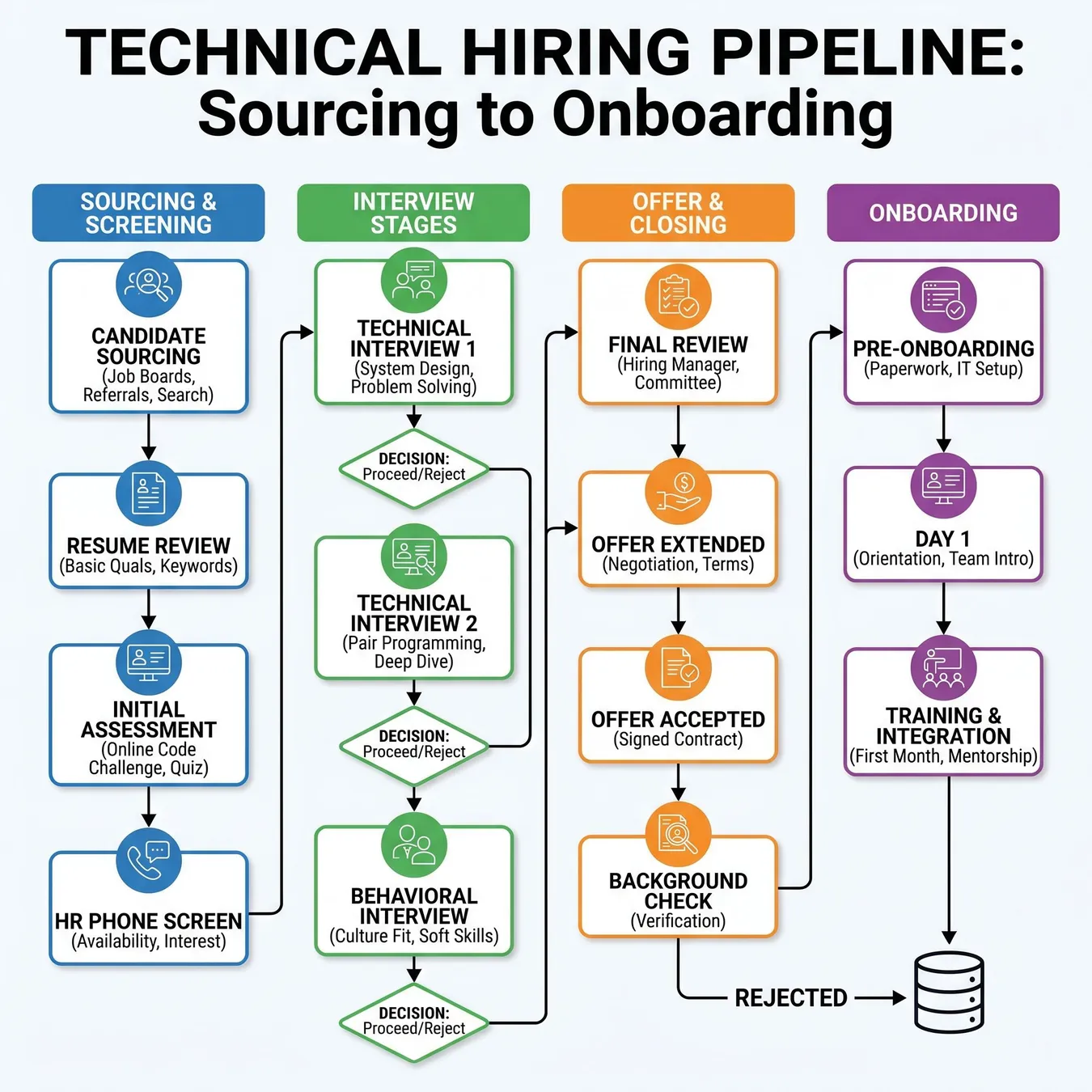
A structured pipeline ensures consistency across every candidate interaction.
Stage 1: Sourcing and Top-of-Funnel Strategy
Successful scaling starts with high-signal sourcing. Instead of casting a wide net, focus on platforms where engineers demonstrate real-world problem-solving. This is where you align your talent search with your technical roadmap planning to ensure you are hiring for future needs.
- Define specific technical archetypes (e.g., Product Engineer vs. Infra Engineer).
- Leverage employee referrals with clear technical benchmarks.
- Use outbound sourcing focused on open-source contributions.
Stage 2: The Technical Screen
The initial screen should be a low-friction, high-signal assessment. Avoid generic brain teasers and focus on practical debugging or architectural discussions that mirror the actual work the engineer will do.
Tip.
// Screening for Scale
Building the Technical Interview Loop
The core of your pipeline is the interview loop. This stage must be optimized to respect the candidate's time while providing the team with enough data to make a confident decision. If you find the loop is dragging, you must identify bottlenecks in the scheduling or feedback process.
| Interview Stage | Focus Area | Duration |
|---|---|---|
| Coding Practical | Clean code, edge cases | 60 mins |
| System Design | Scalability, trade-offs | 60 mins |
| Culture/Values | Collaboration, ownership | 45 mins |
The Practical Coding Assessment
Move away from LeetCode-style algorithms. Instead, provide a small, existing codebase and ask the candidate to implement a feature or fix a bug. This tests their ability to read, understand, and improve code—the primary job of a senior engineer.
Use a real-world development environment.
Allow the use of documentation and AI tools.
Focus on the 'why' behind their technical choices.
Don't ask for whiteboard syntax-perfect code.
Don't use trick questions with a single 'aha' moment.
Don't leave the candidate in silence for 60 minutes.
Standardizing Evaluation Rubrics
Consistency is the enemy of bias. Every interviewer should use a shared rubric that defines what 'Exceeds Expectations' looks like for specific competencies like 'System Thinking' or 'Code Quality'.
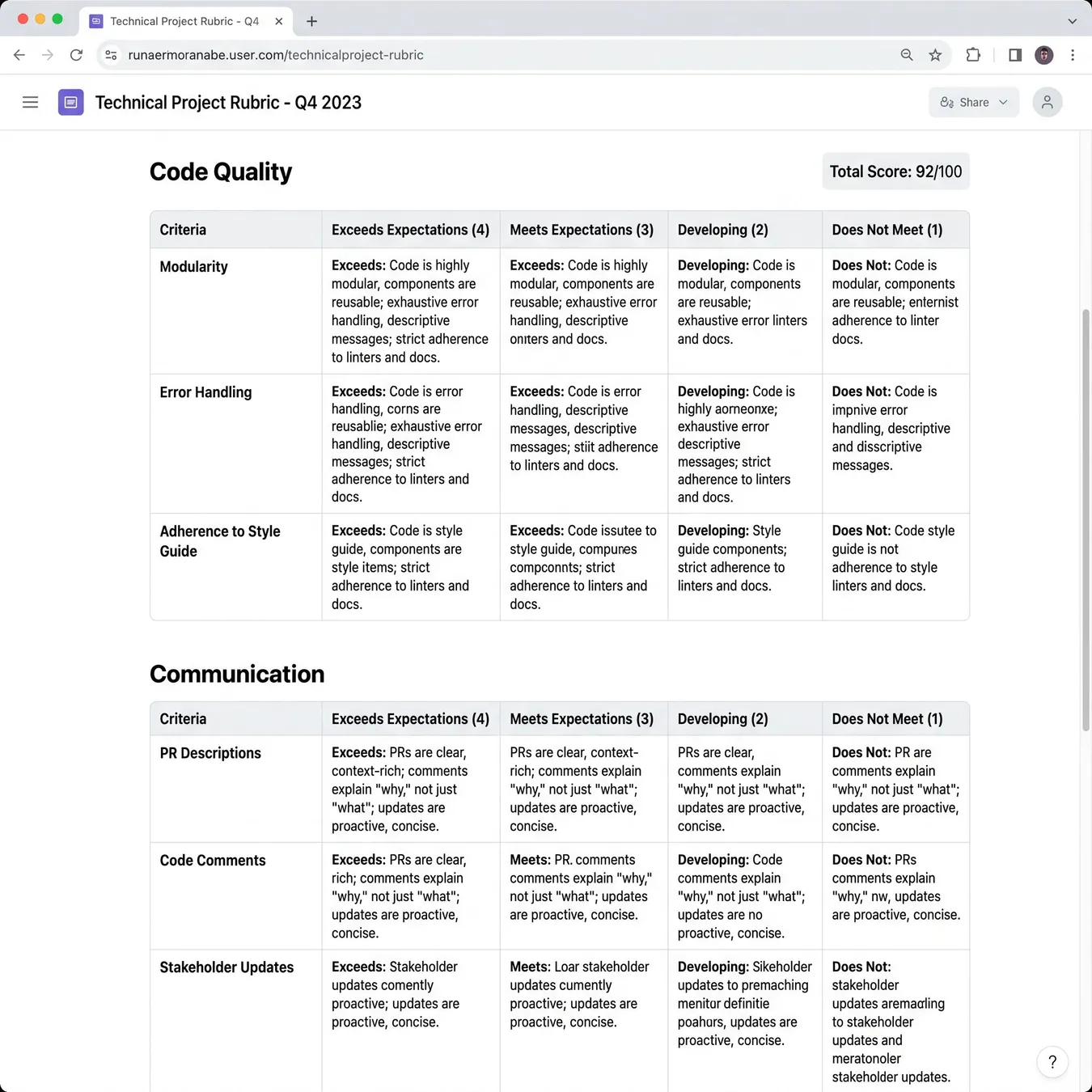
Rubrics provide a objective framework for hiring decisions.

Track metrics to keep the pipeline healthy.
Scaling the Interviewer Pool
As you grow, the burden of interviewing can crush engineering velocity. You must train a wider pool of interviewers. This requires a formal 'shadowing' and 'reverse-shadowing' process to ensure quality remains high as the team expands.
01 / 03
phase 01 / 03
Shadowing
phase 02 / 03
Reverse Shadowing
phase 03 / 03
Certification
Automation in the Hiring Pipeline
Automation should handle the 'toil' of hiring. Use tools for automated scheduling, initial resume parsing, and basic technical assessments. This frees your engineers to focus on the high-value human interactions.
Automated calendar syncing for interviewers
Automated feedback reminders for the team
Self-serve candidate status portal
Common Scaling Pitfalls
Many teams fail to scale because they treat hiring as a secondary task. If hiring is a priority, it must be reflected in the engineering team structure and individual performance goals.
Trade-off
3 pros · 3 cons
Pros
Faster growth and market entry
Diverse technical perspectives
Reduced burnout for existing staff
Cons
Risk of culture dilution
Increased management overhead
Potential drop in code quality
Measuring Pipeline Health
You cannot improve what you do not measure. Track your 'Offer Acceptance Rate' and 'Time to Productivity' to see if your pipeline is actually delivering the talent your organization needs.
14 Days
Target time from first screen to offer
90%
Target candidate satisfaction score
The Role of Onboarding in Hiring
The pipeline doesn't end at the signed offer. A repeatable onboarding process ensures that the talent you worked so hard to find can actually ship code on day one. This is the final step in an end-to-end solution.
Alternative Scaling Strategies
Sometimes the internal pipeline isn't enough to meet aggressive deadlines. In these cases, you might choose to hire a software development team to augment your internal efforts while you continue to build out your long-term staff.
Bridging Strategy to Execution
Building these pipelines is a significant engineering project in itself. At Studio 402, we help engineering leaders design the systems and infrastructure that make scaling possible. We don't just give advice; we build the tools and processes that harden your hiring and delivery.
Scaling isn't about doing more of the same; it's about building a machine that produces quality outcomes at a higher frequency.
Studio 402 Engineering Lead
How Studio 402 Supports Engineering Leaders
Whether you are navigating a post-vibe-code rescue or scaling a seed-stage team, we provide the technical consulting and hands-on building required to stabilize and grow your engineering organization.

Studio 402 partners with your leadership to build durable engineering foundations.
Frequently Asked Questions
Ready to Scale Your Engineering Team?
Let's build the systems that turn your hiring pipeline into a competitive advantage. Contact Studio 402 today.
Keep reading
More in Engineering Leadership & Scaling
Index
Related categories
- Engineering Leadership
- Scaling
- Hiring Systems
- CTO Advisory
Building a hiring pipeline is just one part of the leadership journey. For more on organizational growth, see our other guides on engineering leadership and scaling.
Studio 402 provides the execution depth needed to move from a fragile startup environment to a robust, production-ready engineering organization. We partner with you to ship faster and build foundations that last.
Trusted by venture-backed startups to scale engineering systems.
From MVP to Series B and beyond.
Final Thoughts on Hiring Pipelines
A great pipeline is a living system. It requires constant tuning, feedback from new hires, and alignment with the evolving technical goals of the business. Start small, measure everything, and iterate.