
Best Agile Framework for Custom Software Development
Selecting the best agile framework for custom software development requires balancing the need for rapid iteration with the rigor of systems engineering processes for agile software development. Engineering leaders must evaluate how a methodology supports their specific product lifecycle, team size, and technical complexity.
- Agile Strategy
- Engineering Leadership
- Process Optimization
- Scrum vs Kanban
Core Agile Frameworks for Modern Engineering
The three most common frameworks used in high-growth environments are Scrum, Kanban, and Lean. Each offers a different approach to managing work in progress and delivery cadence.
| Framework | Primary Focus | Best For | Cadence |
|---|---|---|---|
| Scrum | Structured Sprints | Product Development | Fixed (1-4 weeks) |
| Kanban | Flow & Throughput | Maintenance & Ops | Continuous |
| Lean | Waste Elimination | MVPs & Startups | Iterative |
Optimizing Scrum for Custom Software Builds
Scrum is often the default choice for building complex SaaS platforms because it provides a predictable rhythm. However, success depends heavily on mastering velocity and capacity planning in scrum to ensure the team isn't over-committed.
Tip.
// Pro Tip
Understanding the nuances of velocity vs capacity in scrum is essential for maintaining a healthy development pace without burning out engineers.
Kanban for Continuous Delivery and Reliability
For teams focused on system reliability or high-volume maintenance, Kanban offers a more flexible alternative to the rigid sprint cycles of Scrum. It excels at visualizing bottlenecks in the pipeline.
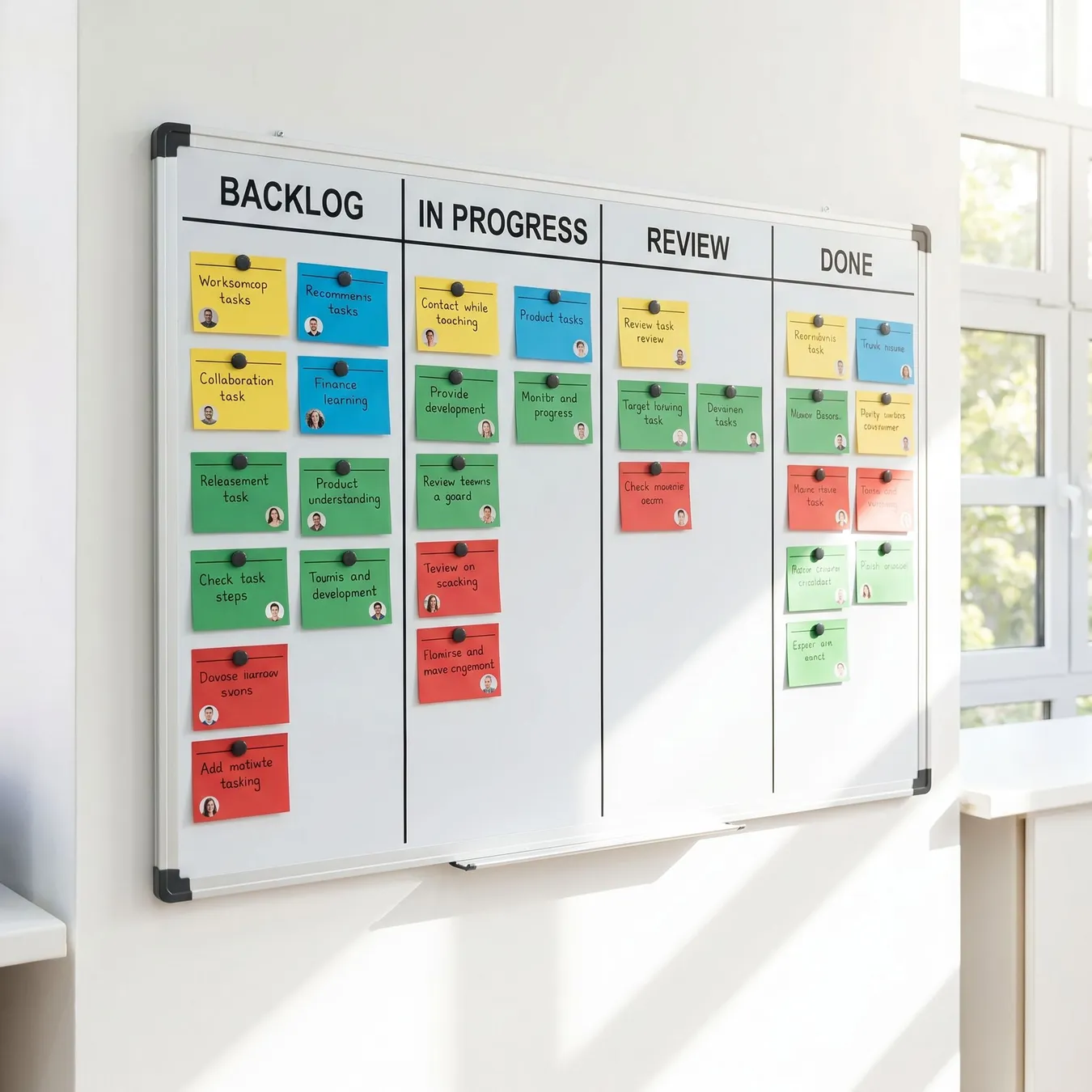
Kanban boards help visualize work-in-progress limits and identify delivery bottlenecks.
Integrating Systems Engineering with Agile Speed
Custom software development often requires more than just 'moving fast.' You must integrate systems engineering processes for agile software development to ensure that security and scalability are not sacrificed for speed.
- Automated testing integrated into the CI/CD pipeline
- Regular architecture reviews during sprint planning
- Definition of Done that includes security audits
- Infrastructure-as-Code for environment consistency
Framework Selection Criteria for CTOs
When choosing a framework, consider the maturity of your product and the size of your engineering organization. A startup building an MVP has different needs than a Series B company scaling a platform.
Trade-off
3 pros · 3 cons
Pros
Scrum provides excellent predictability for stakeholders.
Kanban reduces developer stress by limiting work-in-progress.
Lean maximizes value by cutting out non-essential features.
Cons
Scrum can feel too rigid for small, fast-moving teams.
Kanban lacks the built-in urgency of a sprint deadline.
Lean requires high discipline to avoid skipping documentation.
Managing Agile Project Milestones
Regardless of the framework, you need a way to communicate progress to non-technical stakeholders. Setting clear agile project milestones helps bridge the gap between technical tasks and business outcomes.
Tooling for High-Velocity Agile Teams
Your methodology is only as good as the tools that support it. Modern agile software development tools allow teams to automate reporting and track metrics without manual overhead.
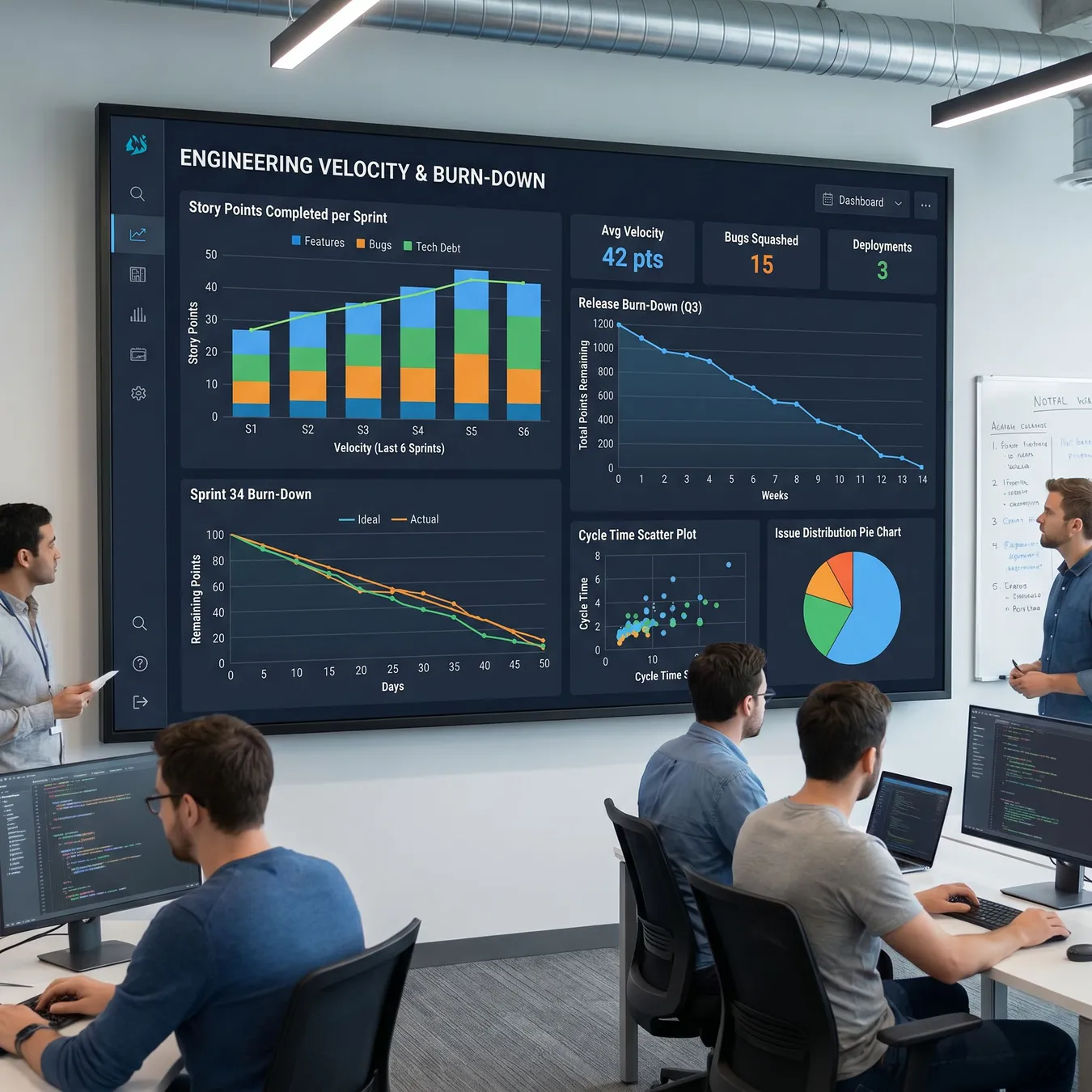
Velocity tracking in a modern project management tool.

Automated pipelines are essential for agile delivery.
The Role of Release Management in Agile
As teams grow, the complexity of deployments increases. Implementing scaled agile release management ensures that frequent code changes don't compromise system stability.
Common Pitfalls in Agile Implementation
Focus on outcomes rather than just output.
Empower teams to adjust the framework as they learn.
Keep documentation lightweight but meaningful.
Don't use velocity to compare different teams.
Don't skip retrospectives when things are going well.
Don't ignore technical debt in favor of new features.
Scaling Agile Across Multiple Teams
When you move from one team to five, communication overhead explodes. Frameworks like SAFe or LeSS attempt to solve this, but often a custom 'Spotify-style' model works better for startups.
25%
Velocity Increase
40%
Reduction in Bugs
Daily
Deployment Frequency
Transitioning from Prototype to Production
Many teams start with a 'vibe-coded' approach that works for a demo but fails at scale. Transitioning to a formal agile framework is the first step in hardening that prototype for real-world use.
How Studio 402 Optimizes Engineering Delivery
At Studio 402, we don't just follow a textbook agile guide. We build the execution infrastructure that allows your team to ship production-ready software without the typical friction of scaling.
The best framework is the one that gets out of the way of the engineers while providing total clarity to the business.
Engineering Lead · Studio 402
Building a Foundation for Growth
Whether you are rescuing a broken prototype or building a new SaaS platform from scratch, your choice of framework will dictate your long-term maintenance costs and shipping speed.
Audit current delivery bottlenecks
Define team capacity and historical velocity
Select a primary framework (Scrum or Kanban)
Implement automated CI/CD pipelines
Agile Framework FAQ
Next Steps for Engineering Leaders
If your current process feels slow, unpredictable, or fragile, it might be time for a structural change. Studio 402 helps companies audit their engineering processes and implement systems that scale.
Build Better Systems Today
Ready to optimize your engineering delivery? Let's discuss how we can build a production-ready framework for your team.
Explore More Resources
Our Core Capabilities
- End-to-end product engineering for startups
- MVP and SaaS development with production rigor
- AI integration and AI-native systems design
- Cloud infrastructure and DevOps engineering
The Studio 402 Difference
We don't just consult; we build. Our team takes ownership of the technical roadmap, ensuring that every line of code is architected for real-world scale and long-term maintainability.
Studio 402 transformed our chaotic dev process into a high-velocity engine. We went from monthly releases to daily deploys in weeks.
Framework Implementation Timeline
01 / 04
phase 01 / 04
Audit
phase 02 / 04
Design
phase 03 / 04
Launch
phase 04 / 04
Optimize
Final Thoughts
The best agile framework is not a static choice. It is a living system that must evolve with your product. By focusing on systems engineering and capacity planning, you build a foundation for lasting success.
Trusted by 50+ scaling startups to build production-ready software.
Updated for 2026 engineering standards.
Keep reading
More in Engineering Leadership & Scaling
Index