
Scaled Agile Release Management & Lead Time Optimization
In high-growth engineering organizations, release management is the critical bridge between development and customer value. As teams scale, the complexity of coordinating deployments across multiple pods often leads to increased lead time in software development, creating bottlenecks that stall innovation.
47%
Reduction in lead time for elite DevOps teams
200x
More frequent code deployments in scaled agile
3x
Lower change failure rate with automated releases
Understanding Scaled Agile Release Management
Scaled agile release management is the practice of synchronizing delivery cycles across independent teams while maintaining a unified production standard. It requires a shift from manual gatekeeping to automated governance and shared visibility.
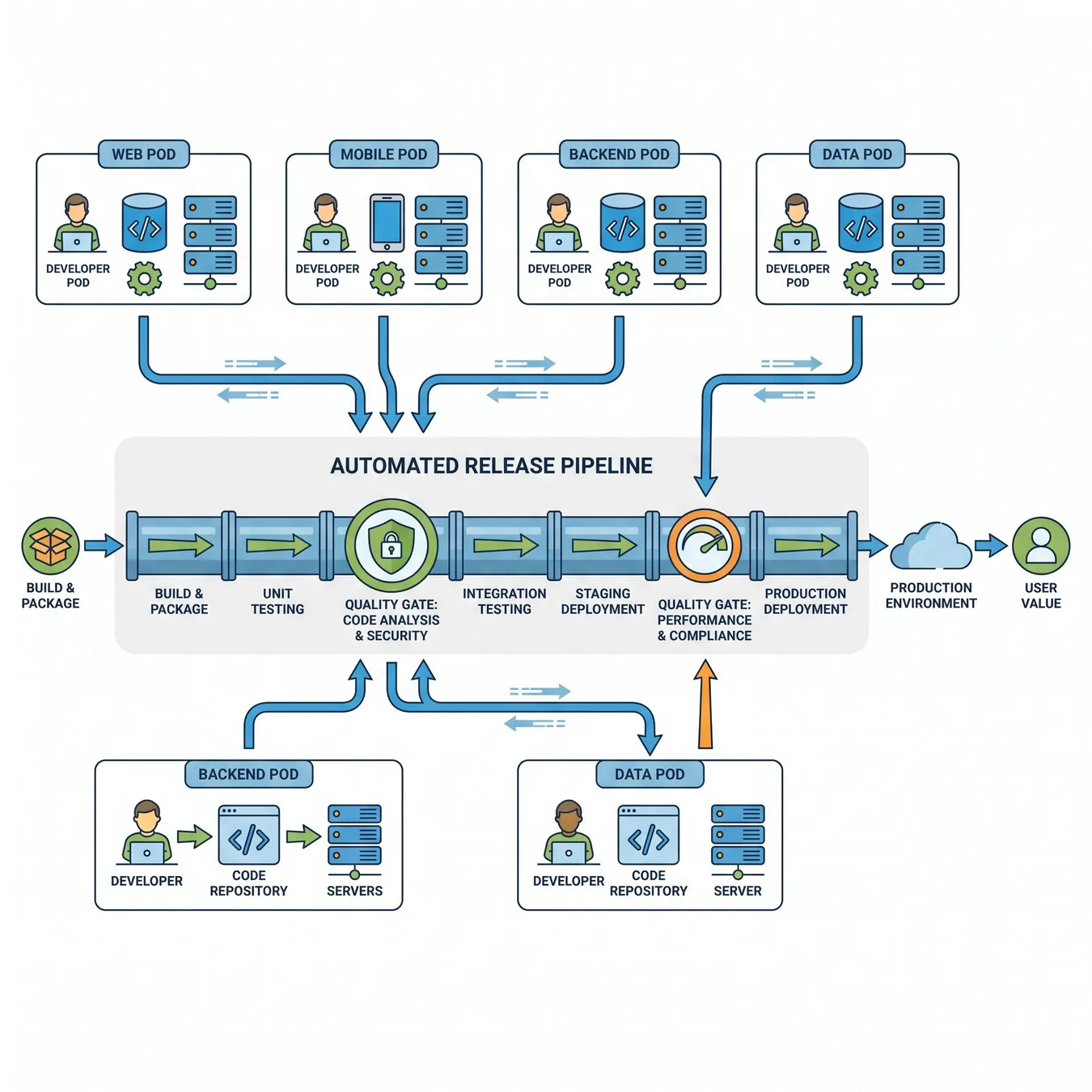
Visualizing the flow from distributed development to unified release.
Core Metrics: Measuring Lead Time in Software Development
To optimize velocity, leaders must first master the measurement of lead time in software development. This metric tracks the duration from the first commit to the moment code is running in production, serving as a pulse check for organizational health.
- Coding Time: The duration spent in active development.
- Pickup Time: How long code sits waiting for peer review.
- Review Time: The cycle of feedback and refactoring.
- Deploy Time: The final stage of moving code through the pipeline.
Strategies for Reducing Release Friction
Reducing friction requires a combination of cultural shifts and technical automation. By implementing process optimization techniques, organizations can remove manual approvals that often act as the primary bottleneck in scaled environments.
Automate regression testing at every stage
Use feature flags to decouple deploy from release
Empower teams with self-service infrastructure
Standardize environment configurations
Rely on manual QA sign-offs for routine updates
Batch large numbers of features into a single release
Ignore deployment failures in the staging environment
Hard-code environment-specific variables
The Role of Automation in Scaled Delivery
Automation is the bedrock of scaled agile release management. Without it, the coordination overhead of multiple teams becomes exponential, eventually leading to a complete halt in shipping velocity.

The lifecycle of an automated release in a modern engineering stack.
Managing Technical Debt During Rapid Releases
High velocity must not come at the cost of stability. Engineering leaders must constantly navigate the tension between agile and technical debt to ensure that the codebase remains maintainable as the product evolves.
Tip.
// The 20% Rule
Optimizing the Handoff Between Pods
A smooth software engineering workflow depends on clear boundaries and contracts between teams. When one pod's release depends on another's API change, the coordination must be handled via versioning and backward compatibility.
Release Management Maturity Model
| Level | Process | Tooling | Frequency |
|---|---|---|---|
| Initial | Manual/Ad-hoc | Scripts | Monthly |
| Managed | Documented | CI Tools | Bi-weekly |
| Defined | Standardized | CD Pipelines | Weekly |
| Optimized | Automated | Full Orchestration | On-demand |
Common Bottlenecks in Scaled Environments
Identifying bottlenecks is the first step toward optimization. In many organizations, the 'last mile' of delivery—security audits and final compliance checks—is where velocity goes to die.
The Impact of Release Frequency on Quality
Counter-intuitively, increasing release frequency often improves quality. Smaller, more frequent changes are easier to test, easier to roll back, and carry significantly less risk than massive monthly deployments.
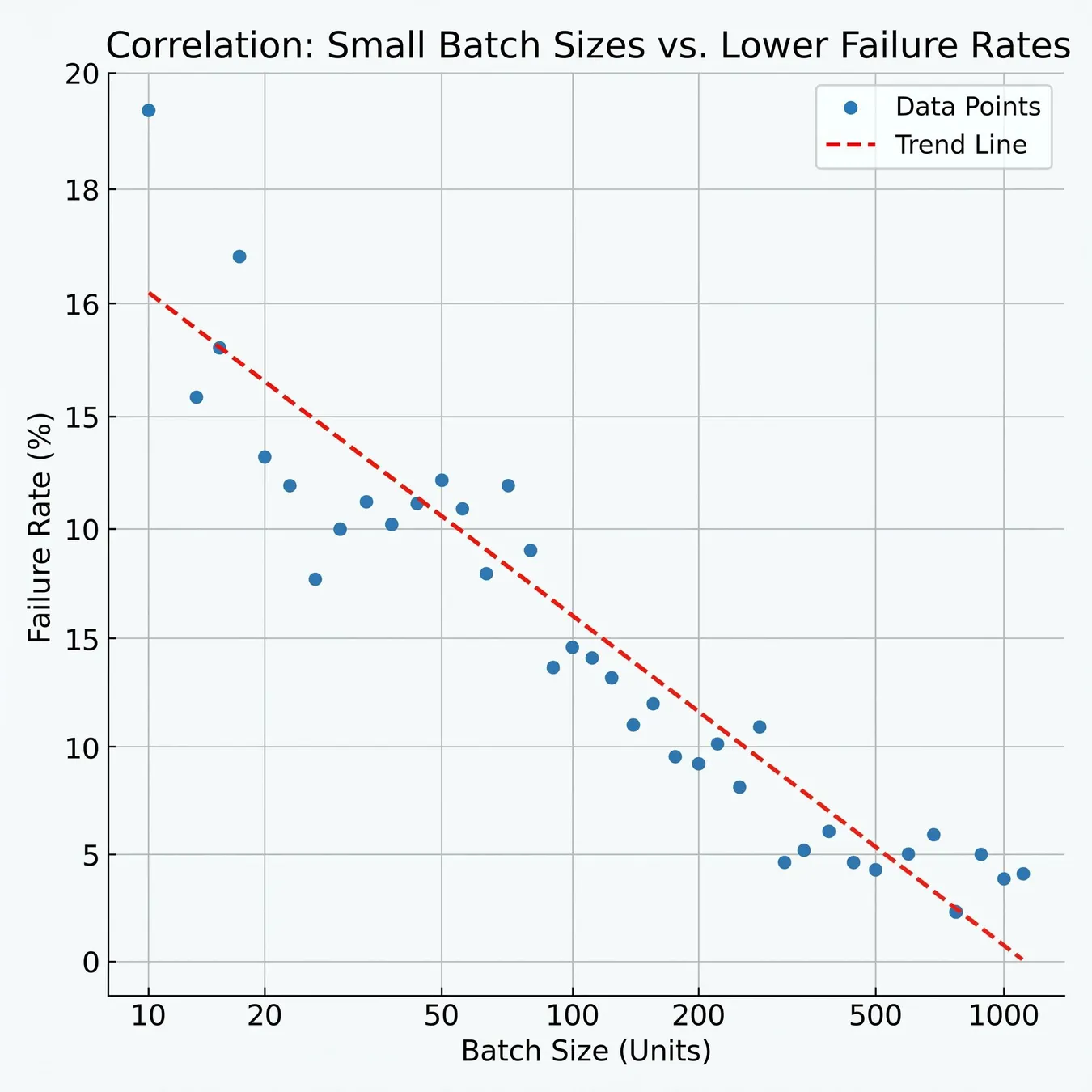
Batch size vs. Failure risk.
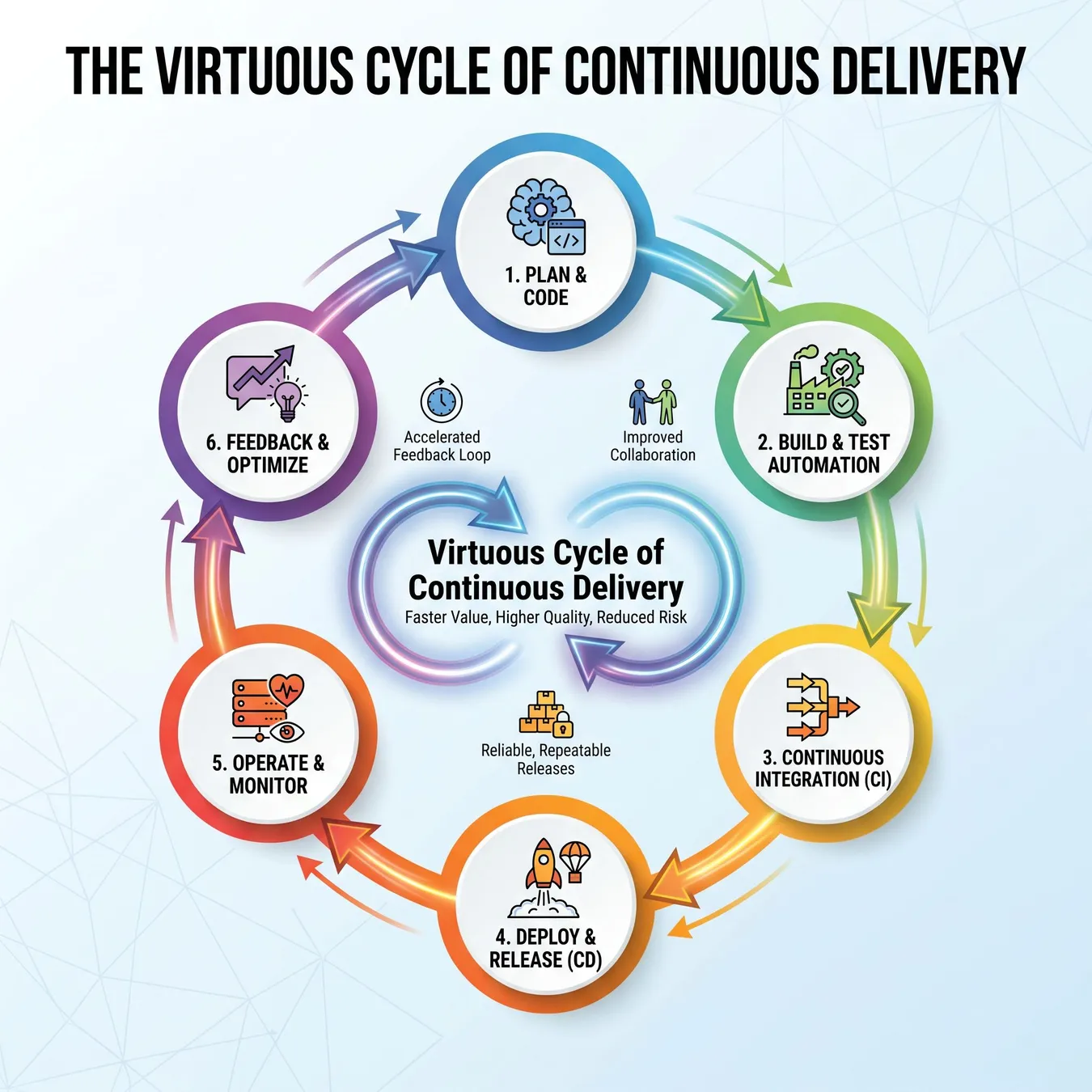
The CD feedback loop.
Governance in a Decentralized Engineering Org
Governance should be 'baked into' the platform. Instead of a Release Control Board, use automated policy enforcement that prevents code from reaching production unless it meets predefined coverage and security thresholds.
Communication Patterns for Release Success
Transparency is vital. Automated Slack notifications, real-time deployment dashboards, and clear changelogs ensure that stakeholders across the business are aligned with engineering output.
Automated changelog generation
Real-time deployment alerts
Stakeholder-facing release notes
Post-deployment smoke tests
Scaling Infrastructure for Release Velocity
As the number of releases grows, so does the load on your build and deploy infrastructure. Scaling these systems is essential to prevent the pipeline itself from becoming a bottleneck.
Building a Culture of Continuous Improvement
Release management is never 'finished.' It requires a culture of blameless post-mortems and continuous iteration on the delivery process itself to maintain peak performance.
The goal of release management isn't to prevent change, but to make change so routine that it becomes boring.
Engineering Lead · Platform Systems
Bridging Strategy and Execution with Studio 402
Optimizing release management at scale is a complex architectural and cultural challenge. At Studio 402, we help engineering leaders move beyond fragile prototypes and manual processes to build durable, automated delivery systems.
Whether you are rescuing a vibe-coded MVP that won't scale or restructuring a global engineering organization for higher velocity, our team provides the senior technical partnership needed to harden your pipelines and reduce lead times.
Trusted by venture-backed startups and scaling SMBs to deliver production-ready software.
From MVP rescue to enterprise-grade cloud infrastructure.
Ready to Scale Your Engineering Velocity?
Let's discuss how to optimize your release management and harden your deployment pipelines for real-world scale.
Deepen Your Engineering Leadership Knowledge
Implementation Roadmap
01 / 04
phase 01 / 04
Audit
phase 02 / 04
Standardize
phase 03 / 04
Automate
phase 04 / 04
Optimize
Release Readiness Checklist
Unit and integration tests passing at 80%+ coverage
Security vulnerability scan completed with zero criticals
Database migration scripts verified in staging
Feature flags configured for progressive rollout
Rollback plan documented and tested
Key Performance Indicators
MTTR
Mean Time to Recovery
CFR
Change Failure Rate
DF
Deployment Frequency
Tracking these KPIs allows leadership to move from anecdotal evidence of 'feeling slow' to data-driven process improvements that directly impact the bottom line.
Keep reading
More in Engineering Leadership & Scaling
Index
Related categories
- Engineering Leadership
- DevOps
- Agile at Scale
- Process Optimization