
When to Choose a Monolith Over Microservices
In the current landscape of software engineering, microservices are often treated as the default choice for any new project. However, for many startups and growth-stage companies, the complexity of a distributed system can become a significant bottleneck. Understanding when is monolith better than microservices is critical for maintaining shipping velocity and operational sanity.
- Architecture
- MVP Strategy
- Engineering Leadership
- Scalability
The Case for Monolithic Architecture in 2026
A monolith is not a legacy pattern; it is a strategic choice. When you choose monolith over microservices, you are prioritizing low cognitive load and rapid iteration. This is especially true for MVPs where the domain boundaries are still shifting and the cost of network latency between services outweighs the benefits of independent scaling.
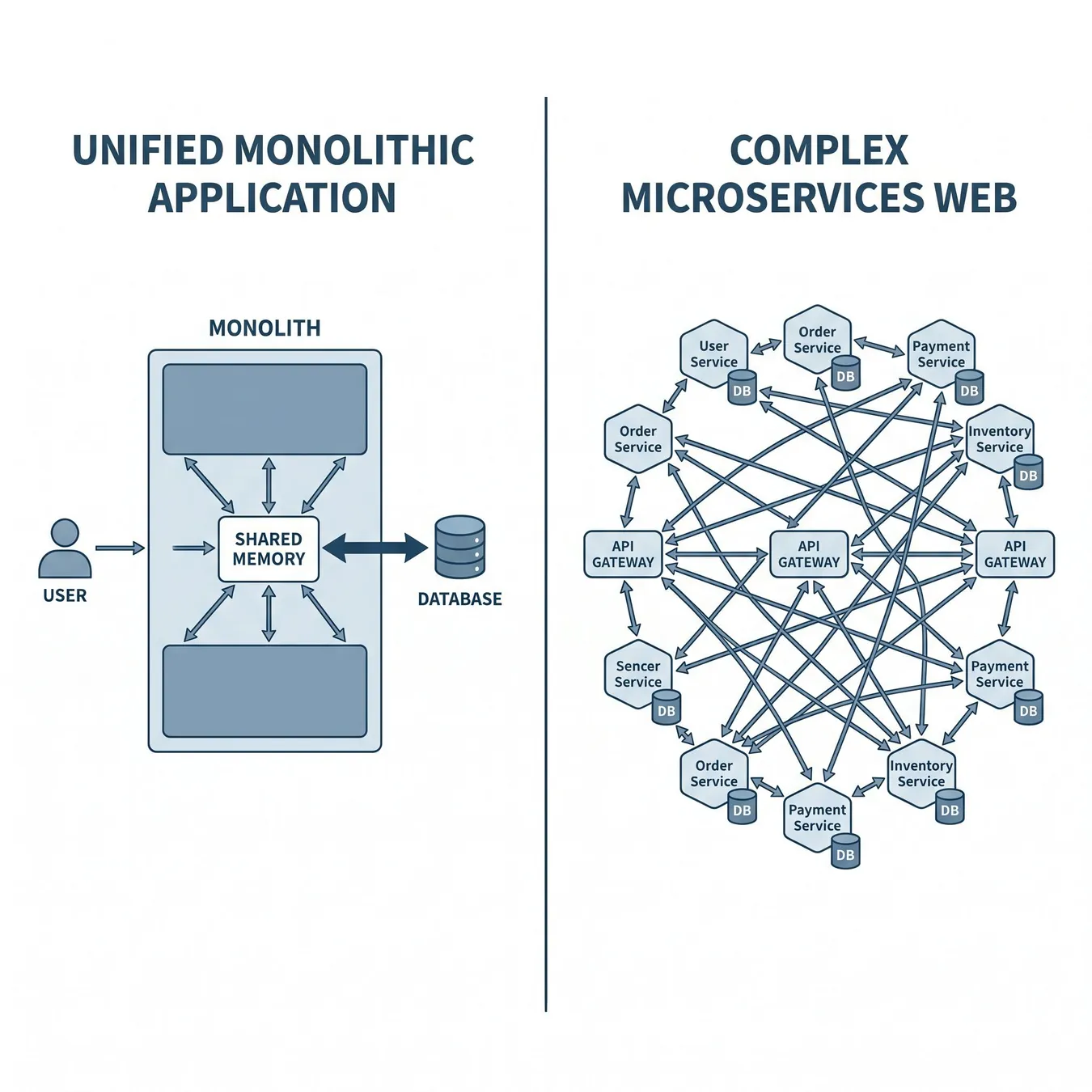
Monolithic architecture simplifies data flow and deployment by keeping the system in a single process.
When to Choose Monolith Over Microservices: Key Indicators
The decision to go monolithic should be based on your team size, product maturity, and operational budget. If your team is under 20 engineers, the overhead of managing service discovery, distributed tracing, and cross-service deployments often consumes more time than it saves.
- Small engineering teams (under 15-20 people)
- Rapidly evolving product requirements and data models
- Limited DevOps and infrastructure automation resources
- Tight deadlines for MVP or first production release
- Low system complexity with few distinct business domains
Speed of Development and Deployment
Monoliths excel at development speed because they allow for easy refactoring across the entire codebase. You can change a function signature or a database schema without coordinating across multiple service teams or managing breaking API changes.
3x
Faster initial MVP development
1
Deployment pipeline to manage
0
Network latency between modules
Operational Simplicity and Lower Costs
Microservices require a sophisticated 'tax'—you must pay for observability, container orchestration, and complex CI/CD. For many, this leads to a situation where they are managing infrastructure rather than building features. For a detailed breakdown of how these choices affect your bottom line, see our guide on microservices vs monolith performance.
Trade-off
4 pros · 4 cons
Pros
Single codebase, easier to search and navigate
Simplified end-to-end testing and debugging
Atomic transactions across all data entities
Lower infrastructure costs and complexity
Cons
Longer build times as the app grows
Single point of failure for the entire system
Scaling requires scaling the whole application
Potential for tight coupling if not disciplined
The Risk of the Distributed Monolith
Many teams adopt microservices too early and end up with a distributed monolith vs microservices nightmare. This happens when services are so tightly coupled that they cannot be deployed independently, yet they suffer from all the networking and consistency issues of a distributed system.
Warning.
// Architectural Warning
Data Consistency and Transactions
In a monolith, you have the luxury of ACID transactions. If a user signs up and an invoice needs to be created, both happen or neither happens. In microservices, you must implement complex patterns like Sagas or Two-Phase Commits to ensure eventual consistency.
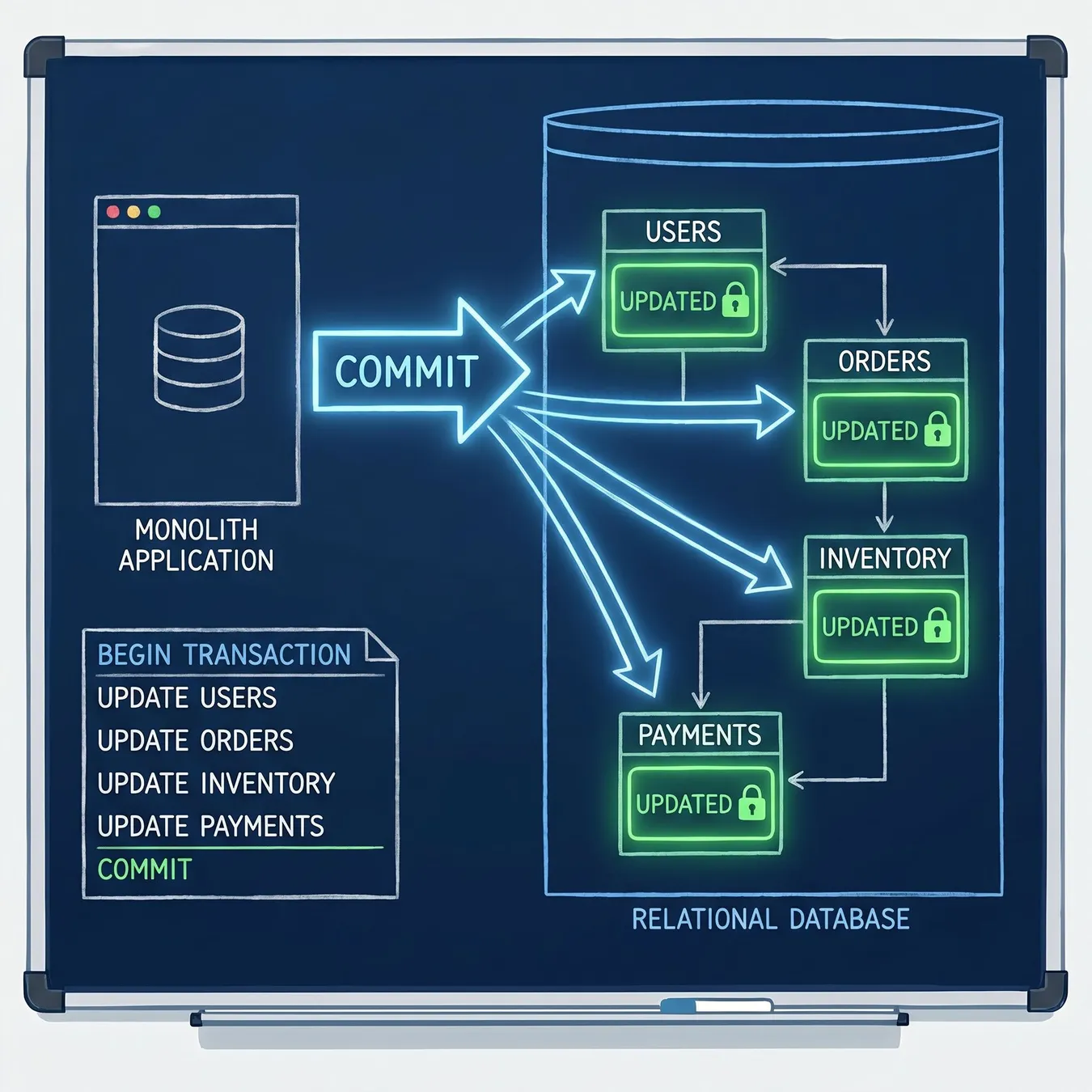
Monoliths allow for simple, reliable data integrity through database-level transactions.
When to Transition: The Scaling Path
Choosing a monolith today doesn't mean you are stuck forever. In fact, the most successful microservices stories started as well-structured monoliths. Once you have clear domain boundaries and a team large enough to justify the split, you can follow a monolith to microservices migration roadmap.
01 / 03
phase 01 / 03
Phase 1: Modular Monolith
phase 02 / 03
Phase 2: Database Separation
phase 03 / 03
Phase 3: Service Extraction
Common Myths About Monoliths
The 'Microservices to Monolith' Trend
We are seeing an increasing number of companies perform a microservices to monolith consolidation. This usually happens when the overhead of distributed systems begins to stall product development, leading teams to realize that a unified codebase is more efficient for their current scale.
Architectural Best Practices for Monoliths
Enforce strict module boundaries in your code
Use a single, well-optimized primary database
Invest in automated testing for the entire suite
Keep your deployment pipeline fast and lean
Allow modules to reach into each other's private data
Ignore build times as the codebase grows
Split services just because a new tool is trendy
Hardcode dependencies between business domains
How Studio 402 Approaches Architecture
At Studio 402, we don't build for the sake of complexity. We build for production-ready outcomes. Whether we are rescuing a 'vibe-coded' prototype or architecting a new SaaS platform from scratch, we prioritize the pattern that allows our clients to ship and scale with the least amount of friction.

We focus on code quality and modularity to ensure long-term maintainability.

Our architectural decisions are driven by business goals and operational reality.
Building Foundations That Grow
Our engineering team specializes in creating 'Modular Monoliths' that provide the speed of a single codebase with the discipline required for future service extraction. This approach ensures that your MVP isn't just a prototype, but a durable foundation for a scaling business.
The best architecture is the one that lets you solve customer problems today without creating a maintenance nightmare for tomorrow.
Studio 402 Engineering Lead · Systems Architect
Architecture Decision Checklist
Is your engineering team smaller than 15 people?
Is your product still in the 'discovery' phase?
Do you need to launch in less than 3 months?
Is your domain model still frequently changing?
Ready to Build Your Next System?
If you are struggling with architectural decisions or need a partner to build a production-grade application that scales, Studio 402 is here to help. We combine senior engineering depth with a pragmatic focus on delivery.
Trusted by founders to ship production-ready software in weeks.
From MVPs to complex cloud infrastructure.
Build Your Production-Ready MVP
Let's discuss your project architecture and build a system that lasts. Reach out to our engineering team today.
Further Reading on Software Architecture
Keep reading
More in Software Architecture & Patterns
Technical Debt and Long-Term Planning
Choosing a monolith is a conscious decision to manage technical debt by avoiding premature distribution. It allows you to focus your engineering resources on the features that actually drive business value.
The Importance of Senior Oversight
Without senior architectural guidance, even a monolith can become unmanageable. We provide the fractional CTO and engineering leadership needed to keep your codebase clean and your roadmap clear.
Infrastructure as a Service
Even with a monolith, modern cloud infrastructure is essential. We set up CI/CD, monitoring, and automated backups so your single application is as resilient as any distributed system.
Security and Compliance
A monolithic architecture can actually simplify security audits and compliance, as there are fewer network boundaries to secure and a centralized point for authentication and authorization.
The Role of AI in Modern Builds
As we integrate AI features into products, the simplicity of a monolith allows for faster experimentation with LLMs and agents without the complexity of cross-service data orchestration.
Final Thoughts on Pragmatic Engineering
Architecture should serve the business, not the other way around. For most companies, the monolith remains the most pragmatic, cost-effective, and high-velocity choice available today.