
Avoiding the Distributed Monolith Anti-Pattern
The distributed monolith is a common architectural failure where a system has the complexity of microservices but the tight coupling of a monolith. Understanding the trade-offs between a distributed monolith vs microservices is critical for engineering leaders who want to avoid the worst of both worlds.
- Architecture
- Scalability
- Advanced
- Engineering Leadership
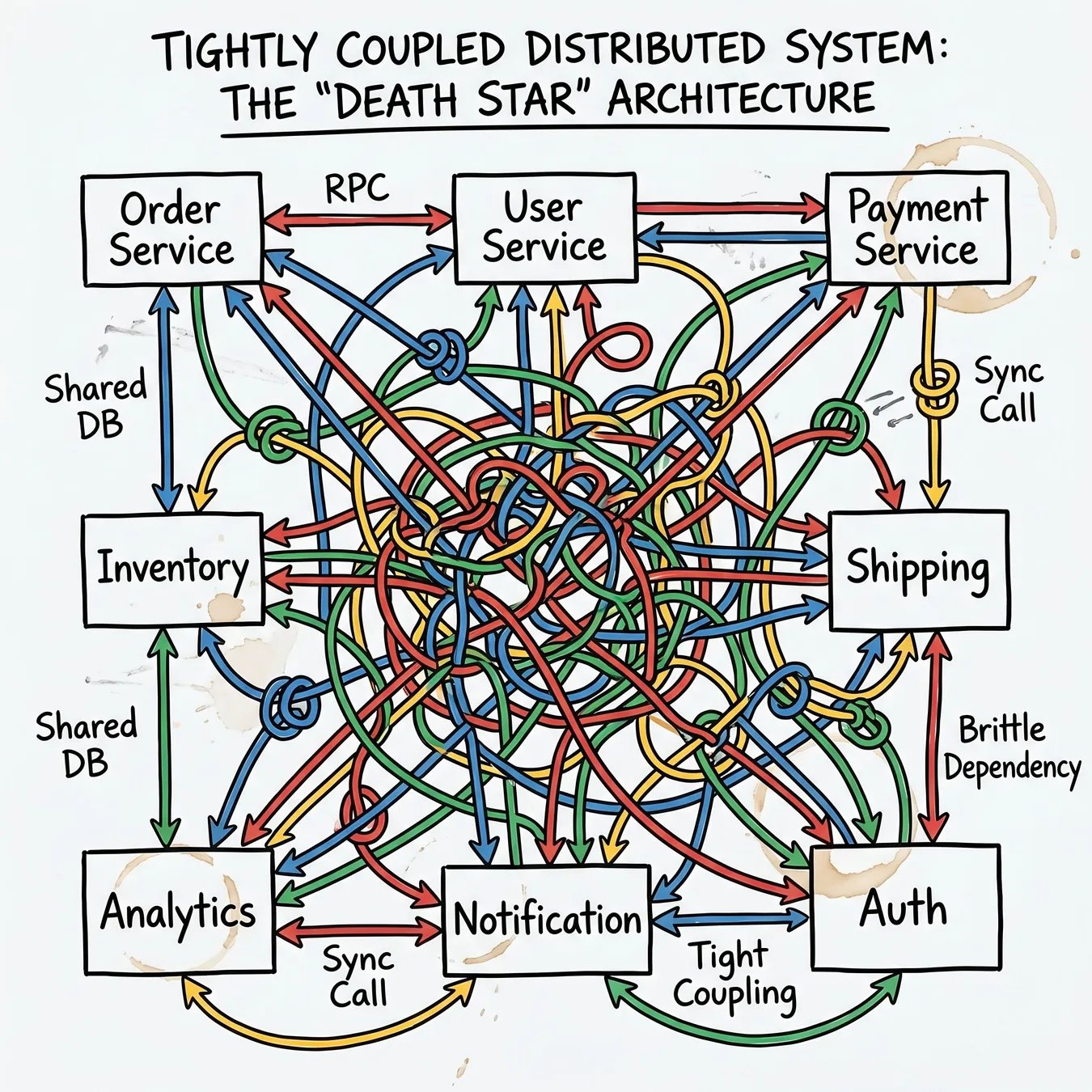
The visual representation of a distributed monolith: high complexity with no independence.
What is a Distributed Monolith?
A distributed monolith occurs when you split your application into multiple services that cannot be deployed, scaled, or managed independently. If changing one service requires a coordinated deployment of three others, you haven't built microservices; you've built a monolith that communicates over a slow network.
Warning.
// The Cascade Test
Key Symptoms of Tight Coupling
Identifying this pattern early can save months of wasted engineering effort. Look for these specific technical debt signals in your current infrastructure.
- Coordinated deployments are mandatory for every feature.
- Shared databases between multiple services.
- Chatty communication via synchronous REST calls.
- Circular dependencies between service boundaries.
- High network latency impacting user experience.
The Shared Database Trap
When multiple services read and write to the same schema, they are effectively one application. Any change to the data model requires all services to be updated simultaneously, breaking the promise of independent iteration.
Distributed Monolith vs Microservices
The distinction between microservices vs distributed monolith lies in the concept of 'Bounded Contexts.' True microservices own their data and logic completely.
Trade-off
4 pros · 4 cons
Pros
Independent service scaling
Isolated failure domains
Faster deployment cycles
Technology stack flexibility
Cons
Network latency between every call
Coordinated deployment overhead
Hard to debug distributed state
Cascading system failures
The Performance Cost of Improper Distribution
Moving logic out of a single process into multiple services introduces the 'fallacy of distributed computing.' You must account for microservices vs monolith performance differences, specifically the overhead of serialization and network transit.
10-50ms
Avg Network Latency Increase
3x
Deployment Complexity
High
Data Consistency Risk
How to Decouple Your Services
If you find yourself in a distributed monolith, you need specific monolith to microservices patterns to regain architectural health. This usually involves moving from synchronous to asynchronous communication.
- 01
Identify and define clear Bounded Contexts.
- 02
Implement asynchronous messaging (Pub/Sub).
- 03
Decompose shared databases into per-service stores.
- 04
Introduce API Gateways for external consumers.
- 05
Automate independent CI/CD pipelines.
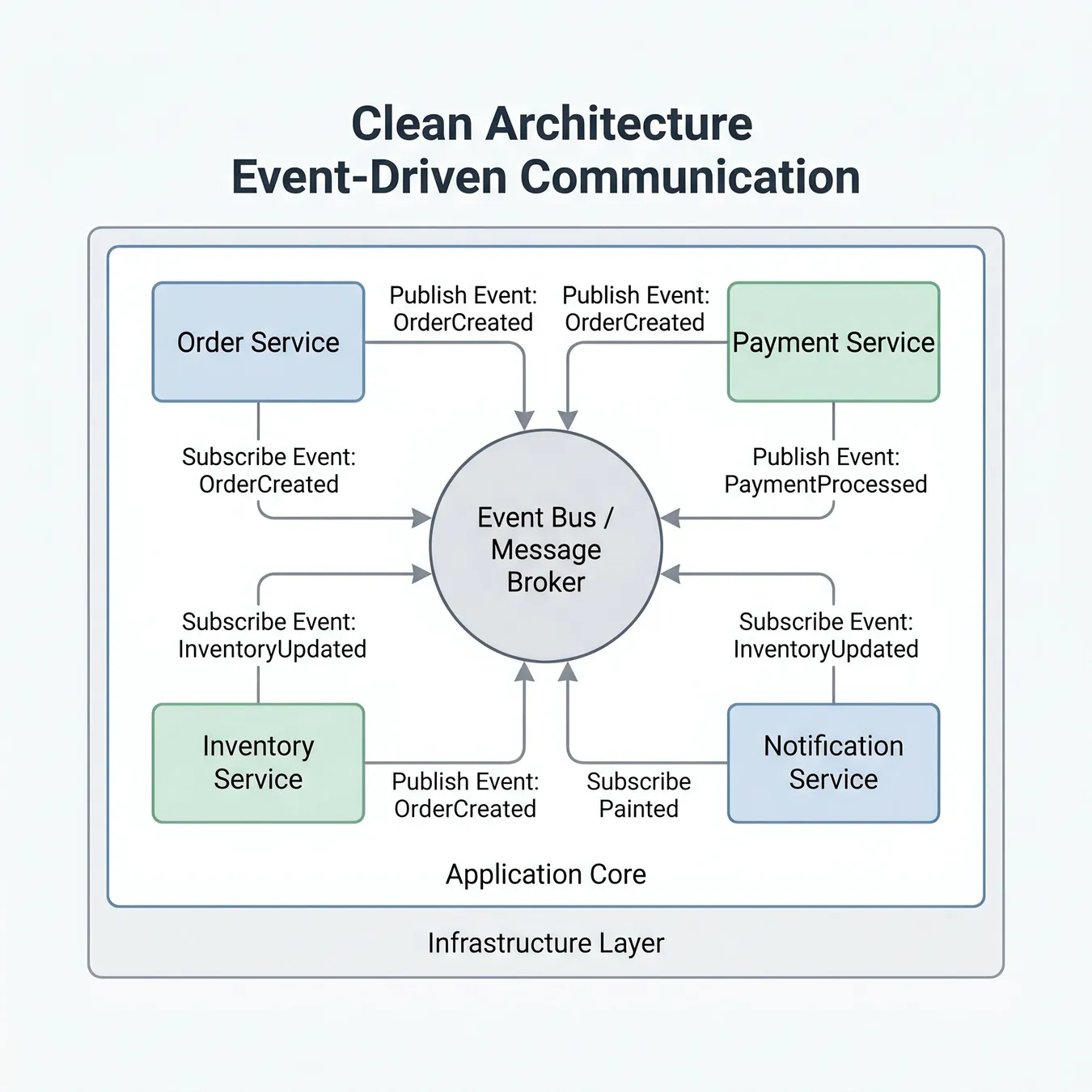
Event-driven architecture reduces coupling.
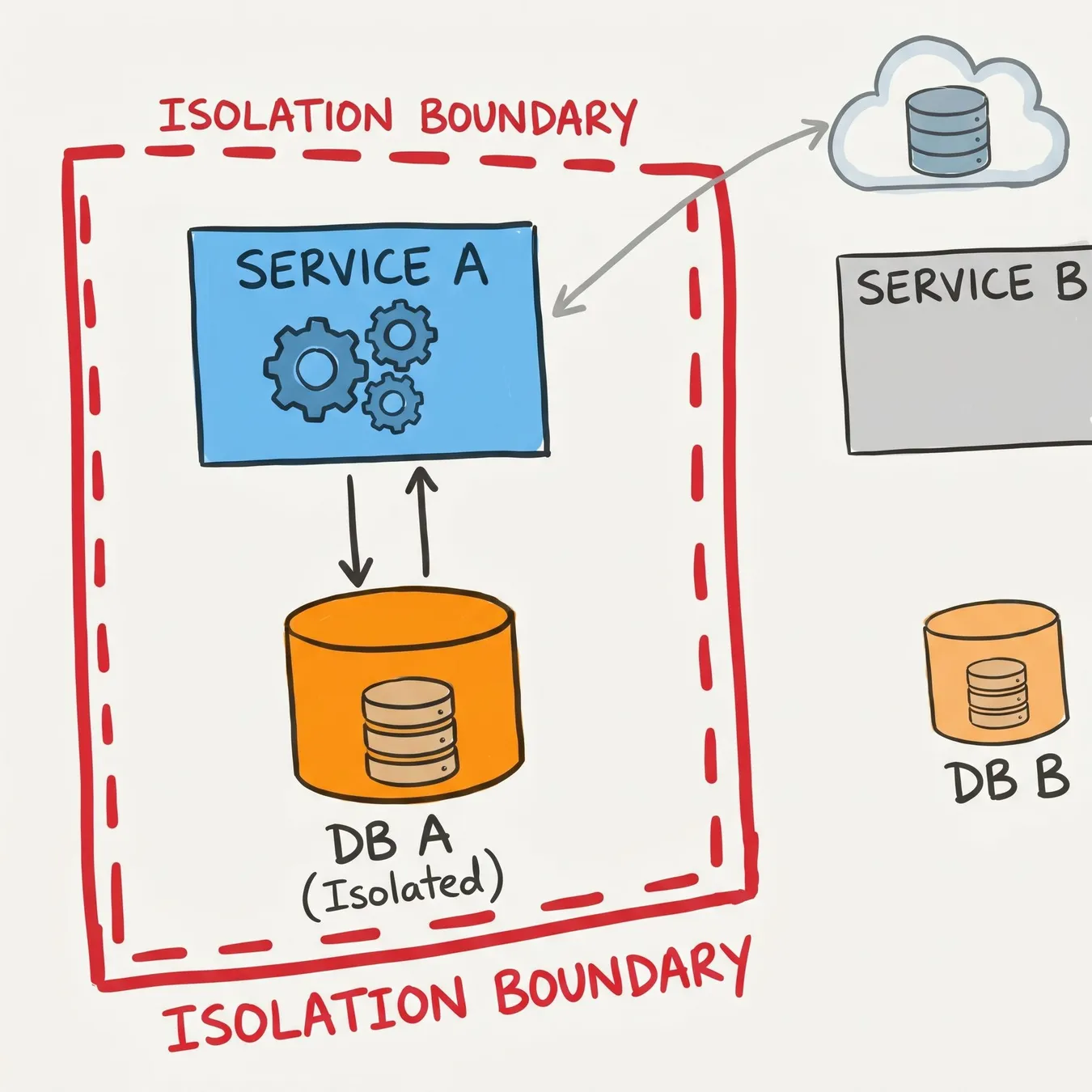
Database per service is a core requirement.
When Consolidation is the Better Path
Sometimes the overhead of managing distributed systems is not worth the benefit, especially for smaller teams. In these cases, it is often wiser to move from microservices to monolith to simplify operations and increase velocity.
Don't even consider microservices unless you have a system that's too big to manage as a monolith.
Martin Fowler · Software Architect
Strategic Migration and Remediation
Fixing a distributed monolith requires a structured monolith to microservices migration approach. You cannot simply flip a switch; you must incrementally decouple logic while maintaining system uptime.
The Role of Eventual Consistency
Moving away from tight coupling often means giving up immediate ACID transactions across service boundaries. Embracing eventual consistency is a prerequisite for true service independence.
Common Pitfalls to Avoid
Use asynchronous events for cross-service updates.
Give every service its own private database.
Design for failure with circuit breakers.
Share code libraries that contain business logic.
Expose internal database schemas via APIs.
Require lock-step deployments across teams.
Architectural Checklist for Independence
Can Service A be deployed while Service B is down?
Does each service have a unique data store?
Are cross-service calls primarily asynchronous?
Is there a clear owner for every data domain?
Frequently Asked Questions
Building Foundations for Scale with Studio 402
At Studio 402, we specialize in rescuing systems that have hit architectural ceilings. Whether you are struggling with a distributed monolith or need to build a production-ready microservices environment from scratch, we provide the engineering depth to ensure your software scales with your business.
We don't just build features; we design durable systems. Our team helps growth-stage companies audit their current stacks, refactor brittle codebases, and implement cloud-native infrastructure that supports high-velocity shipping without the risk of cascading failures.
Trusted by growth-stage startups to scale production infrastructure.
July 2026 Engineering Audit Report
Our Approach to Architectural Rescue
01 / 03
phase 01 / 03
Technical Audit
phase 02 / 03
Refactor Strategy
phase 03 / 03
Execution & Launch
Studio 402 helped us untangle a mess of services that were crashing every time we deployed. They turned our distributed monolith into a scalable platform.
Build a Durable System Today
Ready to fix your architecture and scale your product? Let's discuss your system design and engineering roadmap.
Continue Learning
Keep reading
More in Software Architecture & Patterns
Effective system design is the difference between a product that scales and one that breaks under pressure. By avoiding the distributed monolith, you ensure your engineering team remains agile and your infrastructure remains resilient.
For more insights on modern software patterns, explore our full library of technical guides or reach out to our team for a custom architectural review.
Final Summary
- Prioritize independent deployability above all else.
- Avoid shared databases across service boundaries.
- Use events to decouple business logic.
- Don't be afraid to consolidate if the overhead is too high.
Architecture is never finished; it is an ongoing process of refinement. Stay focused on the business value and let that drive your technical decisions.
Thank you for reading our guide on distributed systems. We hope this helps you build better, more independent software.
Studio 402 is committed to engineering excellence and helping founders navigate the complexities of modern software development.