
Microservices Architecture vs Monolithic Architecture Guide
Choosing between microservices architecture vs monolithic architecture is one of the most consequential decisions an engineering leader will make. This choice dictates how your team ships code, how your infrastructure scales, and how your product evolves over time.
70%
Lower initial complexity in monoliths
10x
Scalability potential in microservices
3-5x
Operational overhead increase for distributed systems
Defining Monolith vs Microservices
A monolithic architecture is a unified model where all software components are interconnected and interdependent. In contrast, microservices break the application into small, independent services that communicate over a network.
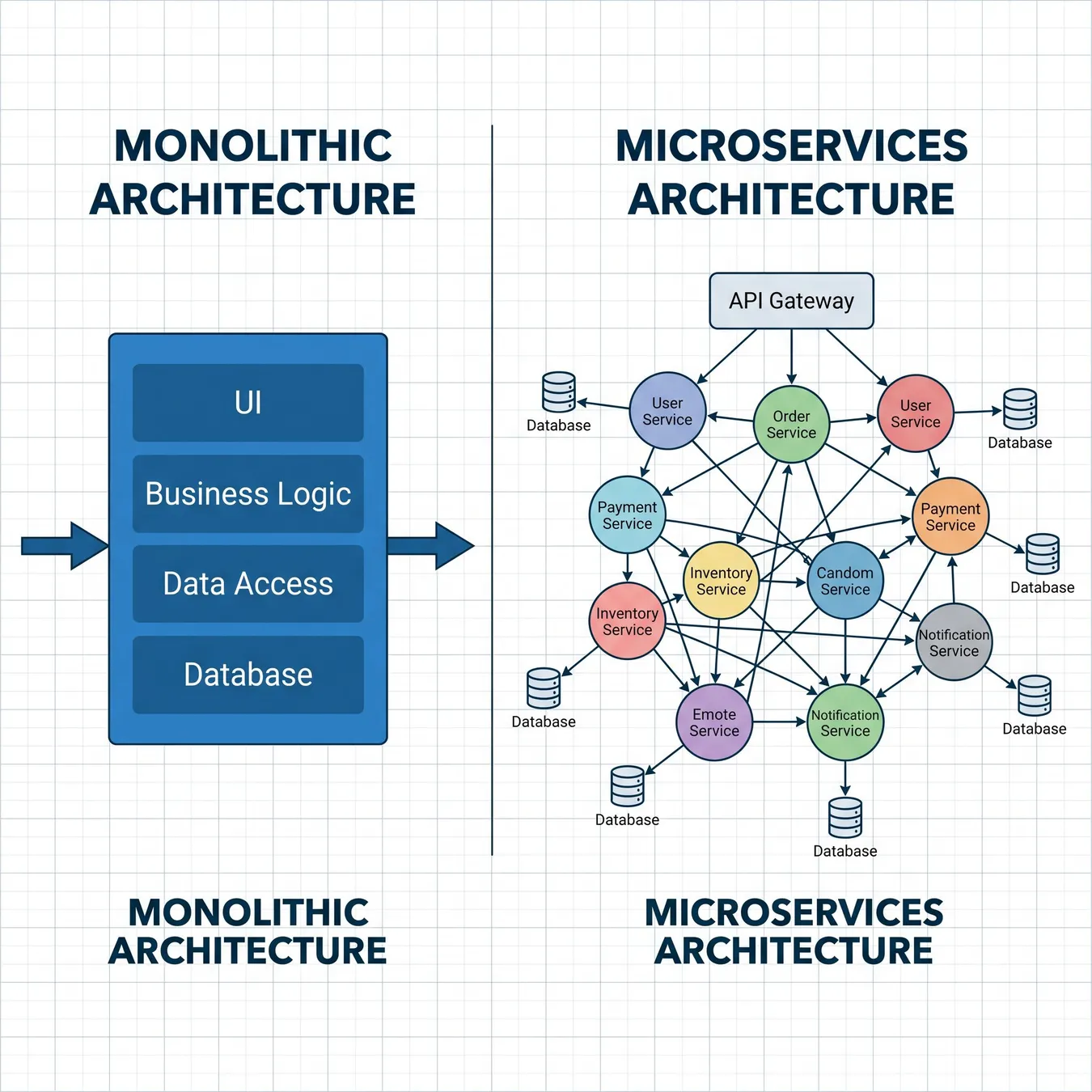
Visualizing the structural difference between unified and distributed systems.
Microservices vs Monolithic Pros and Cons
Understanding the trade-offs is essential. While microservices offer agility, they introduce significant network latency and data consistency challenges that a monolith avoids.
Trade-off
4 pros · 4 cons
Pros
Independent deployment cycles
Technology stack flexibility per service
Granular horizontal scaling
Fault isolation between domains
Cons
Complex distributed data management
High operational and DevOps overhead
Network latency between services
Difficult end-to-end testing
When to Use Microservices vs Monolith
The decision often hinges on your team's maturity and the product's scale. For many startups, starting with a monolith is the fastest path to market.
- Choose Monolith for small teams and rapid MVP iteration.
- Choose Microservices for large-scale organizations with distinct domains.
- Consider a Modular Monolith as a middle-ground strategy.
- Evaluate your DevOps maturity before moving to distributed systems.
Monolithic vs Modular vs Microservices
A modular monolith provides internal separation of concerns without the network overhead of microservices. This is often the best starting point for growth-stage companies.
Tip.
// The Modular Middle Ground
The Impact of Engineering Team Structures
Conway's Law suggests that your architecture will mirror your engineering team structures. If your team is small and collaborative, a monolith is often more efficient.
Operational Complexity and Overhead
Microservices require robust observability, CI/CD, and automated infrastructure. Without these, you risk creating a 'distributed monolith' that is harder to manage than a single codebase.

Observability is a mandatory requirement for healthy microservices.
Data Management Trade-offs
In a monolith, ACID transactions are straightforward. In microservices, you must manage eventual consistency and saga patterns across distributed databases.
Scalability: Vertical vs Horizontal
Monoliths scale vertically by adding more resources to one server. Microservices scale horizontally, allowing you to boost only the specific services under high load.
Deployment Velocity and Risk
Microservices allow teams to ship updates independently. However, this requires sophisticated versioning and backward compatibility strategies to avoid breaking the system.
The Case for Microservice or Monolithic
Whether you choose a microservice or monolithic approach, the goal is the same: maintainable code that supports business growth. Don't let hype dictate your stack.
Migration Strategies and Patterns
If you have outgrown your current system, a monolith to microservices migration can unlock new levels of scale, provided it is executed incrementally.
Decoupling the Codebase
Technical patterns for breaking monolith into microservices, such as the Strangler Fig pattern, allow you to replace legacy functionality without a total rewrite.
When Microservices Fail: The Consolidation Path
Sometimes the overhead of distribution is too high. In these cases, moving from microservices to monolith can restore developer productivity and reduce costs.
Strategic Decision Framework for CTOs
01 / 03
phase 01 / 03
Audit Complexity
phase 02 / 03
Assess Infrastructure
phase 03 / 03
Evaluate Team Scale
Common Architectural Pitfalls
Define clear service boundaries first
Invest in automated testing early
Use asynchronous communication where possible
Don't share databases between services
Don't ignore network latency in your design
Don't adopt microservices just for the hype
Performance Considerations
Network calls are significantly slower than in-memory function calls. This latency must be accounted for in your system's user experience and performance budget.
Architecting for the Future
At Studio 402, we help companies navigate these complex architectural decisions. Whether you are building a greenfield MVP or rescuing a system that won't scale, we focus on production-ready outcomes.

Expert architecture review helps avoid costly technical debt.
Frequently Asked Questions
Deep Dives and Further Reading
Build Your Scalable Foundation
Don't let architectural uncertainty stall your growth. Studio 402 provides the senior engineering leadership and execution depth required to build systems that survive real-world scale.
Build Production-Ready Software
Ready to architect your next phase of growth? Let's discuss your system design and scaling needs.
Keep reading
More in Software Architecture & Patterns
Our team at Studio 402 specializes in custom software and AI systems that are architected for durability. From MVP development to cloud infrastructure, we ship code that scales.
- Software Architecture
- CTO Strategy
- Cloud Infrastructure
- Scalability
Strategic planning today prevents technical debt tomorrow. Ensure your architecture aligns with your long-term business goals.
For more insights on building durable software, explore our hub for software engineering architecture.
Contact us at studio@402.studio to schedule an architecture review or start your next build.