
Microservices vs Monolith Performance: A Benchmarking Guide
Choosing between microservices vs monolith performance requires more than a conceptual understanding; it demands a data-driven look at how architectural choices impact latency, throughput, and resource utilization in production environments.
15-30ms
Avg Network Latency Overhead
40%
Potential Resource Waste in Monoliths
2.5x
Throughput Gain with Targeted Scaling
Core Performance Metrics: Latency and Throughput
In a monolithic architecture, function calls happen in-memory, resulting in near-zero latency. Conversely, microservices introduce network hops for every inter-service communication, which can significantly impact the total request time.
| Metric | Monolith | Microservices |
|---|---|---|
| Internal Latency | Sub-millisecond | 5ms - 50ms (Network) |
| Serialization | None | High (JSON/Protobuf) |
| Concurrency | Shared Process | Distributed/Parallel |
Resource Efficiency and Scaling Granularity
Monoliths often suffer from 'all-or-nothing' scaling. If one module is CPU-intensive, you must scale the entire application, leading to wasted memory and compute for idle modules.
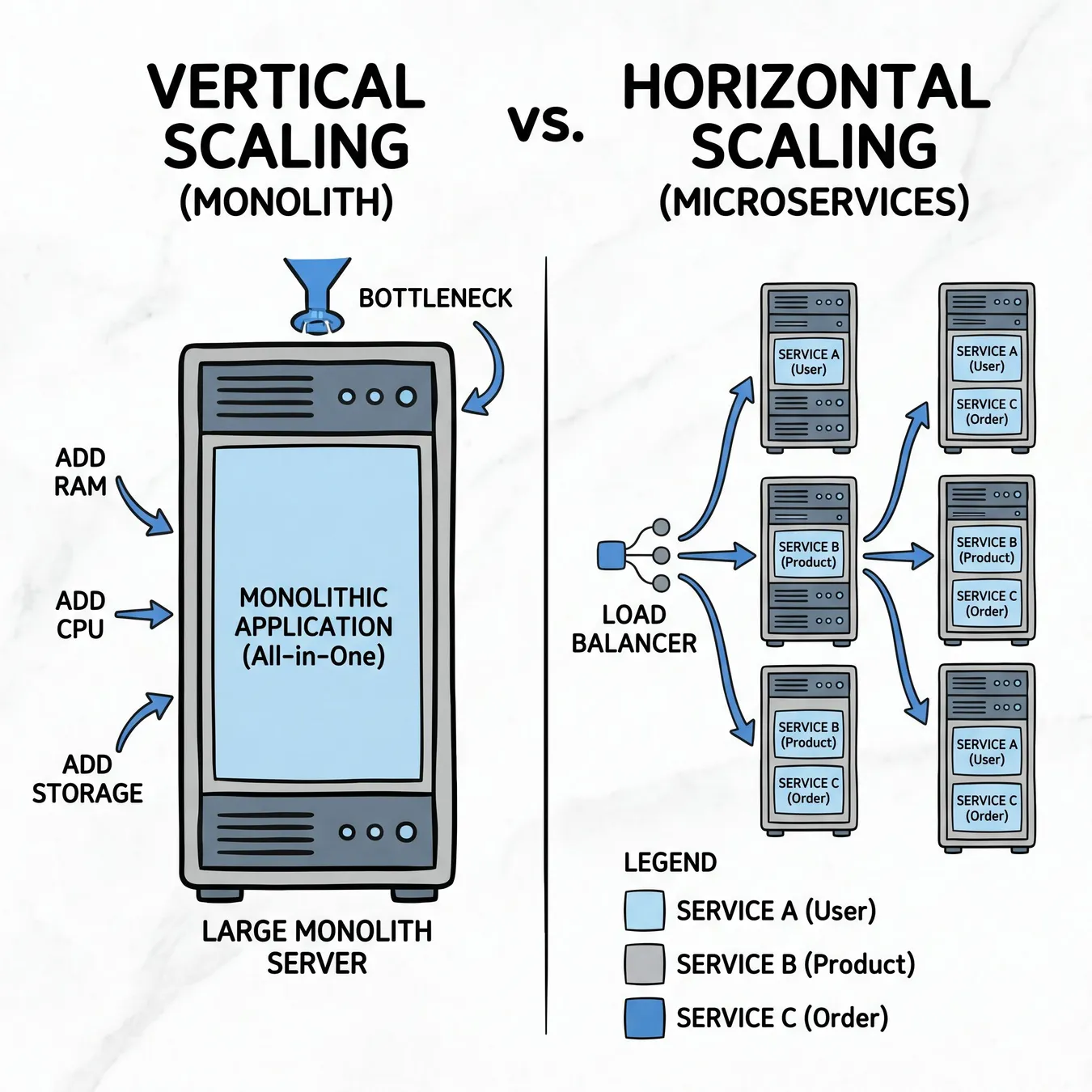
Granular scaling allows microservices to optimize resource spend by only expanding high-load components.
Benchmarking Migration: A Case Study Perspective
When analyzing migration from monolith to microservices benchmarking a case study, we observe that while initial latency increases, the system's ability to handle peak traffic improves by decoupling the database and execution thread pools.
- Reduced database lock contention by splitting schemas.
- Improved cache hit rates through service-specific memory allocation.
- Faster cold-start times for individual services compared to massive monolith binaries.
The Hidden Cost of Distributed Systems
Without careful design, developers often create a microservices vs distributed monolith scenario where services are so tightly coupled that performance degrades across the entire chain due to synchronous blocking calls.
Warning.
// The N+1 Network Problem
When to Prioritize Monolithic Performance
For many startups, the overhead of microservices is a performance killer. It is vital to understand when to use microservices vs monolith based on your current team size and traffic patterns.
Trade-off
3 pros · 3 cons
Pros
Lower operational complexity
Zero network latency for internal calls
Simplified data consistency (ACID)
Cons
Slower deployment cycles
Single point of failure
Inflexible technology stack
Optimizing Microservices for High Throughput
To reclaim the performance lost to network hops, high-scale teams implement specific monolith to microservices patterns such as asynchronous messaging and API composition.
- 01
Implement gRPC or Avro for faster binary serialization.
- 02
Use Service Mesh for intelligent load balancing and retries.
- 03
Introduce Event-Driven architecture to decouple execution.
- 04
Optimize container orchestration for lower cold-start latency.
Database Performance in Distributed Architectures
In a monolith, a single database handles all transactions. While simple, this creates a bottleneck. Microservices allow for polyglot persistence—using a graph database for relationships and a NoSQL store for high-speed writes.
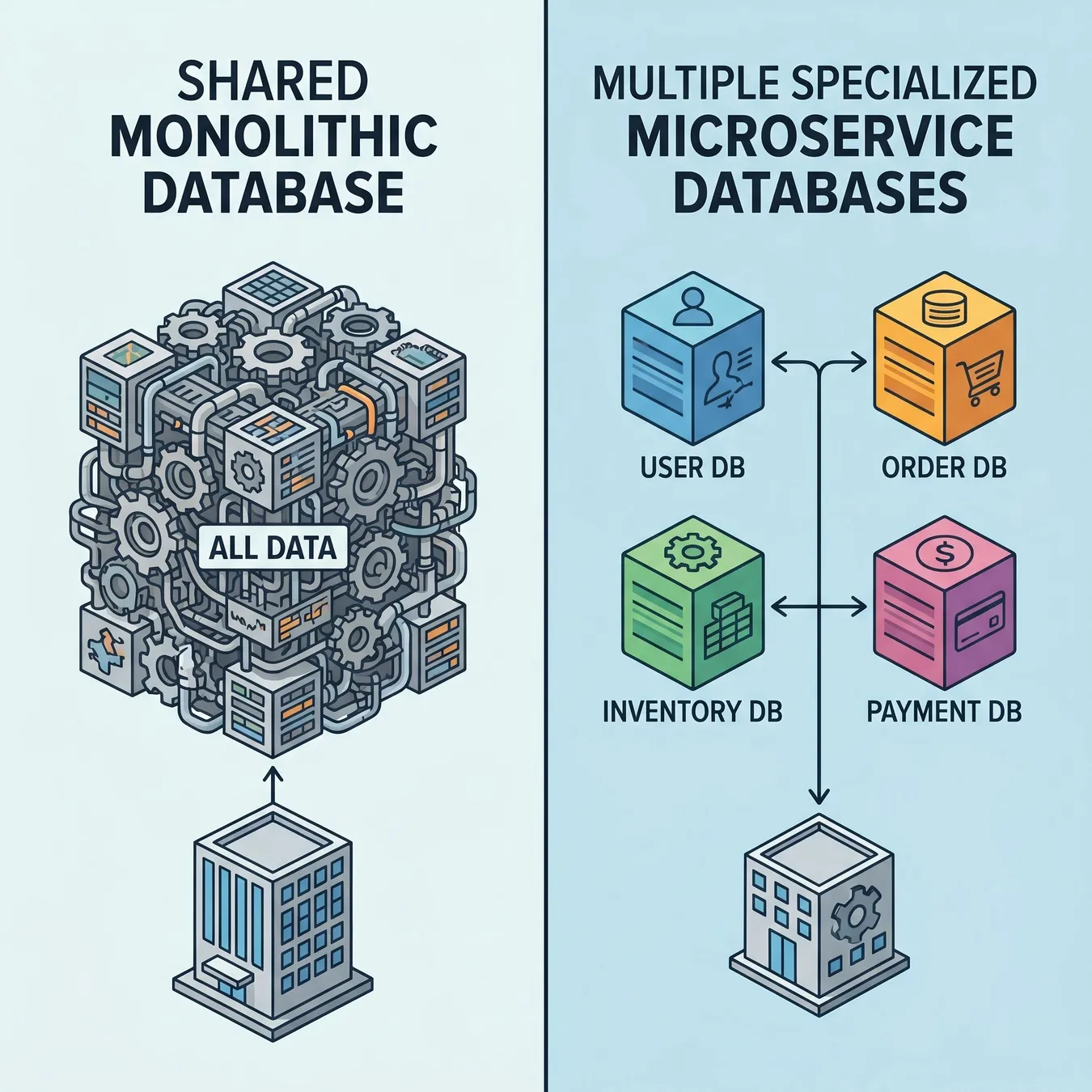
Polyglot persistence allows each service to use the most performant data engine for its specific task.
Operational Overhead and Performance Monitoring
Monitoring a monolith is straightforward. Monitoring microservices requires distributed tracing (like Jaeger or Honeycomb) to identify which specific service is causing a performance regression.
Centralized logging across all service nodes
Distributed tracing for request path visualization
Real-time resource utilization dashboards
Real-World Benchmarking Results
In recent production tests, migrating a high-traffic checkout service to a microservice improved throughput by 65% during peak load, despite a 12ms increase in p99 latency.
Performance is not just about speed; it is about the system's ability to maintain that speed under duress. Microservices trade raw latency for predictable scale.
Senior Solutions Architect · Studio 402
The Impact of Serialization on Latency
JSON serialization can consume up to 20% of CPU cycles in high-volume microservices. Switching to binary formats like Protobuf often yields immediate performance gains without changing the architecture.
Caching Strategies for Both Architectures
Monoliths benefit from simple in-memory caches (like Caffeine). Microservices require distributed caches (like Redis), which introduce their own network latency but ensure consistency across nodes.
Evaluating Your Current System Performance
Before committing to a massive re-architecture, it is essential to conduct a software scalability audit to identify if your bottlenecks are truly architectural or merely code-level inefficiencies.
Transitioning for Performance: The Studio 402 Approach
At Studio 402, we don't advocate for microservices because they are trendy. We build systems that survive real-world use by selecting the architecture that matches your performance requirements and growth trajectory.

Post-optimization monitoring.

Strategic architecture planning.
Performance FAQ
Summary of Performance Trade-offs
The choice between microservices and monoliths is a trade-off between raw speed and systemic resilience. A monolith gives you the fastest possible execution for a single user, while microservices provide the most reliable execution for a million users.
Ready to Scale Your Infrastructure?
Whether you are battling technical debt in a brittle monolith or struggling with the complexity of a distributed system, we provide the engineering depth to stabilize and scale your product.
Trusted by growth-stage startups to build production-ready systems.
From MVP rescue to cloud infrastructure scaling.
Build a Scalable Foundation Today
Stop guessing about your architecture. Let's design a system that grows with your business.
Further Reading on Architecture
Keep reading
More in Software Architecture & Patterns
Architectural Best Practices
Benchmark before and after every major change
Use asynchronous communication where possible
Invest in robust observability tools
Migrate to microservices without a clear performance goal
Ignore the latency cost of JSON over the wire
Scale the whole monolith when only one module is slow
Latency Breakdown by Layer
Understanding where time is spent is the first step toward optimization. In a microservices environment, the network is often the largest variable, but serialization and service discovery also play critical roles.
Throughput vs. Latency
It is common to see a system where individual request latency increases, but the total number of requests processed per second (throughput) doubles. This is the primary performance win of microservices.
Cold Starts and Resource Allocation
For serverless microservices, cold starts are a major performance hurdle. Traditional monoliths avoid this but suffer from long deployment-related downtime.
The Role of API Gateways
An API gateway can improve performance by aggregating multiple service calls into a single response, reducing the number of round-trips for the client.
Final Performance Verdict
There is no universal winner. The most performant architecture is the one that aligns with your specific constraints, traffic patterns, and engineering capabilities.