
Data Migration from Monolith to Microservices
Transitioning from a monolithic database to a distributed architecture requires more than just moving rows between tables. Successful data migration from monolith to microservices involves decomposing shared schemas while maintaining strict data integrity across new service boundaries.
- Database Decomposition
- Data Integrity
- Microservices
- Zero Downtime
The Challenge of Database Decomposition
In a monolith, the database is often a single, massive entity where every module can join any table. When you move toward microservices, this shared state becomes the primary blocker to independent scaling and deployment.
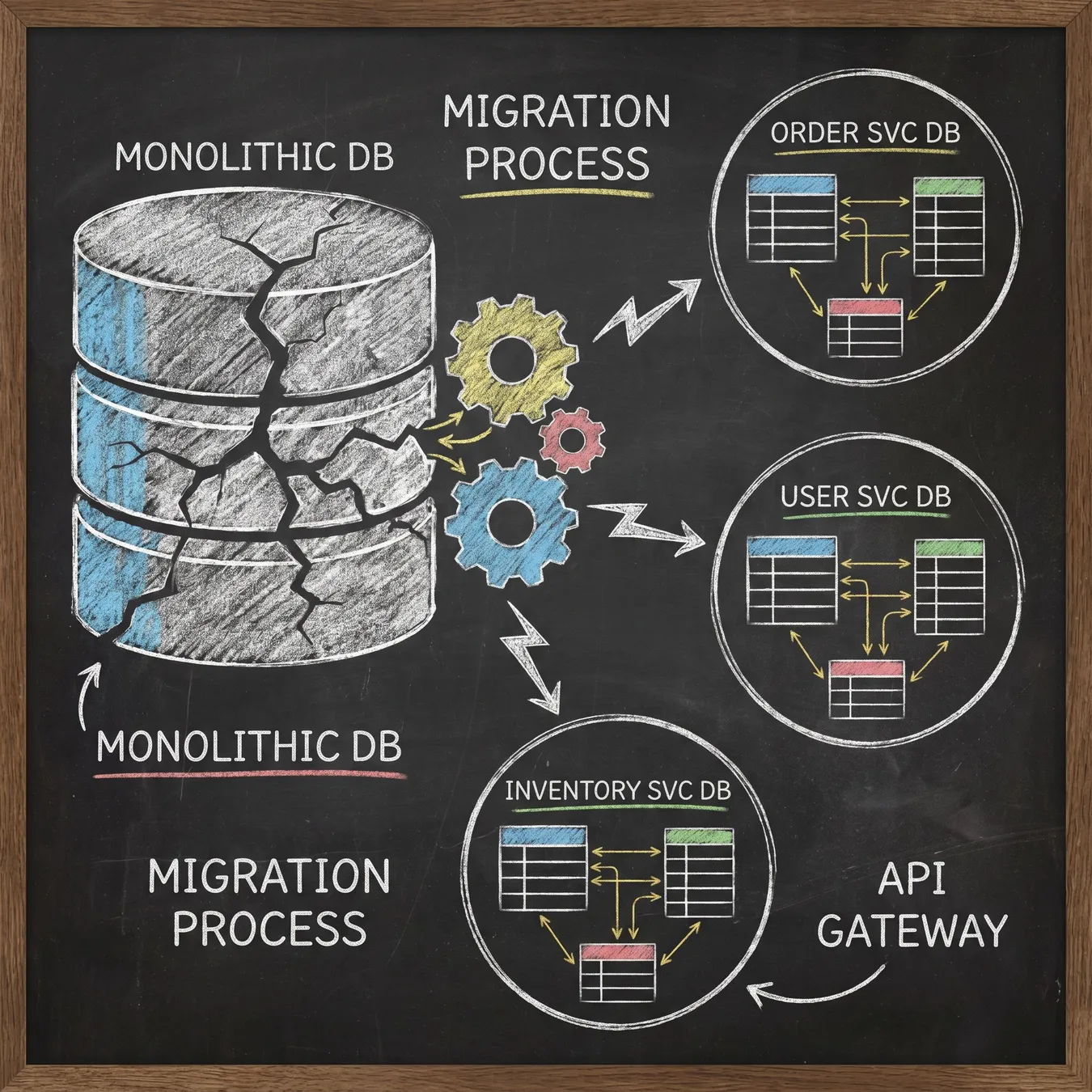
Visualizing the transition from a shared database to per-service data ownership.
Core Patterns for Data Migration
To ensure a smooth transition, engineers typically employ specific monolith to microservices patterns that allow for incremental changes rather than a high-risk 'big bang' migration.
- 01
Identify bounded contexts and data ownership.
- 02
Decouple application logic from the shared database.
- 03
Implement dual-writing to keep both systems in sync.
- 04
Migrate read operations to the new service.
- 05
Decommission the legacy data paths.
The Dual-Write Pattern for Integrity
Dual-writing is a critical technique where the application writes to both the legacy monolith database and the new microservice database simultaneously. This ensures that no data is lost during the transition period.
Note.
// Technical Note
Maintaining Consistency in Distributed Systems
Once data is split, you lose ACID transactions across service boundaries. You must decide between strong consistency and eventual consistency based on the specific business requirements of each service.
| Strategy | Consistency Level | Complexity | Use Case |
|---|---|---|---|
| Two-Phase Commit | Strong | High | Financial Transactions |
| Saga Pattern | Eventual | Medium | Order Fulfillment |
| Event Sourcing | Eventual | High | Audit-heavy Systems |
Avoiding the Distributed Monolith
If your microservices still require frequent cross-database joins, you may have created a distributed monolith vs microservices architecture, which offers the downsides of both worlds without the benefits of either.
Data Migration Lifecycle
01 / 04
phase 01 / 04
Phase 1: Analysis
phase 02 / 04
Phase 2: Shadowing
phase 03 / 04
Phase 3: Verification
phase 04 / 04
Phase 4: Cutover
Handling Legacy Constraints
Many organizations struggle with legacy data modernization because of decades-old stored procedures and triggers that are difficult to extract into modern microservices.
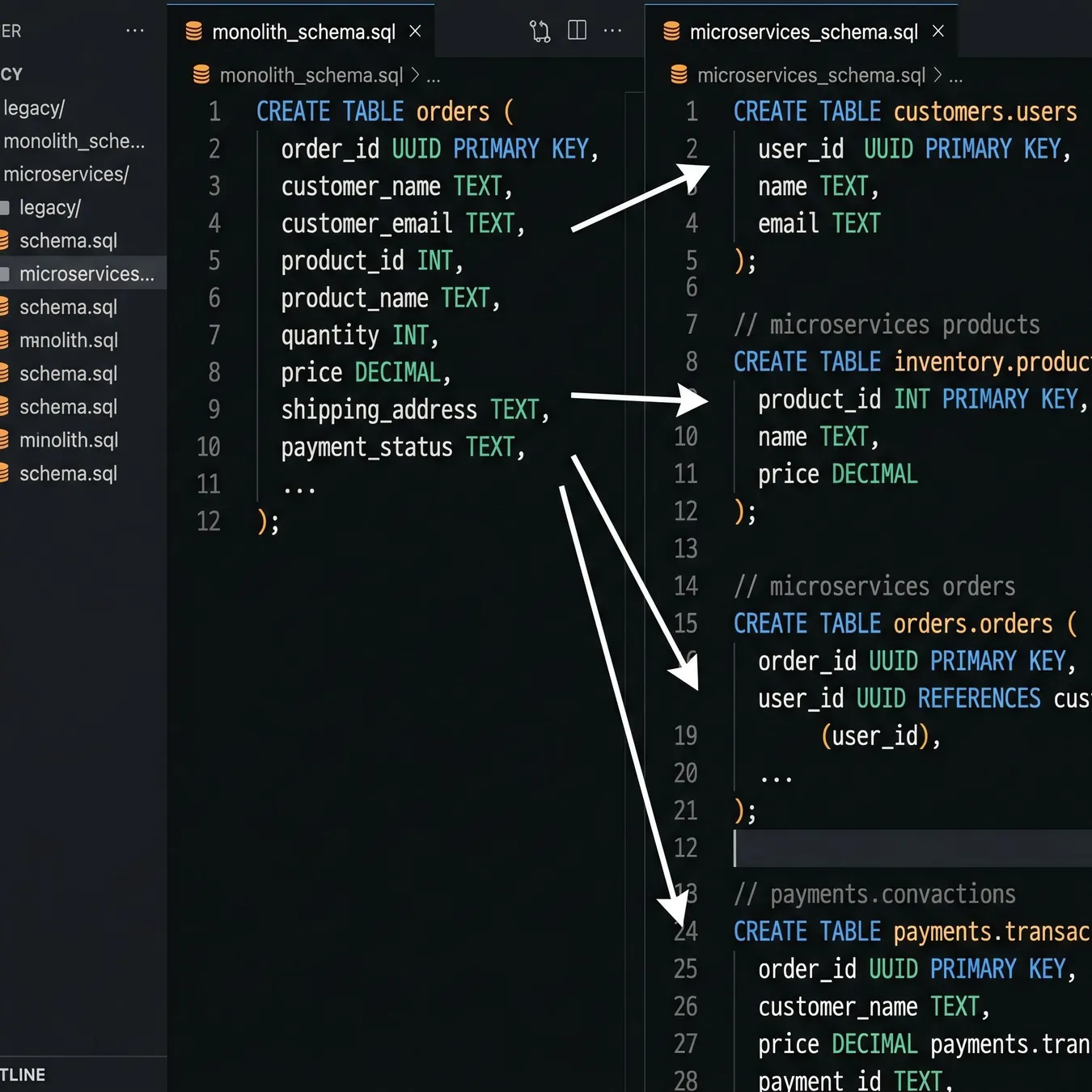
Refactoring schema definitions for service isolation.
Migration Best Practices
Following monolith to microservices best practices ensures that your engineering team doesn't get bogged down in data corruption issues halfway through the project.
Use Change Data Capture (CDC) for real-time syncing.
Automate data validation scripts.
Start with low-criticality data sets.
Implement circuit breakers for dual-write paths.
Don't try to migrate all tables at once.
Don't ignore performance impacts on the legacy DB.
Don't skip the reconciliation phase.
Don't keep the old database as a backup indefinitely.
Common Anti-Patterns to Avoid
One of the most dangerous anti-patterns is the 'Shared Database' microservice, where multiple services connect to the same schema, leading to tight coupling and deployment gridlock.
The Big Bang Migration Risk
Attempting to move all data in a single weekend often leads to extended downtime and catastrophic rollbacks. Incremental patterns are always preferred for production systems.
Technical Requirements for Success
Establish a clear data ownership model.
Set up monitoring for data sync latency.
Create a rollback plan for every migration step.
Verify network throughput between old and new DBs.
Measuring Migration Success
0%
Data Loss Tolerance
<50ms
Dual-Write Latency Target
100%
Schema Validation Coverage
When to Re-Architect Your Data
If your current monolithic database is causing lock contention, blocking feature releases, or preventing horizontal scaling, it is time to consider a structured migration to microservices.
How Studio 402 Handles Complex Migrations
At Studio 402, we specialize in rescuing brittle architectures and executing high-stakes data migrations. We don't just move data; we build the infrastructure and automation required to ensure your new system is production-ready from day one.

Studio 402 engineers durable systems for real-world scale.
Frequently Asked Questions
Expert Insights on Architecture
Data is the most difficult part of any microservices transition. If you get the data boundaries wrong, the rest of the architecture will eventually collapse under its own weight.
Senior Architect · Studio 402
Next Steps for Your Migration
Transitioning your data layer is a high-risk operation that requires senior engineering oversight. Whether you are building from scratch or rescuing a failing migration, having a partner who understands distributed systems is essential.
Build a Scalable Data Foundation
Need to migrate your monolithic database to a scalable microservices architecture? Let's discuss your stack and build a roadmap that works.
Deep Dives and Case Studies
Related Architecture Topics
Keep reading
More in Software Architecture & Patterns
Trusted by growth-stage companies to build and scale production-ready systems.
Studio 402: Engineering for real-world scale.
Final Considerations
Successful data migration is a journey of incremental improvements. By focusing on integrity first and using proven patterns, you can unlock the agility of microservices without the risks of data corruption.

Collaborative architecture planning.

Infrastructure built for scale.
Summary of Migration Patterns
- Strangler Fig for incremental extraction.
- Dual-writing for data synchronization.
- Change Data Capture for low-impact syncing.
- Saga pattern for distributed transactions.
Technical Debt and Migration
Ignoring data migration patterns during a transition is the fastest way to accumulate unmanageable technical debt. Address your data layer early to ensure long-term system health.
Conclusion
The path from a monolithic database to microservices is complex but rewarding. With the right patterns and a production-first mindset, your team can achieve the scalability and independence required for modern software growth.