
Securing Pre-Seed Funding: A Guide to Early-Stage Capital
Securing pre-seed funding is the first major financial milestone for many founders. This initial pre-seed capital allows a team to move from a validated idea to a functional product, often before significant revenue is generated. Understanding where this fits within the venture capital stages is critical for long-term planning.
$100k - $1M
Typical Pre-Seed Round Size
6-18 Months
Runway Target
10% - 20%
Average Equity Dilution
Defining Pre-Seed Funding for Startups
Pre-seed funding for startups is often described as 'institutionalizing' the friends and family round. It is the capital used to prove that a problem exists and that your proposed solution has a viable path to market. Unlike later rounds, pre-seed is heavily focused on the team and the vision.
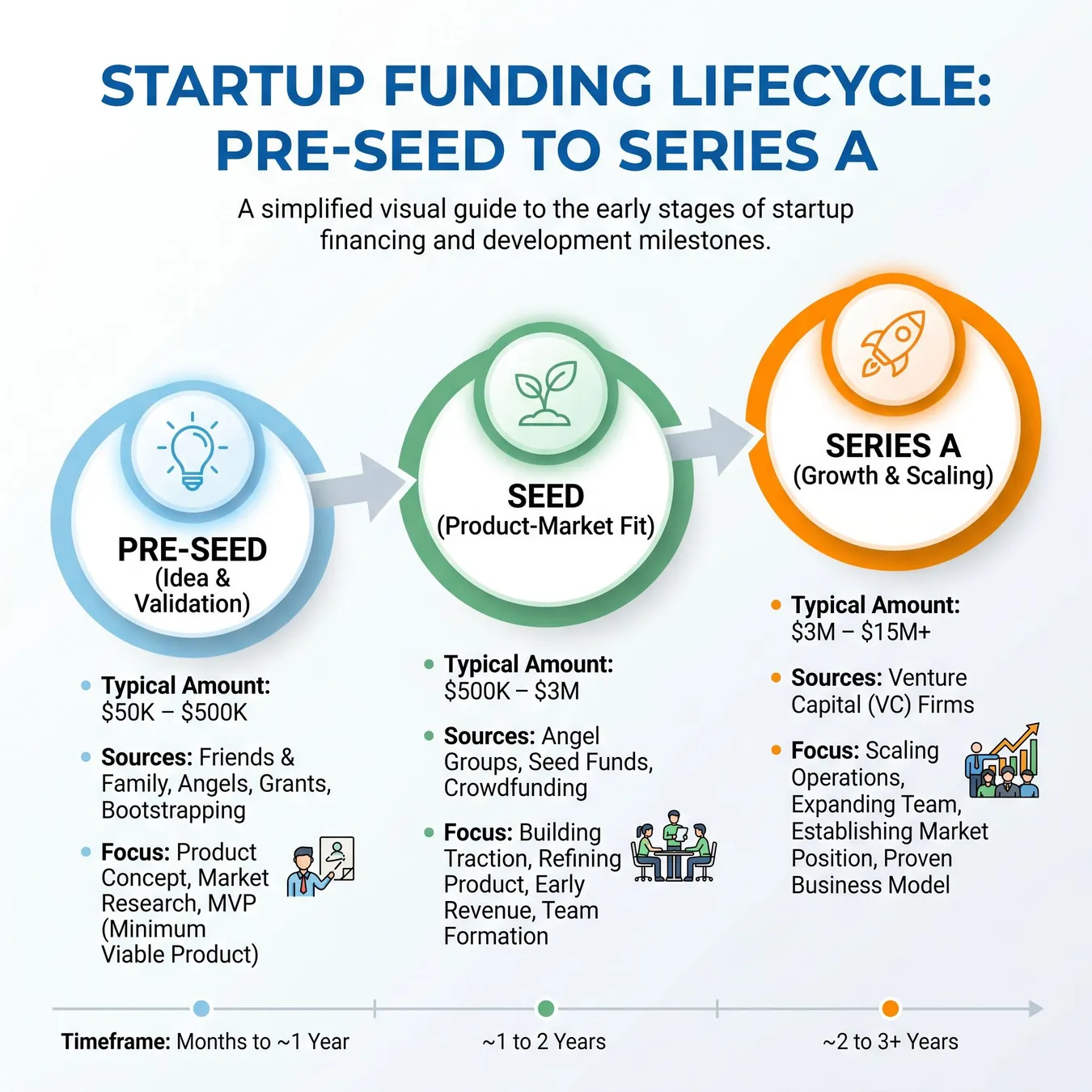
The early-stage funding journey starts with pre-seed capital.
When to Raise Pre-Seed Capital
Timing is everything. You are ready for pre-seed funding when you have moved past the 'napkin sketch' phase. Investors at this stage look for evidence of customer discovery, a clear technical roadmap, and ideally, some form of initial prototype or MVP.
Info.
// The Validation Threshold
Identifying Pre-Seed Stage Investors
Finding the right pre-seed stage investors requires looking beyond just the check. You need partners who understand the chaos of the zero-to-one phase. This group typically includes angel investors, specialized pre-seed VC firms, and startup accelerators.
- Angel Investors: High-net-worth individuals investing personal capital.
- Pre-Seed VCs: Micro-funds specifically built for the earliest stages.
- Accelerators: Programs like YC or Techstars that provide capital and mentorship.
- Family Offices: Private wealth management firms diversifying into tech.
Common Pre-Seed Funding Amounts
The pre-seed funding amount varies wildly by geography and industry. In 2026, we see rounds as small as $150,000 for lean software startups and as large as $2 million for capital-intensive AI or hardware ventures.
| Sector | Typical Range | Primary Use of Funds |
|---|---|---|
| SaaS / Web | $250k - $750k | MVP Development & Initial GTM |
| AI / Deep Tech | $500k - $1.5M | Compute Costs & R&D |
| Consumer | $100k - $500k | Community Building & Branding |
The Transition: Pre-Seed and Seed Funding
The line between pre-seed and seed funding has blurred. Generally, pre-seed gets you to a product, while seed funding is used to prove product-market fit. Understanding the nuances of the mvp stage of startup development is key to making this jump successfully.
Key Milestones for Pre-Seed Readiness
- 01
Founder-Market Fit: Demonstrating why your team is uniquely qualified.
- 02
Problem Validation: Evidence from 50+ customer interviews.
- 03
Technical Feasibility: A documented plan for how the product will be built.
- 04
Initial Traction: Waitlists, LOIs, or early beta users.
Instruments Used in Pre-Seed Rounds
Most pre-seed rounds do not use priced equity. Instead, founders use faster, cheaper instruments. It is vital to understand the different types of seed funding available to avoid messy cap tables later.
Trade-off
3 pros · 3 cons
Pros
SAFE: Fast, low legal costs, no valuation cap required.
Convertible Note: Familiar to older investors, includes interest.
Equity: Clear ownership, professional signaling.
Cons
SAFE: Can lead to unexpected dilution if not tracked.
Convertible Note: Debt on the balance sheet can be a burden.
Equity: High legal fees and complex negotiations.
How to Find Investors for Your Startup
The best way to find investors for startup growth is through warm introductions. Cold outreach rarely works unless your data is undeniable. Focus on building a network of other founders who have recently raised their pre-seed rounds.

Pre-seed pitches are often informal and relationship-driven.

Organization is the key to a successful fundraising sprint.
Preparing the Pre-Seed Pitch Deck
Your deck at this stage should be 10-12 slides. It needs to tell a story about the future. Since you likely lack revenue data, your 'Why Now' and 'Team' slides are the most important components of the presentation.
- The Problem: A specific, painful gap in the market.
- The Solution: Your unique approach to solving it.
- Market Size: Why this can be a billion-dollar company.
- The Team: Why you are the ones to win.
- The Ask: How much you need and what it will buy.
Common Mistakes in Pre-Seed Fundraising
Focus on the vision and the team's ability to execute.
Be transparent about technical risks and unknowns.
Run a tight process with a clear closing date.
Over-optimize for valuation at the cost of speed.
Hide the fact that you don't have a full product yet.
Pitch investors who only do Series A or later.
Technical Readiness for Pre-Seed
Investors are increasingly wary of 'vibe-coded' prototypes that can't scale. To secure capital in 2026, you need a technical roadmap that shows you understand infrastructure, security, and the path to a production-grade application.
Warning.
// The Prototype Trap
Legal and Administrative Setup
Before you take a single dollar, ensure your corporate hygiene is spotless. This means having a Delaware C-Corp, clear IP assignment agreements for all founders, and a clean cap table.
Incorporate as a Delaware C-Corp
IP Assignment Agreements signed
Founder vesting schedules established
Data room prepared with basic docs
Post-Funding: What Happens Next?
Once the money hits the bank, the clock starts. Your goal is to reach the milestones required for your next round within 12 to 18 months. This usually involves hiring your first engineers and launching your MVP.
01 / 04
phase 01 / 04
Month 1-2
phase 02 / 04
Month 3-6
phase 03 / 04
Month 7-12
phase 04 / 04
Month 13+
Frequently Asked Questions
Bridging the Gap to Production
Raising capital is only half the battle. The real challenge is turning that pre-seed capital into a durable, scalable product. Many startups fail because they spend their first round building a 'vibe-coded' prototype that has to be completely rewritten for their seed round.
At Studio 402, we help founders avoid this trap. We don't just build prototypes; we engineer production-ready software that survives real users and scales with your business. Whether you are preparing for your pre-seed raise or have just closed your round, we provide the technical depth you need to ship with confidence.
How Studio 402 Supports Early-Stage Founders
- MVP Development: Fast-path to a fundable, production-grade product.
- Technical Strategy: Architecture and roadmap planning for investors.
- Rescue & Refactor: Hardening AI-generated or freelancer code for scale.
- Fractional Engineering: Senior leadership without the full-time overhead.
Studio 402 took our pre-seed vision and turned it into a production-ready platform in weeks. They didn't just write code; they built the foundation for our entire company.
Sarah Chen · Fintech Founder
Ready to build your fundable MVP?
Don't waste your pre-seed capital on throwaway code. Let's build a production-ready foundation together.
Keep reading
More in Venture Capital & Seed Investment
Navigating the early-stage landscape requires a balance of financial strategy and technical execution. By securing the right pre-seed capital and building on a solid foundation, you set your startup up for long-term success.

The beginning of your startup's growth journey.
Final Thoughts on Pre-Seed Strategy
Remember that pre-seed is a means to an end, not the end itself. Use this capital to learn fast, build a core team, and create enough value to make your seed round inevitable.
Studio 402 has helped dozens of founders transition from pre-seed to seed with production-grade engineering.
Trusted by venture-backed teams across the US.
If you are ready to take the next step in your technical journey, reach out to our team. We specialize in turning early-stage ideas into durable software systems.