
Bootstrap vs Venture Capital: Choosing Your Funding Path
Deciding between a bootstrap venture capital approach is one of the most consequential choices an entrepreneur will make. This decision dictates your growth speed, your control over the product, and your ultimate exit strategy.
90%
Startups that fail within 10 years
0.05%
Startups that receive VC funding
100%
Equity retained by bootstrappers
Understanding the Fundamentals of Entrepreneur Funding
The landscape of entrepreneur funding is diverse, ranging from personal savings to institutional rounds. Before committing to a path, you must understand how each model aligns with your specific business goals and technical requirements.
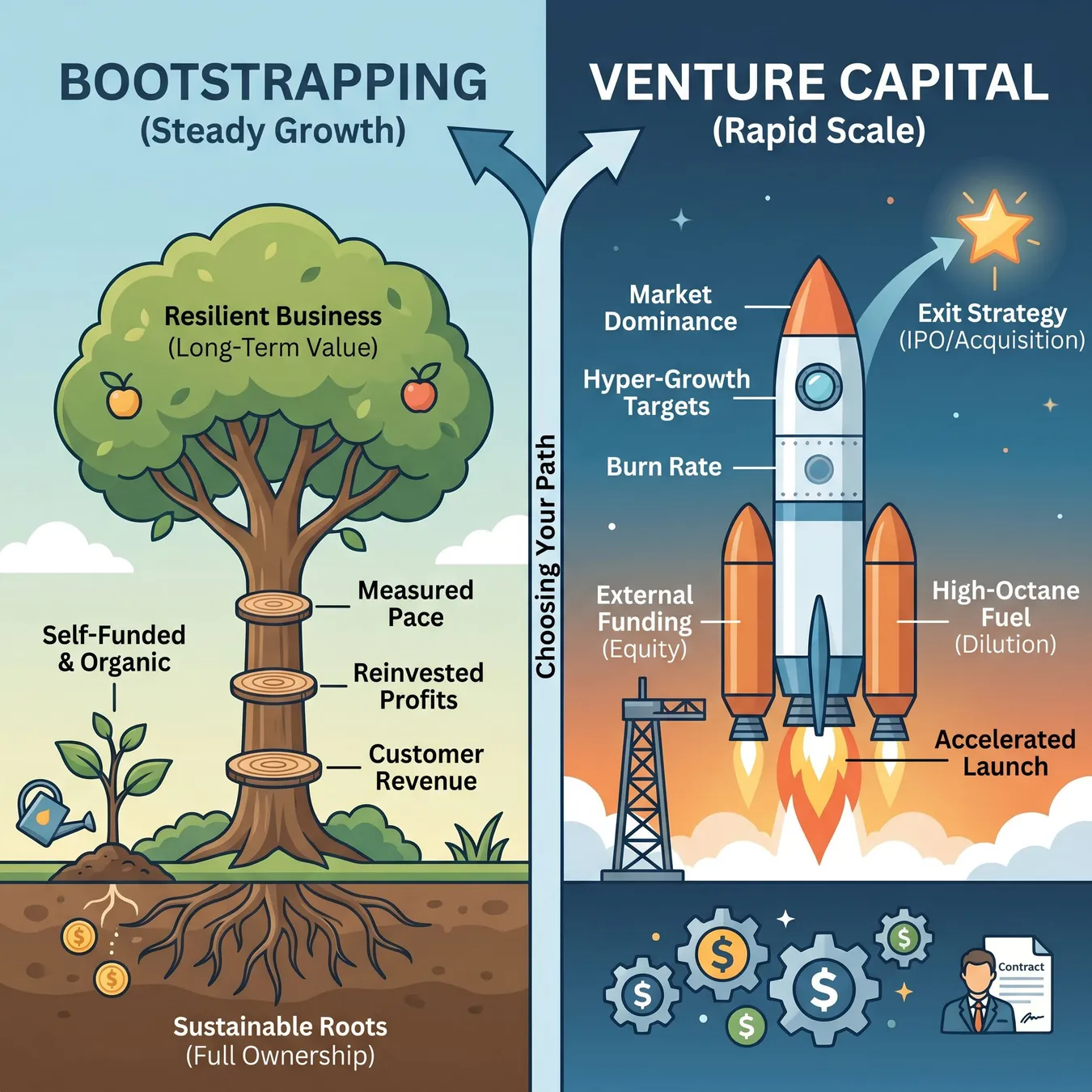
The fundamental difference between organic growth and accelerated scaling.
The Bootstrapping Path: Self-Sustaining Growth
Bootstrapping involves building your company using only personal savings and revenue from first customers. It prioritizes profitability and sustainability over raw user acquisition speed.
- Full ownership and decision-making authority
- Focus on building a product customers actually pay for
- No pressure from external board members or exit timelines
- Forced operational efficiency and lean engineering
The Venture Capital Path: High-Stakes Acceleration
Venture capital is designed for businesses with massive market potential that require significant upfront capital to capture market share quickly. It is essential to understand the venture capital business model before signing a term sheet.
Trade-off
4 pros · 4 cons
Pros
Rapid scaling and market entry
Access to high-level talent and networks
Validation from institutional investors
Capital to solve complex technical hurdles
Cons
Significant equity dilution
Loss of complete operational control
Aggressive growth targets and 'exit or bust' mentality
Increased administrative and reporting overhead
Key Differences in Product Strategy
Your funding choice directly impacts how you build. Bootstrappers often focus on high-margin niche features, while VC-backed teams focus on platform scale and network effects.
| Feature | Bootstrapping | Venture Capital |
|---|---|---|
| Development Speed | Iterative & Revenue-Linked | Aggressive & Capital-Linked |
| Tech Stack | Cost-Efficient & Proven | Scalable & Cutting-Edge |
| Hiring | Slow & Sustainable | Rapid & Specialized |
The Hybrid Approach: Starting Lean
Many founders choose to bootstrap until they reach product-market fit. This allows them to maintain a higher valuation when eventually raising seed funding for the next stage of growth.
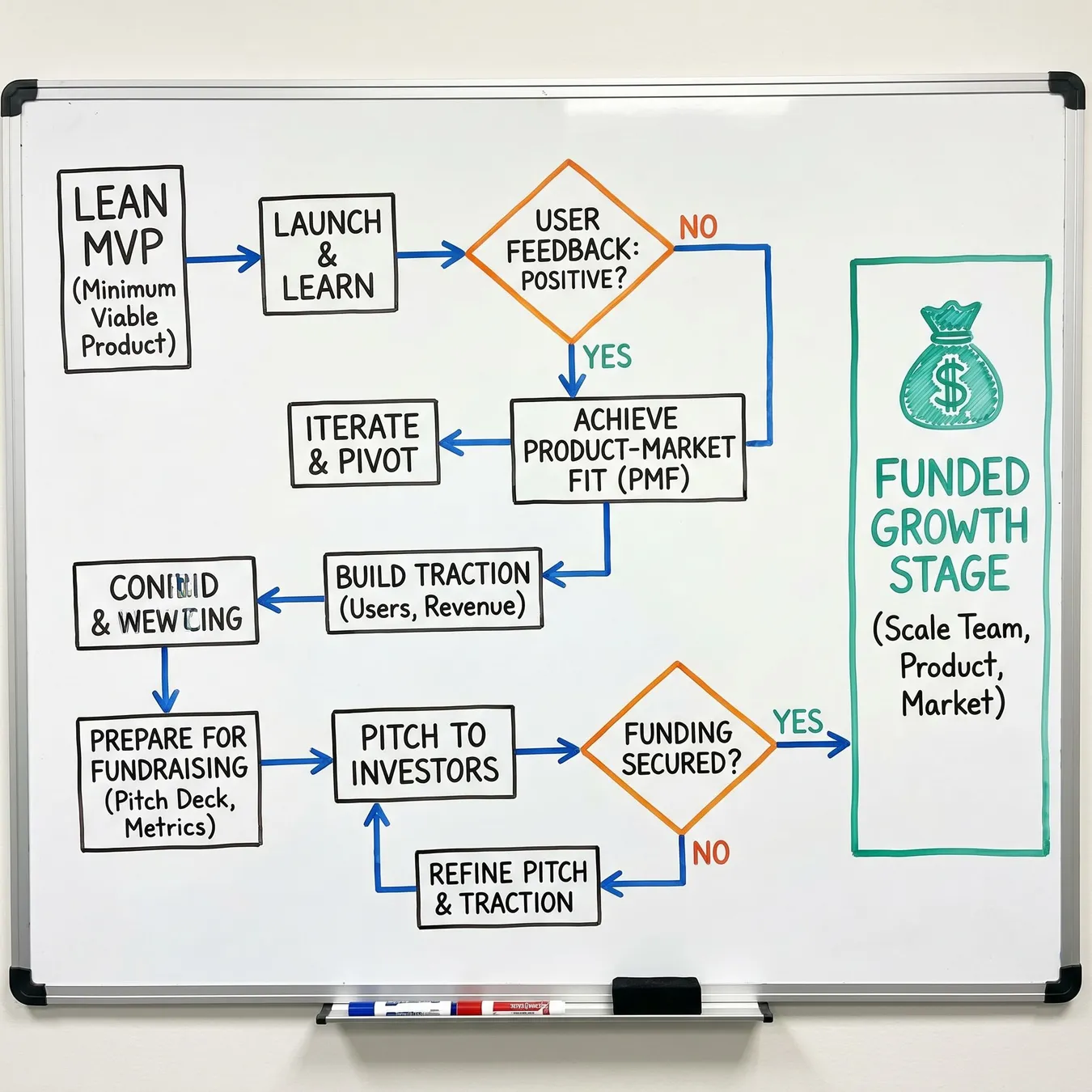
The transition from self-funding to institutional capital.
The Role of Early Stage Individual Investors
If you aren't ready for a full VC round but need more than your savings, early stage angel investors can provide a middle ground of capital and mentorship without the same pressure as a large fund.
When to Choose Bootstrapping
Bootstrapping is ideal for founders who value autonomy and are building in a market where they can reach profitability quickly without massive infrastructure costs.
You want to retain 100% ownership
Your product has high margins from day one
You are building a lifestyle or sustainable business
You have the technical skills to build the MVP yourself
When to Choose Venture Capital
Venture capital is the right choice when the window of opportunity is narrow and the cost of engineering a competitive product is high.
Raise when you have a clear growth lever
Vet investors for technical expertise
Understand your burn rate and runway
Raise capital to 'find' a product idea
Ignore the terms in favor of valuation
Underestimate the time spent on fundraising
Technical Implications of Funding
Funding changes your technical roadmap. VC-backed companies must often build for millions of users before they have thousands, while bootstrappers build only what is needed today.
Info.
// Investor Insight
The Pre-Seed Stage: Testing the Waters
For many, the journey into institutional funding starts with pre seed funding, which provides the initial runway to prove a concept and build a founding team.
Common Funding Pitfalls to Avoid
Founders often fail by choosing the wrong model for their business type. A slow-growth business will struggle under VC expectations, while a capital-intensive tech play will die without funding.
- 01
Misaligning investor expectations with founder goals
- 02
Over-hiring before reaching product-market fit
- 03
Ignoring unit economics in favor of vanity metrics
- 04
Neglecting technical debt during rapid scaling
Frequently Asked Questions
Navigating the Technical Execution Gap
Regardless of your funding path, the quality of your software determines your survival. Bootstrappers need efficient, low-maintenance systems, while VC-backed teams need infrastructure that won't break during a 10x growth spurt.

Infrastructure is the foundation of any funded or bootstrapped scale-up.
How Studio 402 Supports Your Funding Journey
At Studio 402, we understand that capital is just a tool. Whether you are self-funding a lean MVP or preparing for a major venture round, we provide the production-grade engineering needed to ensure your software is an asset, not a liability.
We help founders bridge the gap between 'vibe-coded' prototypes and scalable systems. Our team acts as a senior technical partner, helping you make stack decisions that align with your long-term capital strategy.
Our Core Capabilities for Founders
- MVP development built for real-world scale
- Post-vibe-code rescue and technical audits
- Cloud infrastructure and DevOps foundations
- AI integration and custom SaaS development
Trusted by founders from Seed to Series B.
Delivering production-ready software since 2024.
The Studio 402 Process
01 / 04
phase 01 / 04
Discovery
phase 02 / 04
Architecture
phase 03 / 04
Build & Launch
phase 04 / 04
Scale
Ready to Build Your Foundation?
Choosing a funding path is only the first step. Executing on that path requires a partner who values craftsmanship and reliability as much as you do.
Build Software That Scales With Your Ambition
Let's discuss your product roadmap and how to build a technical foundation that supports your funding goals.
Explore More Funding Insights
Keep reading
More in Venture Capital & Seed Investment
Choosing between bootstrapping and venture capital is not a one-time event but a continuous strategic alignment. Ensure your technical partner understands the nuances of both.
- Startup Strategy
- Venture Capital
- Bootstrapping
- Product Engineering
Final thought: The best funding path is the one that allows you to solve real problems for your customers while maintaining the health of your team and your cap table.

The intersection of business strategy and technical execution.
Whether you are chasing a unicorn exit or building a profitable niche leader, the code you write today is the legacy you manage tomorrow.
Studio 402 remains committed to helping founders navigate these complex waters with clarity and technical excellence.