
Continuous Delivery Maturity Model
A continuous delivery maturity model provides a structured framework for engineering teams to assess their current deployment capabilities and chart a path toward elite performance. By moving beyond ad-hoc releases, teams can achieve the high-velocity shipping cycles required for modern software competition.
- DORA Metrics
- Engineering Velocity
- DevOps Strategy
- Maturity Assessment
Standardizing your approach to delivery is critical for reducing lead time software development. High-maturity teams don't just ship faster; they ship with higher reliability and lower failure rates by automating the entire path from code commit to production.
The Five Stages of Continuous Delivery Maturity
Maturity is typically measured across five distinct levels, ranging from manual, high-risk processes to fully automated, self-healing systems. Understanding where your team sits today is the first step toward optimization.
01 / 05
phase 01 / 05
Level 1: Initial
phase 02 / 05
Level 2: Managed
phase 03 / 05
Level 3: Defined
phase 04 / 05
Level 4: Measured
phase 05 / 05
Level 5: Optimized
Key Dimensions of the Maturity Framework
To accurately assess your team, you must look beyond just the build server. A holistic maturity model evaluates culture, automation, architecture, and observability.
- Culture and Organization: Collaboration between Dev and Ops.
- Design and Architecture: Decoupled services and testability.
- Build and Deploy: Automation of the release pipeline.
- Test and Quality: Automated regression and security scanning.
- Environment and Data: Infrastructure as Code (IaC) and data management.
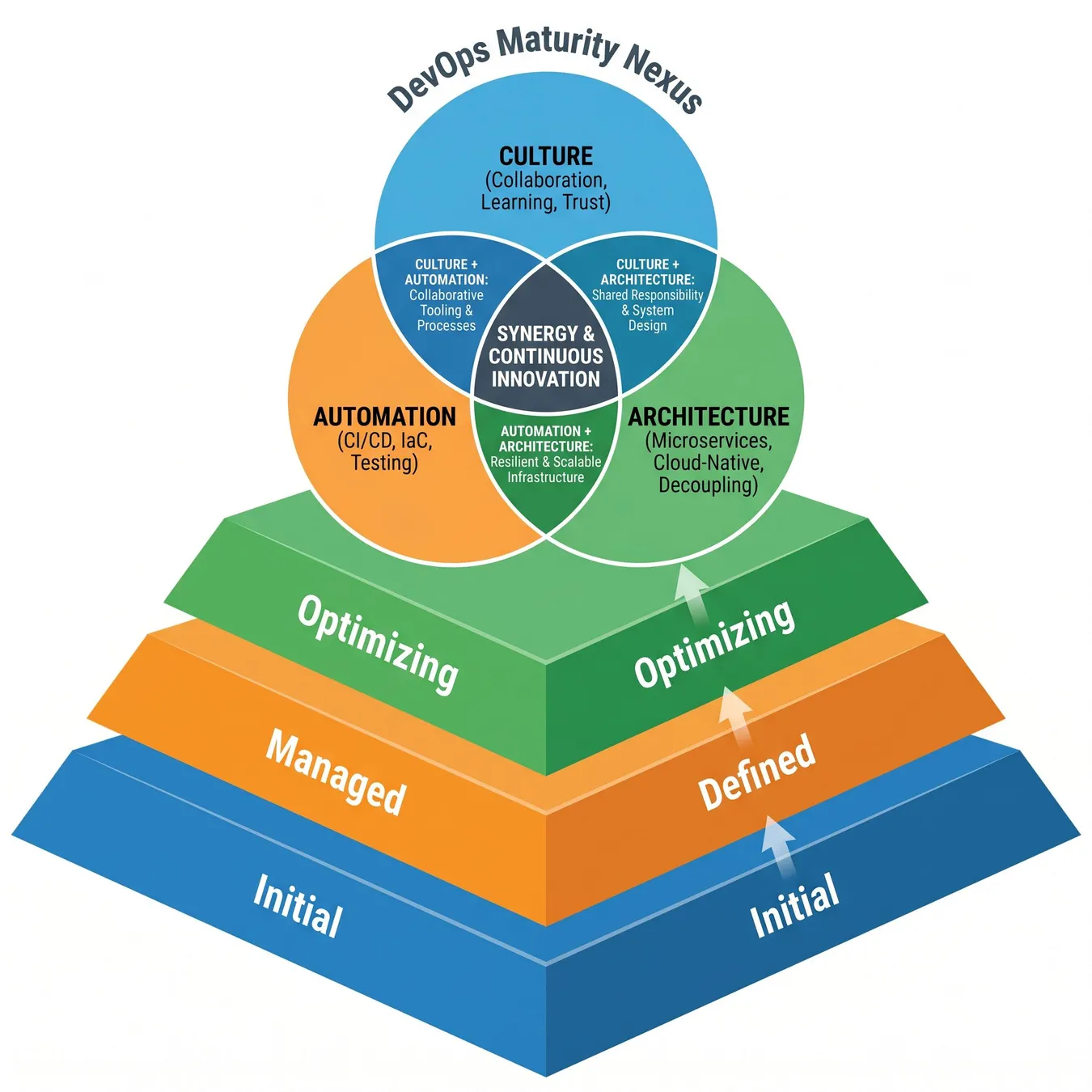
The core pillars of continuous delivery maturity.
Benchmarking Against DORA Metrics
The most effective way to quantify maturity is through software engineering performance metrics. These KPIs provide an objective view of how your delivery process impacts business outcomes.
973x
Faster deployment frequency for elite performers
6570x
Faster lead time from commit to deploy
3x
Lower change failure rate in mature teams
Common Obstacles to CD Maturity
Many teams struggle to advance because they prioritize feature output over pipeline health. This often leads to a cycle of agile and technical debt that makes automation increasingly difficult.
Automate every manual step in the pipeline.
Treat infrastructure as code from day one.
Incorporate security scanning into the CI process.
Empower developers to own their deployments.
Ignore failing tests to meet a deadline.
Perform manual configuration on production servers.
Wait for a 'release window' to ship small fixes.
Silo the QA team from the development process.
The Role of Infrastructure in Scaling Maturity
As teams grow, manual infrastructure management becomes a bottleneck. Reaching the highest levels of maturity often requires investing in cloud platform engineering to provide self-service environments.
Tip.
// Pro Tip
Maturity Assessment Checklist
Version control for all application code and config
Automated build and unit test execution
Automated deployment to staging environments
Database migrations are automated and versioned
Zero-downtime deployment (Blue/Green or Canary)
Automated rollbacks on health check failure
Comparing Maturity Levels: Before vs. After
Trade-off
4 pros · 4 cons
Pros
Multiple deployments per day
Automated testing in minutes
Zero-downtime updates
Predictable, boring releases
Cons
Monthly or quarterly releases
Manual QA cycles taking weeks
Production outages during deploys
High developer burnout and stress
How to Advance Your Maturity Score
Advancing through the levels requires a tactical approach to process improvement. Start by identifying the single biggest bottleneck in your current path to production.
- 01
Audit your current lead time and deployment frequency.
- 02
Automate the most painful manual step in your pipeline.
- 03
Implement trunk-based development to reduce merge friction.
- 04
Shift security and testing left into the CI phase.
- 05
Standardize environment configuration using IaC.
Maturity in Custom Software Development
For organizations working with external partners, choosing custom software development firms with continuous delivery pipelines is essential. A partner without CD maturity will inevitably slow down your time-to-market and introduce operational risk.
Moving to a continuous delivery model didn't just speed us up; it changed the culture. We stopped fearing Fridays and started focusing on features.
Engineering Lead · SaaS Platform
Frequently Asked Questions
Bridging Maturity to Business Outcomes
At Studio 402, we don't just build software; we build the systems that deliver it. We understand that engineering velocity is a byproduct of a mature, automated delivery pipeline.
Whether you are looking to rescue a fragile prototype or build a new SaaS platform from scratch, our team implements the maturity frameworks discussed here to ensure your product is production-ready on day one.
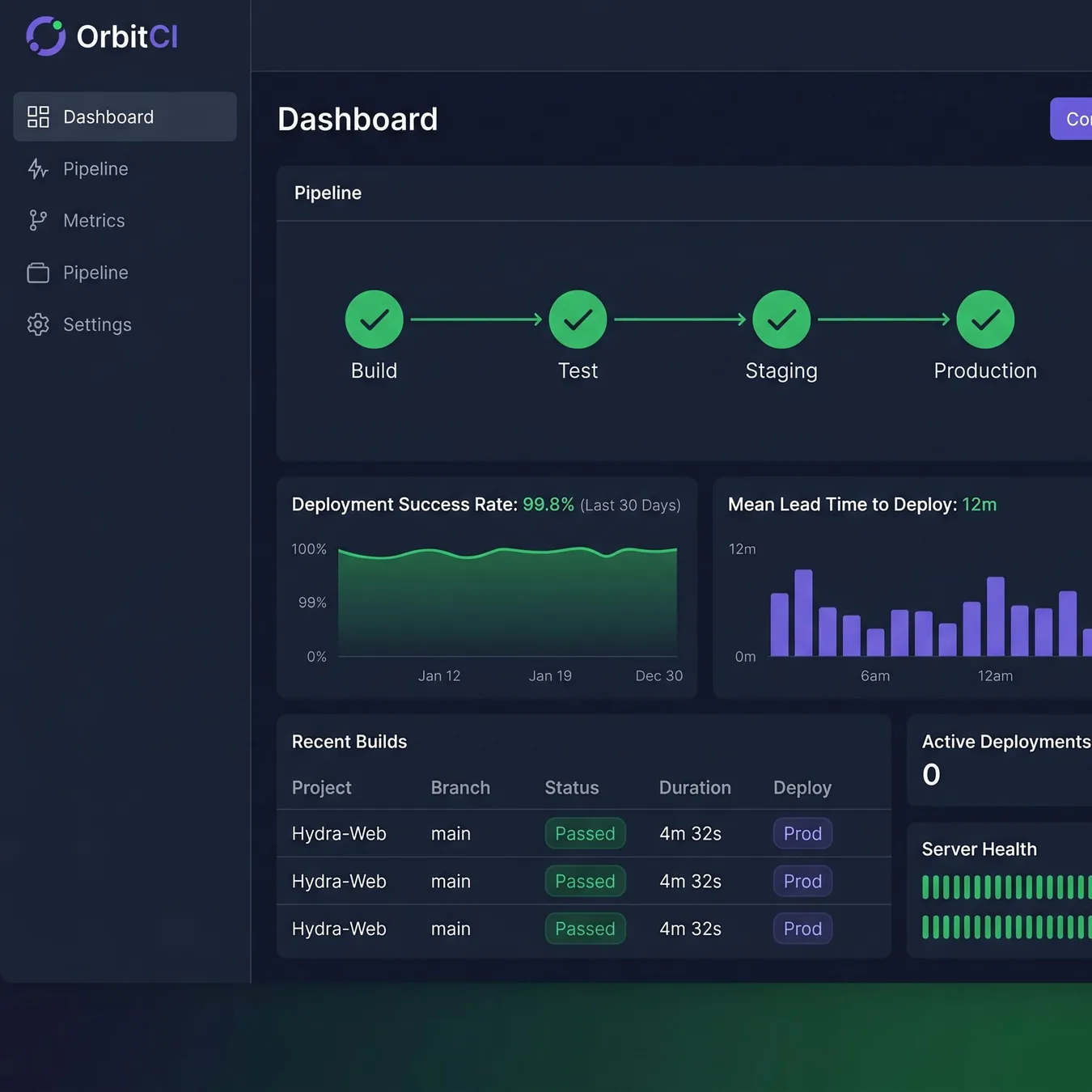
Real-time visibility into delivery health.
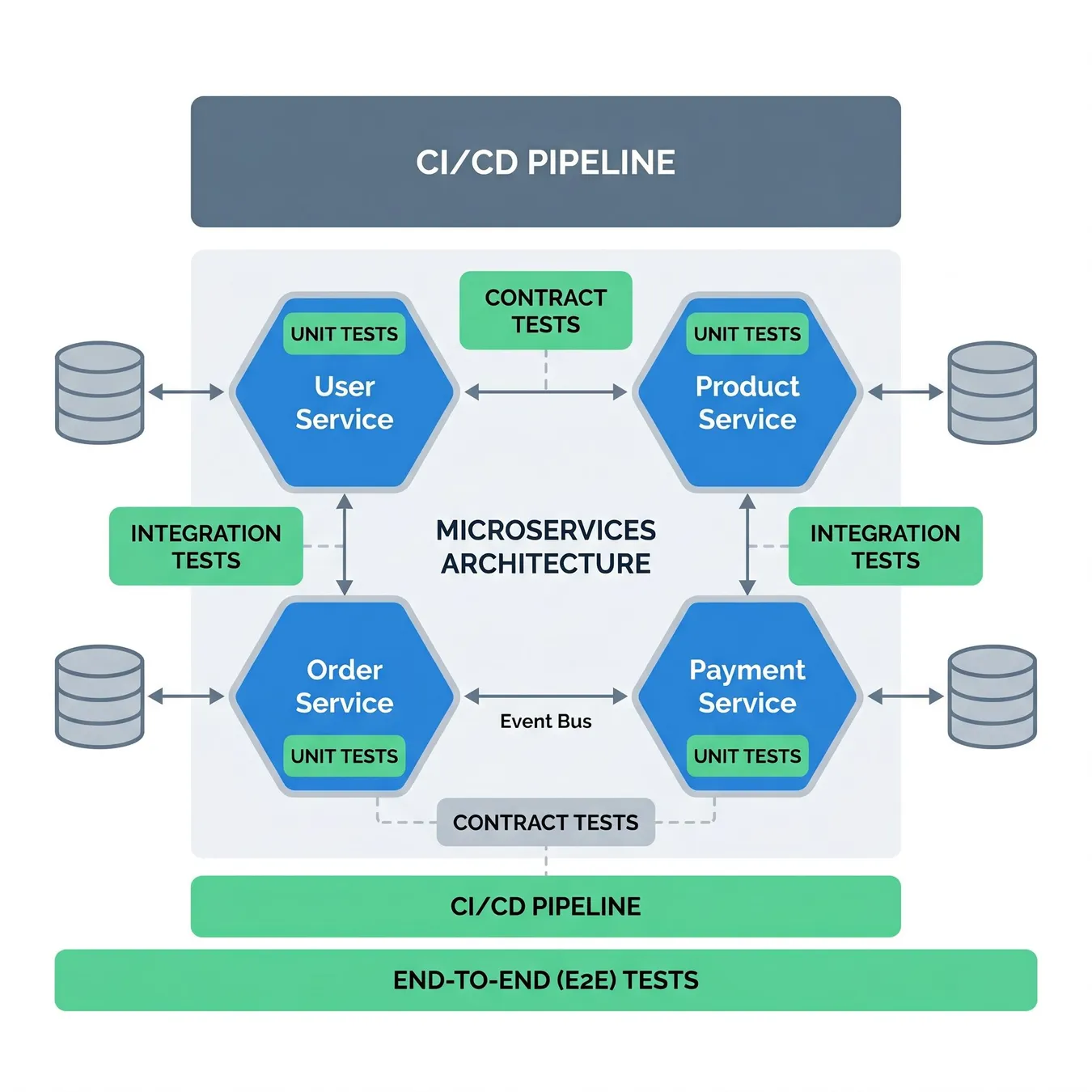
Architecting for continuous delivery.
Next Steps for Your Engineering Team
Ready to evolve your delivery capabilities? Explore our related guides on process optimization and identifying bottlenecks to start your journey toward elite performance.
Build Your High-Velocity Engineering Foundation
Need to harden your delivery pipeline or build a scale-ready product? Let's discuss your engineering roadmap.
Data-Driven Delivery
| Metric | Low Maturity | Elite Maturity |
|---|---|---|
| Deploy Frequency | Monthly | On-demand |
| Lead Time | 1-6 Months | < 1 Hour |
| MTTR | Days | < 1 Hour |
| Failure Rate | 46-60% | 0-15% |
Achieving these elite numbers requires more than just tools; it requires a commitment to engineering excellence and a partner who understands the nuances of production-grade software.
Helping growth-stage teams achieve 10x deployment frequency.
Studio 402 Engineering Standards
The Impact of Automated Testing
Automated testing is the safety net that allows for high velocity. Without it, every deployment is a gamble. A mature model integrates unit, integration, and end-to-end tests into the deployment gate.
Observability as a Maturity Signal
You cannot improve what you cannot measure. Mature teams use advanced observability to detect issues before customers do, enabling the 'Measured' and 'Optimized' stages of the model.
Culture: The Final Frontier
The hardest part of the maturity model isn't the code—it's the people. Moving to a blameless culture where failures are treated as learning opportunities is essential for Level 5 maturity.
By following this framework, engineering leaders can transform their departments from cost centers into high-speed innovation engines.
Keep reading
More in Engineering Velocity & Metrics
Studio 402 provides the technical consulting and execution power to move your team up the maturity curve. From infrastructure audits to full-scale product builds, we ensure your engineering velocity is built on a foundation of reliability.
Contact us today to learn how we can help you implement a continuous delivery maturity model tailored to your specific business goals.