
How to Calculate and Manage Scrum Team Capacity
Understanding how to calculate velocity and capacity in scrum is the foundation of predictable delivery. While velocity looks at what was done in the past, capacity focuses on the actual time available for the upcoming sprint.
- Engineering Leadership
- Agile Planning
- Sprint Predictability
- Scrum Metrics
What is Capacity in Scrum?
Capacity in scrum represents the total amount of time a team has available to work on sprint backlog items. It accounts for the human reality of the workplace, including meetings, holidays, and administrative tasks.
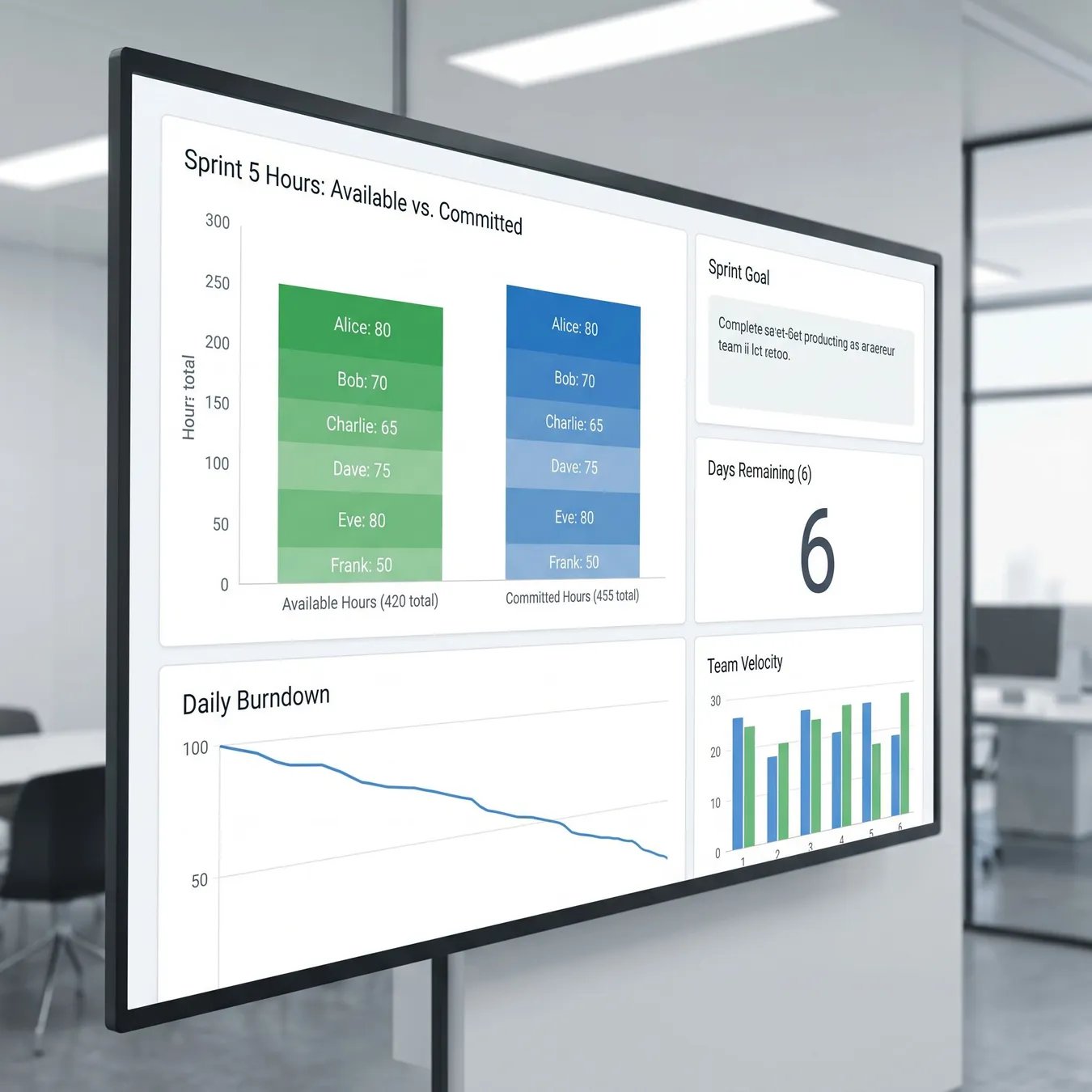
Visualizing team availability is the first step in effective scrum capacity planning.
How to Calculate Scrum Team Capacity
To calculate capacity in scrum, you must determine the total available hours for every team member. This requires looking at the sprint duration and subtracting non-development time.
- 01
Identify the total number of working days in the sprint.
- 02
List every team member and their daily working hours.
- 03
Subtract planned time off, holidays, and company events.
- 04
Deduct 'overhead' time for scrum ceremonies (daily standups, retro).
- 05
Apply a focus factor to account for context switching.
The Formula for Scrum Capacity Planning
A standard formula helps engineering leaders maintain consistency. Start with the gross hours and work down to the net available hours for the sprint.
Info.
// The Capacity Formula
Accounting for Focus Factor and Overhead
No developer is 100% productive for 8 hours a day. Most high-performing teams use a focus factor between 0.6 and 0.8 to ensure realistic commitments.
70%
Average Focus Factor
10-15%
Ceremony Overhead
25%
Predictability Gain
Velocity vs Capacity: Knowing the Difference
Velocity is a historical average of story points completed. Capacity is a forward-looking measure of available hours. You need both for velocity and capacity planning in scrum to be effective.
Trade-off
3 pros · 3 cons
Pros
Capacity: Accounts for real-time availability
Capacity: Highlights individual bottlenecks
Capacity: Prevents over-commitment
Cons
Velocity: Ignores upcoming vacations
Velocity: Doesn't account for new hires
Velocity: Can be skewed by 'point inflation'
Managing Capacity During Team Growth
When scaling software engineering teams, capacity often dips temporarily due to onboarding and mentorship requirements. Leaders must factor in this 'onboarding tax'.
Common Capacity Killers to Watch For
If your team consistently misses sprint goals despite careful planning, you may need to identify bottlenecks in the workflow that are siphoning off productive hours.
- Unplanned 'emergency' bugs
- Excessive cross-departmental meetings
- Context switching between multiple projects
- Vague requirements leading to rework
- Technical debt slowing down new features
Factoring in Technical Debt
One of the most overlooked aspects of scrum team capacity planning is the time required for managing technical debt. High debt levels act as a tax on every hour worked.
Step-by-Step Sprint Capacity Workflow
01 / 05
phase 01 / 05
Calendar Audit
phase 02 / 05
Individual Input
phase 03 / 05
Aggregation
phase 04 / 05
Buffer Application
phase 05 / 05
Final Commitment
Capacity Calculation Example
| Factor | Calculation | Total Hours |
|---|---|---|
| Gross Hours | 5 devs x 10 days x 8 hrs | 400 |
| Ceremonies | 15 hrs per dev | -75 |
| PTO/Holidays | 1 dev off for 2 days | -16 |
| Net Capacity | 309 hrs x 0.7 focus | 216.3 |
Best Practices for Engineering Leaders
Use a consistent focus factor across sprints
Track 'actual vs planned' capacity to improve accuracy
Include QA and Design in the capacity model
Protect the team from mid-sprint scope creep
Plan for 100% utilization (burnout risk)
Ignore historical velocity trends
Forget to account for interview time during hiring
Use capacity as a performance stick
Tools for Tracking Scrum Capacity
While spreadsheets are a common starting point, modern engineering teams often use integrated tools to automate the calculation of scrum team capacity.
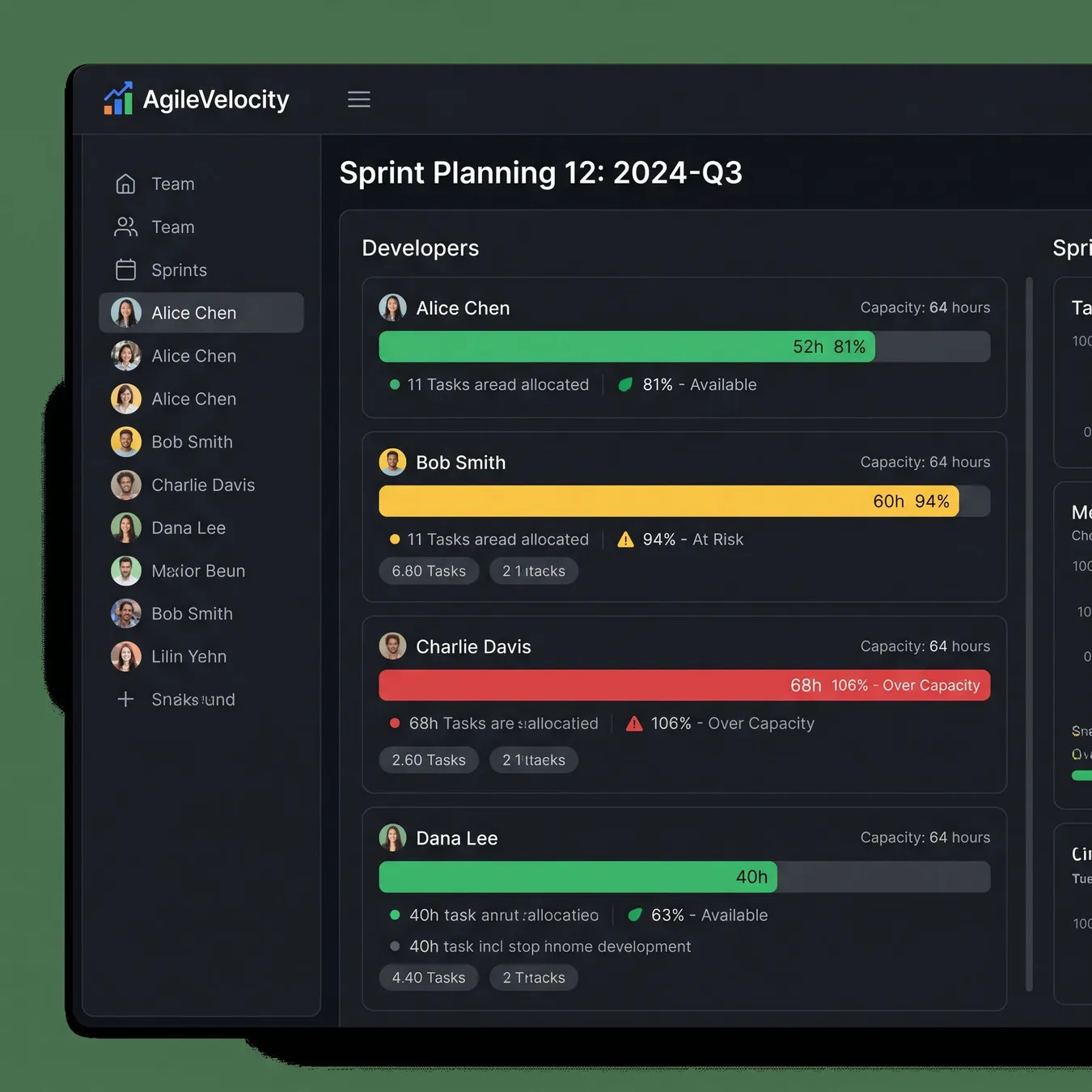
Modern tools visualize individual load.

Burn-down charts reflect capacity reality.
The Impact of Capacity on Burnout
Over-estimating capacity leads to a 'hero culture' where developers work overtime to meet impossible goals. Consistent capacity management is a key tool for long-term retention.
Predictability isn't about working harder; it's about knowing exactly how much space you have to work effectively.
Alex Rivera · VP of Engineering
Frequently Asked Questions
Improving Your Planning Accuracy
Once you have the basics down, the next step is refining your process. This involves looking at how your team handles unplanned work and refining your focus factor over time.
Review last sprint's actual hours worked
Adjust focus factor based on historical data
Audit recurring meetings for relevance
Standardize story point estimation
Bridging Metrics to Execution
Calculating capacity is a tactical necessity, but it's only one part of a high-velocity engineering culture. At Studio 402, we help teams move beyond simple metrics to build durable systems.
If your team is struggling with unpredictable shipping cycles or technical debt that eats your capacity, our engineering leadership advisory can help you stabilize and scale.
Helping growth-stage teams increase sprint predictability by 40%.
Based on 2026 engineering audit data.
Build a High-Velocity Engineering Team
Need to stabilize your engineering velocity? Let's discuss how to build a more predictable delivery engine for your product.
Deepen Your Engineering Knowledge
Keep reading
More in Engineering Velocity & Metrics
Effective capacity management is just one component of a broader set of software engineering metrics that drive high-performing teams.
By mastering these calculations, leaders can ensure their teams remain focused on shipping value rather than fighting fires.
For more detailed frameworks on delivery management and scaling, explore our full library of engineering leadership guides.
Studio 402 remains committed to helping founders and engineering leaders build software that survives the real world.
Contact us today at studio@402.studio to learn more about our product engineering and advisory services.