
A Roadmap for Monolithic to Microservices Migration
Transitioning from a brittle monolith to a distributed architecture is a high-stakes engineering challenge. This monolithic to microservices roadmap provides a strategic path to decoupling services without disrupting your business operations.
70%
Reduction in deployment lead time
99.99%
Target availability for distributed systems
4x
Increase in engineering velocity
Phase 1: Assessment and Readiness
Before you begin to convert monolith to microservices, you must evaluate your current system's health and organizational readiness. Not every monolith needs to be broken apart immediately.
Identify bounded contexts within the existing codebase
Audit existing CI/CD pipelines and deployment frequency
Map all external third-party dependencies
Assess team familiarity with distributed systems
Defining Your Migration Strategy
A successful legacy system migration strategy requires choosing between a total rewrite or an incremental refactor. We typically recommend the incremental approach to minimize risk.
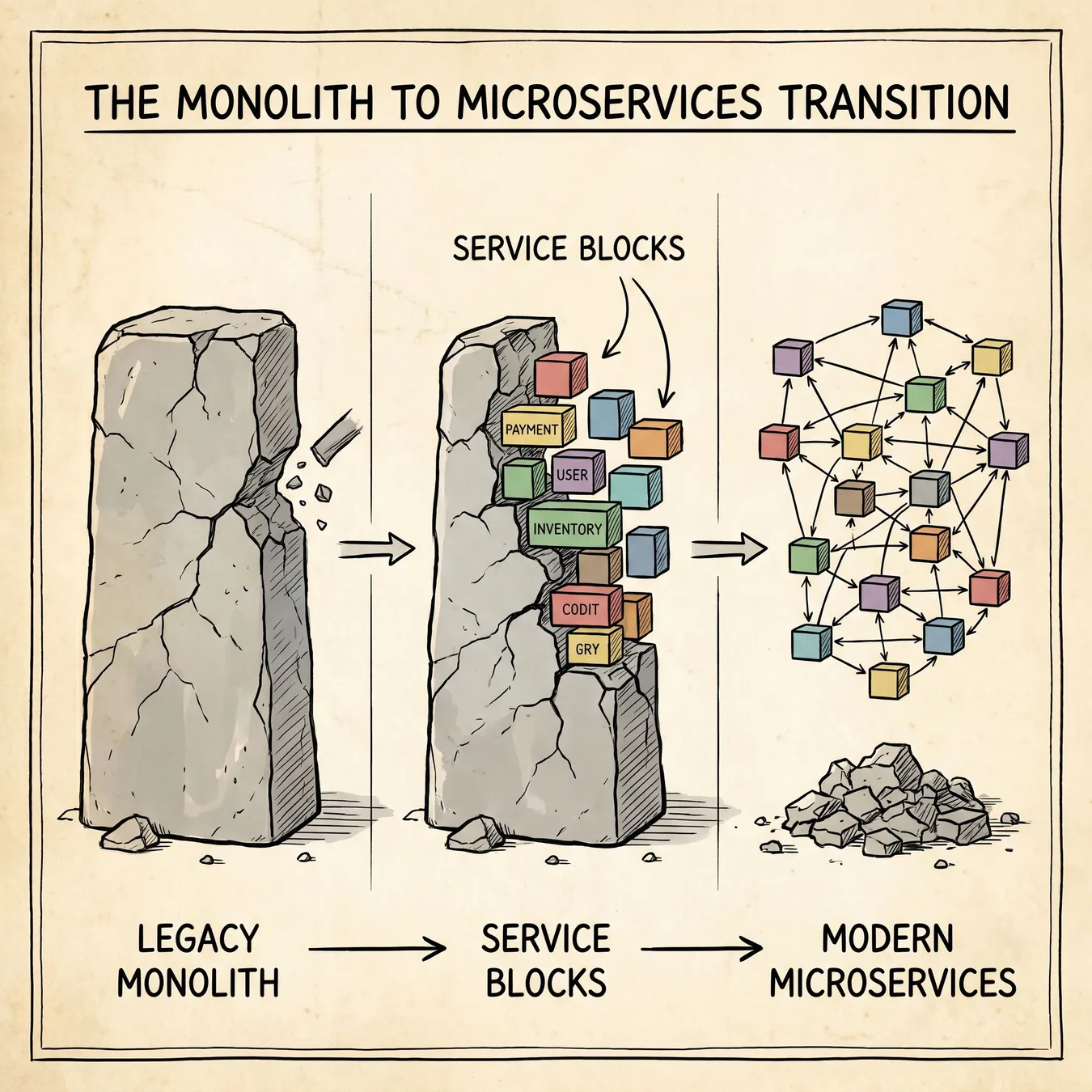
The Strangler Fig pattern in action: incremental replacement of legacy logic.
Phase 2: Decoupling the Data Layer
The hardest part of any migration is the data. You must plan for data migration from legacy system schemas to service-specific databases to ensure true independence.
Warning.
// Data Integrity Warning
| Strategy | Complexity | Risk Level |
|---|---|---|
| Shared Database | Low | High |
| Database per Service | High | Low |
| API Composition | Medium | Medium |
Phase 3: Infrastructure and Cloud Foundations
Moving to microservices often involves a shift to the cloud. Many teams find success by monolithic to microservices aws implementations using ECS or EKS.
- Containerization with Docker
- Orchestration with Kubernetes
- Service Mesh for inter-service communication
- Centralized logging and observability
Establishing Observability
In a distributed system, you cannot debug with local logs. You need distributed tracing to follow requests across service boundaries.

Observability is the lifeline of a healthy microservices ecosystem.
Phase 4: The Strangler Fig Execution
01 / 04
phase 01 / 04
Identify a 'Seam'
phase 02 / 04
Build the New Service
phase 03 / 04
Implement the Proxy
phase 04 / 04
Decommission
Managing Inter-Service Communication
Decide between synchronous REST/gRPC calls and asynchronous event-driven patterns using message brokers like RabbitMQ or Kafka.
Trade-off
3 pros · 3 cons
Pros
Independent scaling
Technology flexibility
Fault isolation
Cons
Operational complexity
Network latency
Data consistency challenges
Phase 5: Organizational Shift
Microservices are as much about people as they are about code. You must move toward 'Two-Pizza Teams' that own a service from development to production.
Organizations which design systems are constrained to produce designs which are copies of the communication structures of these organizations.
Melvin Conway · Computer Scientist
DevOps Culture Integration
Automated testing and CI/CD are non-negotiable. Without them, the overhead of managing dozens of services will crush your engineering velocity.
Common Migration Pitfalls
Start with a small, non-critical service
Invest heavily in CI/CD automation
Prioritize observability from day one
Try to migrate everything at once
Share databases between services
Ignore the cultural impact on the team
Frequently Asked Questions
The Studio 402 Approach to Modernization
At Studio 402, we don't just recommend architectures; we build them. We help growth-stage companies navigate the complexities of distributed systems by providing senior engineering leadership and execution.

Studio 402 partners with your team to ship production-ready distributed systems.
Whether you are dealing with a brittle legacy system or a prototype that has hit its scaling limit, our team specializes in stabilizing, refactoring, and evolving your codebase for the long term.
Why Partner With Us?
- Senior-level architecture review and planning
- Hands-on execution of the Strangler Fig pattern
- Cloud infrastructure and DevOps setup
- Post-migration support and performance tuning
Trusted by Series B startups to scale their core infrastructure.
Studio 402 has successfully migrated over 15 complex monoliths since 2024.
Next Steps for Your Architecture
A roadmap is only as good as its execution. If you're ready to move beyond the theory and start decoupling your systems, let's discuss your specific challenges.
Scale Your Engineering Velocity
Stop fighting your monolith and start shipping faster. Let's build a scalable, distributed future for your product.
Deep Dives and Resources
Related Architectural Concepts
Understanding the fundamental differences between architectural styles is key to making the right decision for your business.
- Microservices
- Monolith
- Serverless
- Event-Driven
- Cloud-Native
Keep reading
More in Modernization & Rescue
Modernizing legacy systems is a continuous journey. By following a structured roadmap, you can reduce technical debt and unlock the potential of your engineering team.
Final Thoughts on Migration
The transition to microservices is not just a technical upgrade; it is a strategic investment in your company's ability to innovate and scale in a competitive market.
For more information on how we handle complex software rescues and modernization projects, explore our full suite of services.
Studio 402 took our tangled monolith and helped us extract our core billing logic into a robust microservice. Our deployment speed tripled in three months.
Ready to begin? Our team is standing by to help you audit your current codebase and build a custom roadmap for your transition.
Contact Studio 402
Reach out to us at studio@402.studio to schedule a technical discovery session.