
Overview
Scaling Cloud Architecture for High-Traffic Platforms
Master the principles of dynamic scalability architecture and capacity planning to ensure your infrastructure thrives under massive user load.

Scalable Cloud Architecture for High-Traffic Platforms
Designing a scalable cloud architecture is no longer just about adding more servers; it is about creating a system that responds fluidly to demand. As platforms grow, the complexity of managing traffic spikes requires a shift toward dynamic scalability architecture that automates resource allocation.
99.99%
Uptime Target
<200ms
Latency Goal
10x
Traffic Burst Capacity
The Fundamentals of Scaling a Cloud Infrastructure
When scaling a cloud infrastructure, engineers must choose between vertical and horizontal scaling. While vertical scaling increases the power of a single machine, horizontal scaling adds more machines to the pool, which is essential for designing scalable systems that remain resilient during outages.
- Horizontal Scaling: Adding more instances to distribute load.
- Vertical Scaling: Increasing CPU or RAM on existing instances.
- Statelessness: Ensuring application servers don't store local session data.
- Database Sharding: Partitioning data across multiple database instances.
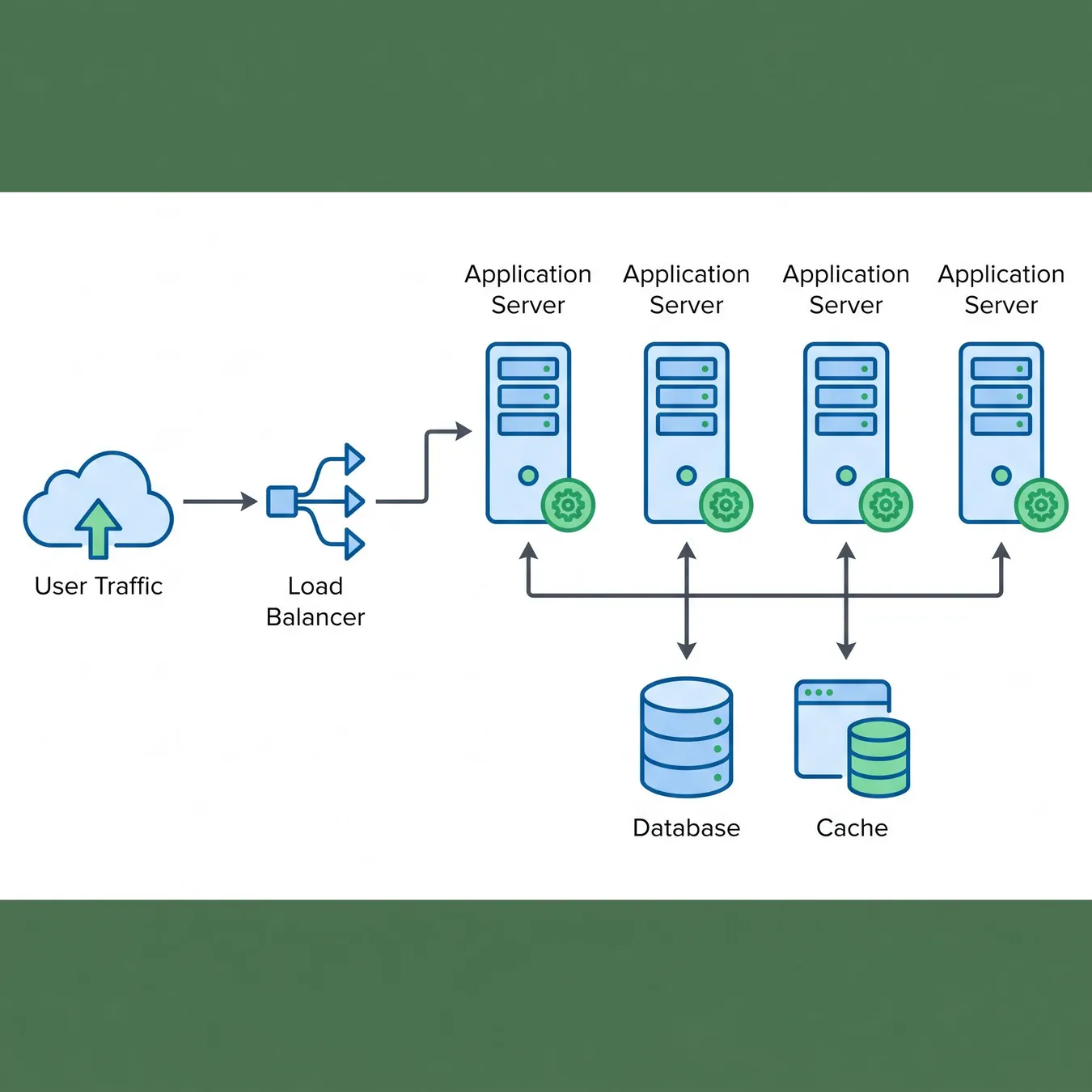
Horizontal scaling vs. vertical scaling patterns.
Proactive Capacity Planning for Growth
The need for capacity planning arises long before a traffic spike occurs. By analyzing historical data and growth projections, teams can determine the baseline resources required to maintain performance without over-provisioning and wasting budget.
Info.
// Capacity vs. Demand
Implementing Availability Monitoring
Effective availability monitoring goes beyond simple 'up or down' checks. It involves tracking latency, error rates, and system saturation to identify bottlenecks before they impact the end-user experience.
Set up synthetic transaction monitoring
Configure real-user monitoring (RUM)
Establish multi-region health checks
Define alerting thresholds for P99 latency
Leveraging AWS for High-Traffic Scale
For many enterprises, aws cloud devops practices provide the most robust toolset for managing global traffic. Services like Auto Scaling groups and Elastic Load Balancing are foundational for maintaining high availability.

Configuring Auto Scaling for traffic bursts.
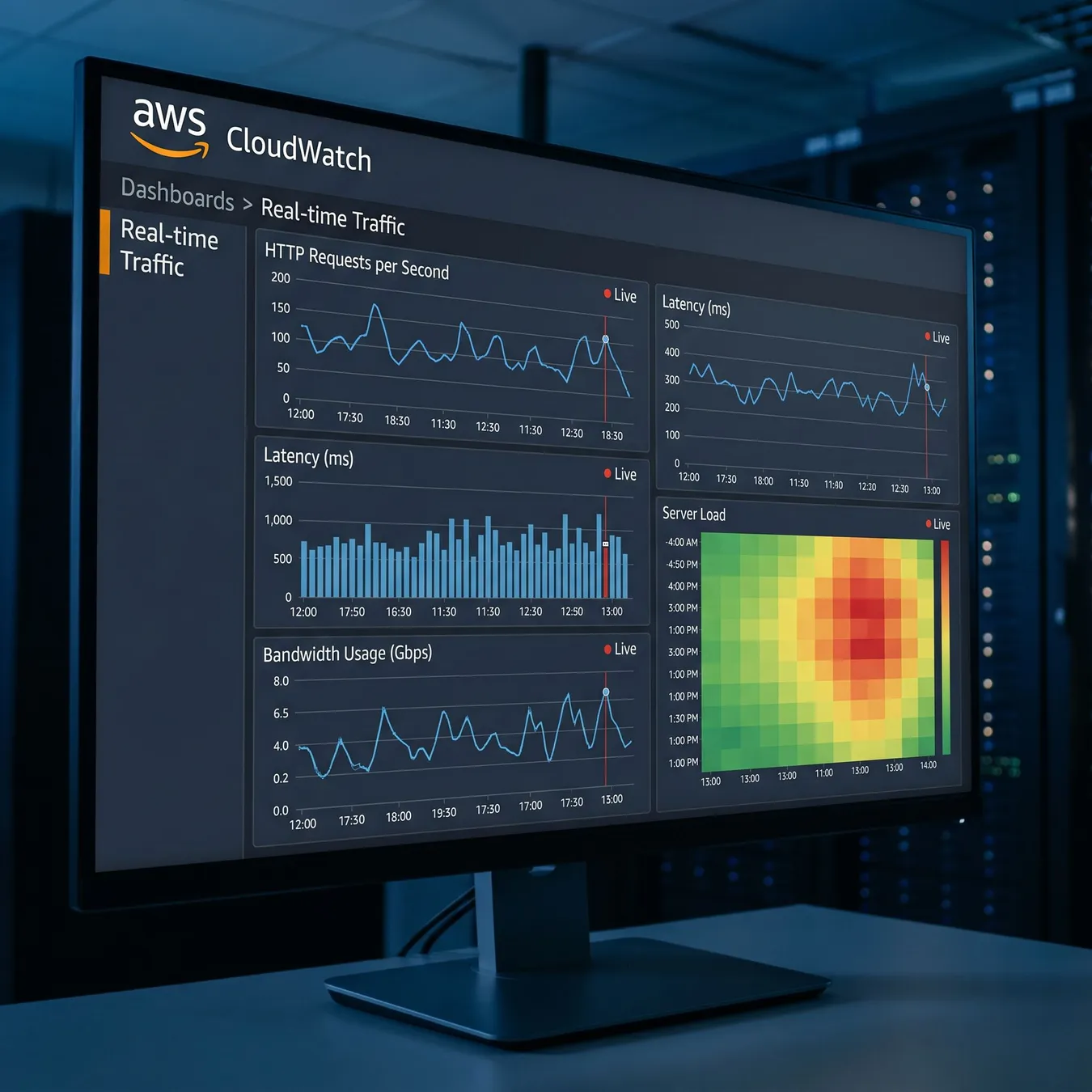
Monitoring infrastructure health in real-time.
Automation: The Key to Reliable Scaling
Manual scaling is prone to human error and slow response times. Modern teams utilize infrastructure deployment automation to ensure that environment changes are versioned, tested, and deployed consistently across all regions.
Infrastructure as Code (IaC)
Tools like Terraform and Pulumi allow architects to define their entire cloud environment in code. This makes scaling to a new region as simple as updating a configuration file and running a pipeline.
Data Layer Scaling Strategies
The database is often the hardest component to scale. While application servers are easily replicated, data consistency requirements often create bottlenecks that require advanced architectural patterns.
| Strategy | Best For | Complexity |
|---|---|---|
| Read Replicas | Read-heavy workloads | Low |
| Caching (Redis) | Frequent queries | Medium |
| Sharding | Massive datasets | High |
Common Scaling Anti-Patterns to Avoid
Use CDNs to offload static asset traffic.
Implement circuit breakers for failing services.
Automate database backups and failover tests.
Hardcode IP addresses or resource limits.
Scale based on CPU usage alone without testing.
Ignore the costs of cross-region data transfer.
The Role of Content Delivery Networks (CDNs)
A CDN is the first line of defense against high traffic. By caching content at the edge, closer to the user, you reduce the load on your origin servers and significantly improve page load times globally.
Testing for Scale: Load and Stress Testing
You don't know if your architecture scales until you break it. Regular load testing simulates expected traffic, while stress testing pushes the system to its breaking point to identify the first point of failure.
- 01
Define your baseline performance metrics.
- 02
Create realistic user scenarios and traffic patterns.
- 03
Gradually increase load to identify the 'knee' in the performance curve.
- 04
Analyze logs and monitoring data to find bottlenecks.
- 05
Refactor architecture and repeat the test.
Microservices vs. Monoliths for Scale
Microservices allow you to scale specific parts of your application independently. If your image processing service is under heavy load, you can scale just that service without touching the rest of the platform.
Cost Optimization in Scalable Systems
Scaling shouldn't mean an infinite bill. Implementing spot instances, reserved capacity, and automated shutdown of dev environments are critical for maintaining a healthy bottom line while growing.
Security at Scale
As your infrastructure footprint grows, so does your attack surface. Automated security scanning and identity management must be integrated into your scaling workflows to ensure protection.
Evaluating Your Current Infrastructure
If you are already experiencing performance issues, a software scalability audit can pinpoint exactly where your current architecture is failing and provide a roadmap for remediation.
Bridging to Production-Ready Infrastructure
At Studio 402, we don't just build prototypes; we engineer execution infrastructure designed for the real world. Whether you are launching a new SaaS platform or rescuing a system that is buckling under load, we provide the senior engineering depth needed to scale.
Studio 402 rebuilt our entire cloud foundation in six weeks. We went from daily outages during peak hours to a self-healing system that handles 5x the traffic with lower costs.
Frequently Asked Questions
Our Scaling Process
01 / 05
phase 01 / 05
Audit & Discovery
phase 02 / 05
Architecture Design
phase 03 / 05
Infrastructure as Code
phase 04 / 05
Load Testing & Hardening
phase 05 / 05
Launch & Support
Take the Next Step Toward Scale
Scaling a high-traffic platform is a continuous journey of optimization. Don't wait for your next outage to realize your infrastructure isn't ready for the load. Let's build a foundation that grows with your business.
Ready to Scale Your Infrastructure?
Stop fighting fires and start building for growth. Contact Studio 402 today to discuss your cloud architecture needs.
Keep reading
More in Cloud & DevOps Engineering
Advanced Scaling Techniques
Beyond the basics, advanced scaling involves predictive scaling using machine learning to anticipate traffic spikes before they happen. This proactive approach ensures zero-latency impact during sudden viral events.
Global Traffic Management
For platforms with a worldwide user base, latency is the enemy. Deploying resources across multiple geographic regions and using Anycast DNS ensures that users are always connected to the nearest healthy node.
Serverless and Scale
Serverless architectures like AWS Lambda offer 'infinite' scale without managing servers. While not suitable for every workload, they are perfect for event-driven tasks and unpredictable traffic patterns.
The Human Element of Scaling
Scaling isn't just a technical challenge; it's an organizational one. As your infrastructure grows, your team needs clear runbooks, incident response plans, and a culture of observability to stay ahead of complexity.
Conclusion: Building for the Future
A truly scalable cloud architecture is a competitive advantage. It allows you to say yes to new opportunities, handle unexpected growth, and provide a seamless experience for every user, every time.
Trusted by growth-stage startups to manage millions of requests daily.
Studio 402 Engineering Standards 2026
- Cloud Architecture
- DevOps
- Scalability
- AWS
- High Availability