
DevOps on Google Cloud Platform
Implementing devops on google cloud platform requires a strategic blend of automation, observability, and managed services to achieve production-ready scale. By leveraging Google's native tools like GKE and Cloud Build, teams can accelerate delivery while maintaining high reliability.
- GCP DevOps
- Cloud Migration
- GKE Management
- CI/CD Pipelines
Core Pillars of GCP DevOps Engineering
Successful GCP environments are built on infrastructure deployment automation to ensure consistency across staging and production. This approach eliminates manual configuration errors and allows for rapid, repeatable environment provisioning.
- Infrastructure as Code (IaC) using Terraform or Google Cloud Deployment Manager
- Automated CI/CD pipelines with Cloud Build and Artifact Registry
- Container orchestration via Google Kubernetes Engine (GKE)
- Centralized logging and monitoring through Cloud Operations Suite
- Identity and Access Management (IAM) for granular security control
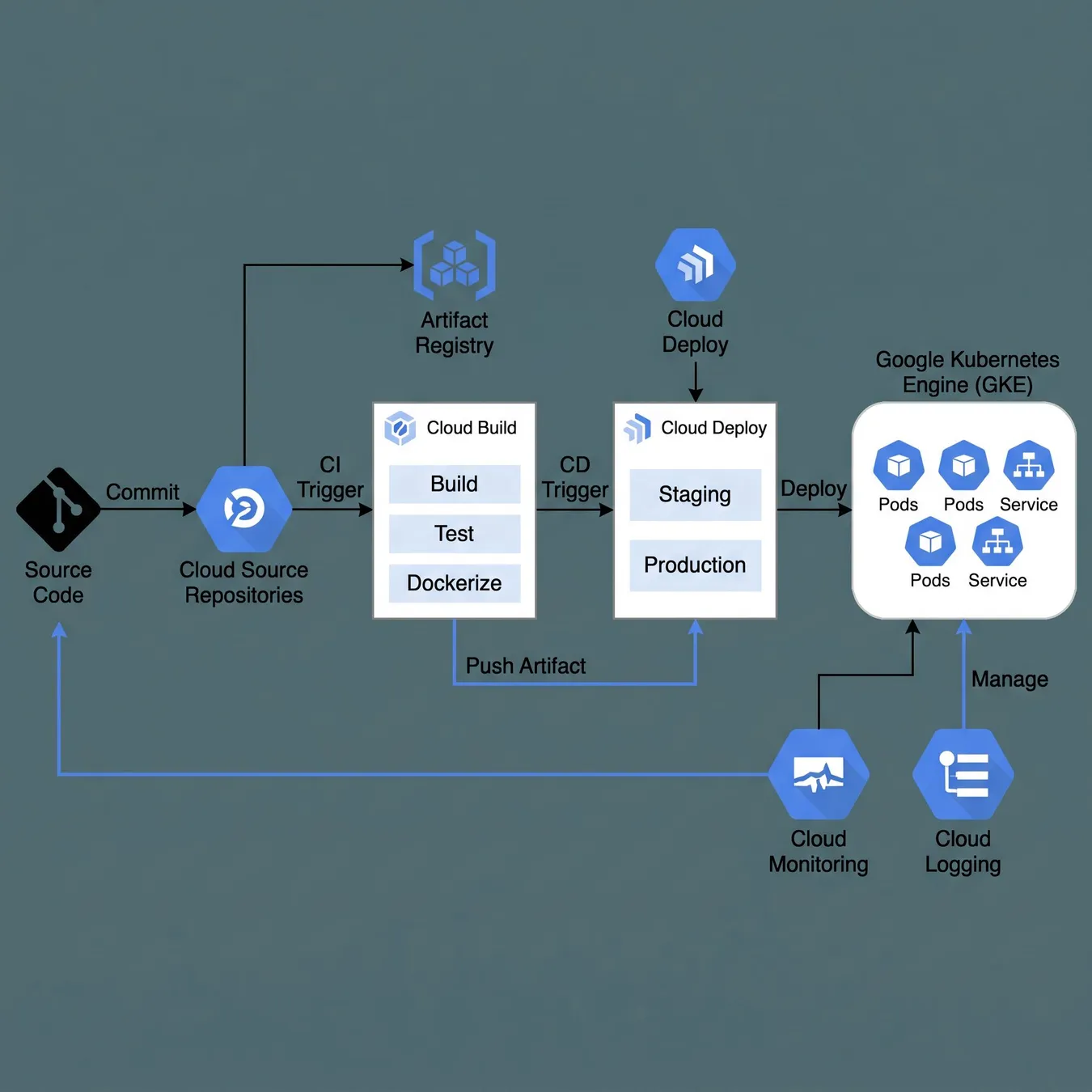
Standardized GCP DevOps workflow using Cloud Build and GKE.
Migrating to Google Cloud: A Strategic Approach
Migration is more than moving data; it is about modernizing your operational model. Whether you are coming from on-premise servers or considering a move from devops on aws, the focus should be on utilizing GCP's data-centric strengths.
01 / 04
phase 01 / 04
Assessment
phase 02 / 04
Pilot Phase
phase 03 / 04
Data Migration
phase 04 / 04
Application Cutover
Optimizing Google Kubernetes Engine (GKE)
GKE is the industry standard for managed Kubernetes. To maximize its value, teams must implement proper node auto-scaling, pod security policies, and cost-optimization strategies like using preemptible VMs for batch processing.
Tip.
// GKE Tip
Security and Compliance in GCP Pipelines
Security must be integrated into the pipeline from the start. This involves securing cloud infrastructure by implementing VPC Service Controls and automated container scanning during the build process.
Enable Binary Authorization for GKE clusters
Implement Secret Manager for all environment variables
Configure VPC Flow Logs for network auditing
Set up Organization Policy Service constraints
Comparing GCP DevOps Tools
| Function | GCP Native Tool | Open Source Alternative |
|---|---|---|
| CI/CD | Cloud Build | Jenkins / GitLab |
| IaC | Deployment Manager | Terraform |
| Monitoring | Cloud Operations | Prometheus / Grafana |
| Registry | Artifact Registry | Harbor |
Operational Excellence with Managed Services
For many growth-stage startups, the burden of 24/7 infrastructure monitoring is too high. Utilizing devops managed services allows your internal engineering team to focus on product features while experts handle platform uptime.
4x
Deployment Speed Increase
60%
Reduction in Recovery Time
30%
Infrastructure Cost Savings
Common Pitfalls in GCP DevOps
Use Terraform for all resource provisioning
Enable Workload Identity for GKE
Set up budget alerts at the project level
Automate image cleanup in Artifact Registry
Use the default service account for VMs
Store secrets in source control
Manually edit resources in the GCP Console
Ignore egress costs between regions
Scaling Infrastructure for High Traffic
GCP provides global load balancing that can handle millions of requests per second. DevOps teams must configure these load balancers alongside Cloud CDN to ensure low-latency delivery to a global user base.
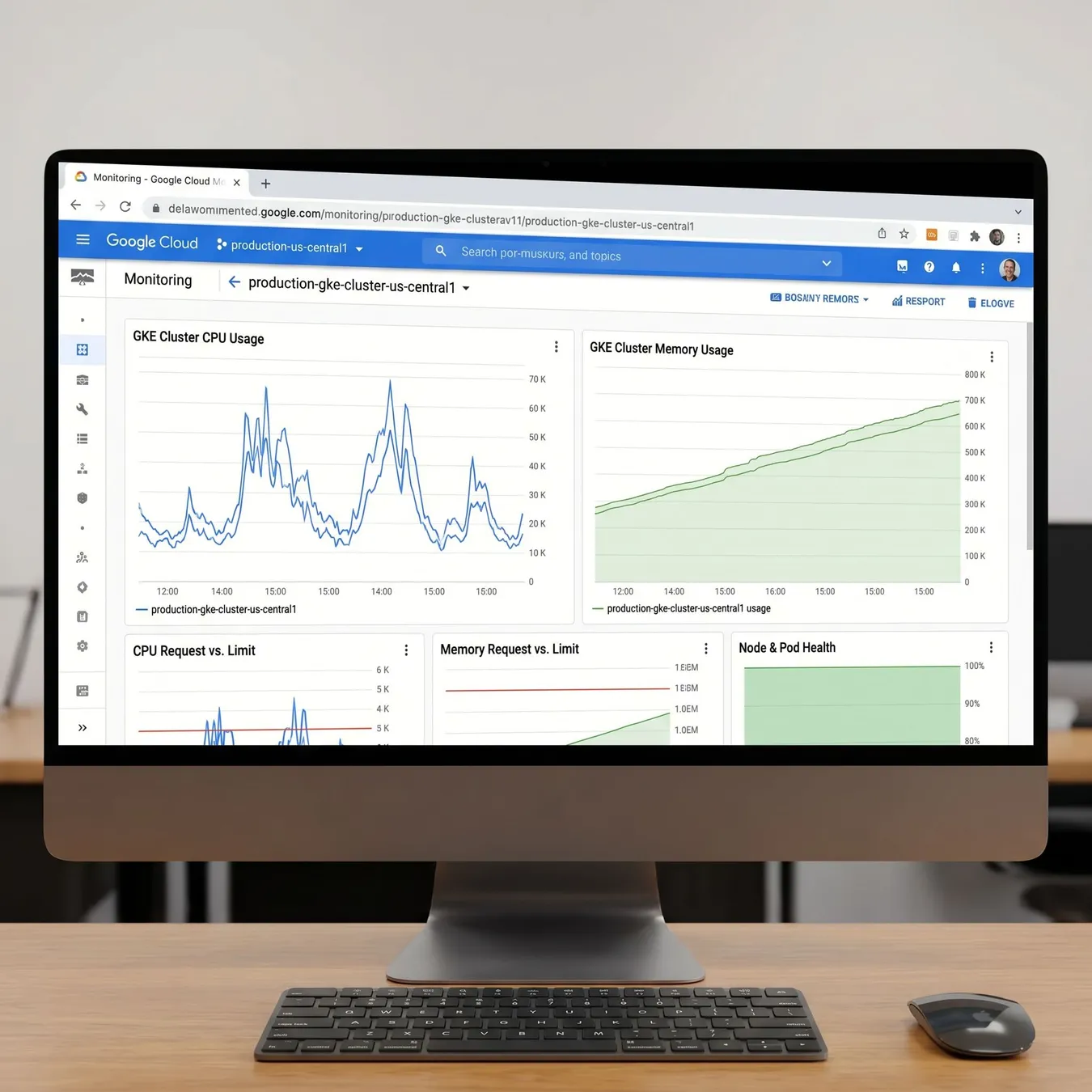
Real-time observability with Cloud Operations.
Infrastructure as Code for repeatable setups.
The Role of Site Reliability Engineering (SRE)
SRE principles on GCP focus on Service Level Objectives (SLOs) and Error Budgets. By defining what 'healthy' looks like, teams can make data-driven decisions about when to ship new features versus when to focus on stability.
GCP DevOps Frequently Asked Questions
Bridging to Production-Ready GCP Infrastructure
Moving from a functional prototype to a production-grade GCP environment requires specialized engineering depth. At Studio 402, we help startups and growth-stage companies build the durable foundations they need to scale without the typical growing pains of manual infrastructure.
Whether you are looking for a complete migration or need to harden your existing GKE clusters, our team provides the technical consulting and execution power to turn cloud complexity into a competitive advantage.
Why Partner with Studio 402 for GCP?
Trade-off
4 pros · 4 cons
Pros
Production-first engineering mindset
Deep expertise in GKE and Cloud Build
Security-hardened pipeline designs
Fixed-scope, outcome-oriented delivery
Cons
Manual, error-prone deployments
Opaque infrastructure costs
Fragile, non-scalable architectures
Security as an afterthought
Trusted by venture-backed startups to manage production GCP workloads.
Updated for July 2026
Our GCP DevOps Process
- 01
Infrastructure Audit: We review your current GCP setup for security and cost gaps.
- 02
Foundation Building: We establish a secure landing zone with IaC.
- 03
Pipeline Automation: We build custom CI/CD workflows tailored to your stack.
- 04
Knowledge Transfer: We document the system and train your team for handoff.
Expert Guidance for Your Cloud Roadmap
If you are unsure where to start with your cloud journey, our team can help you define a clear path forward that balances speed with long-term maintainability.
GCP offers incredible power, but without a disciplined DevOps approach, that power often turns into unmanageable complexity and cost.
Engineering Lead · Studio 402
Explore More Cloud Insights
Ready to Scale Your GCP Infrastructure?
Stop fighting with manual deployments and fragile cloud setups. Let's build a production-ready platform that grows with your business.
Build Your GCP Foundation Today
Get expert GCP DevOps engineering to automate your deployments and optimize your cloud infrastructure for scale.
Additional Resources
For teams looking to dive deeper into specific cloud strategies, we offer a range of guides covering everything from security to automation.
- Best practices for multi-tenant GKE clusters
- Automating GCP compliance with Forseti
- Optimizing BigQuery for DevOps analytics
- Serverless CI/CD with Cloud Run
GCP Cost Management
Cost is often the biggest surprise in cloud migrations. We implement automated tagging and reporting to ensure every dollar spent on GCP is accounted for and optimized.
Disaster Recovery on GCP
We design multi-region failover strategies using Cloud DNS and Global Load Balancing to ensure your application remains available even during regional outages.
Infrastructure as Code Standards
Our Terraform modules are built for reuse and security, following the principle of least privilege for all service accounts and resource permissions.
Continuous Monitoring
We set up proactive alerting in Cloud Monitoring to catch performance regressions before they impact your end users.
Keep reading