
Overview
Securing Cloud Infrastructure & DevOps Pipelines
Protect your product from vulnerabilities at scale by hardening your cloud environment and automating security within your CI/CD pipelines.

Securing Cloud Infrastructure and DevOps Pipelines
Securing cloud infrastructure is no longer a perimeter-based task; it requires a deep integration of security protocols directly into the software delivery lifecycle. To maintain a secure cloud environment, teams must shift security left, ensuring that every line of code and infrastructure change is audited before it ever reaches production.
82%
Breaches involving cloud data
45%
Reduction in vulnerabilities via SecDevOps
10x
Faster recovery from security incidents
The Fundamentals of Cloud Infrastructure Security
Cloud infrastructure security centers on the principle of least privilege and the automation of identity and access management (IAM). Without a robust strategy for managing secrets and permissions, even the most advanced firewall cannot protect against internal misconfigurations or leaked credentials.
- Identity and Access Management (IAM) hardening
- Data encryption at rest and in transit
- Network segmentation and VPC configuration
- Continuous compliance monitoring
- Automated patch management
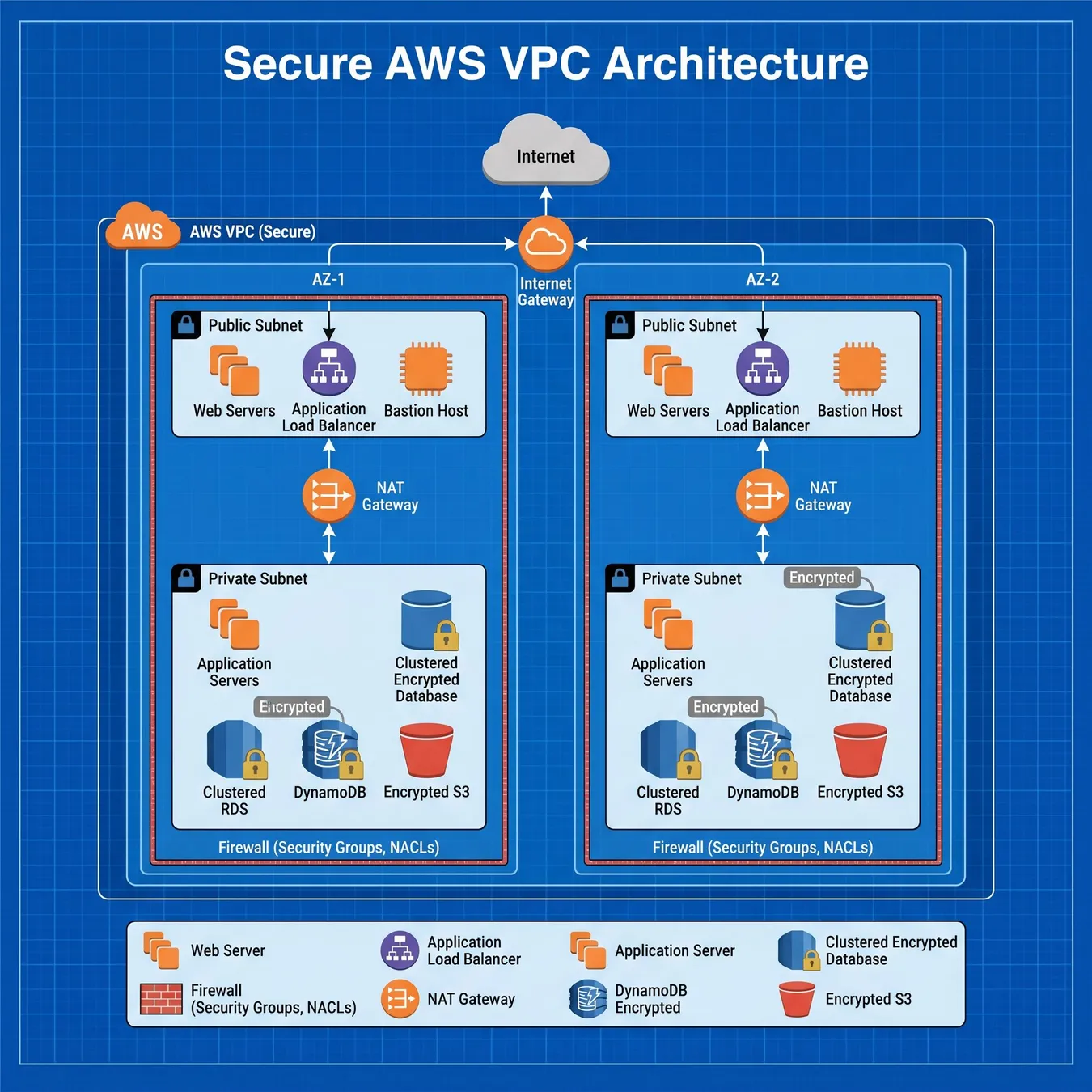
A standard secure cloud environment architecture.
DevOps Security Automation: Shifting Left
DevOps security automation involves embedding security checks directly into the CI/CD pipeline. By automating static and dynamic analysis, teams can catch vulnerabilities early. This approach, often called SecDevOps automation, ensures that security is a continuous process rather than a final gate.
Tip.
// Automate Early
Hardening the CI/CD Pipeline
A secure pipeline is the backbone of reliable software. You should implement infrastructure deployment automation to ensure that your environments are reproducible and free from manual configuration drift, which is a common source of security gaps.
- 01
Secure the source code repository with MFA and branch protection.
- 02
Inject secrets using a dedicated vault rather than environment variables.
- 03
Run Static Application Security Testing (SAST) on every pull request.
- 04
Execute Container Image Scanning for known CVEs.
- 05
Deploy to a staging environment for Dynamic Testing (DAST).
AWS Cloud Security Architecture Best Practices
When building an aws cloud security architecture, it is essential to leverage native tools like AWS Config, GuardDuty, and CloudTrail. These services provide the visibility needed to maintain a high security posture across complex, multi-account environments.
For teams using Infrastructure as Code, adopting a standardized aws cloudformation architecture allows you to bake security requirements directly into your templates, ensuring every resource is compliant by default.
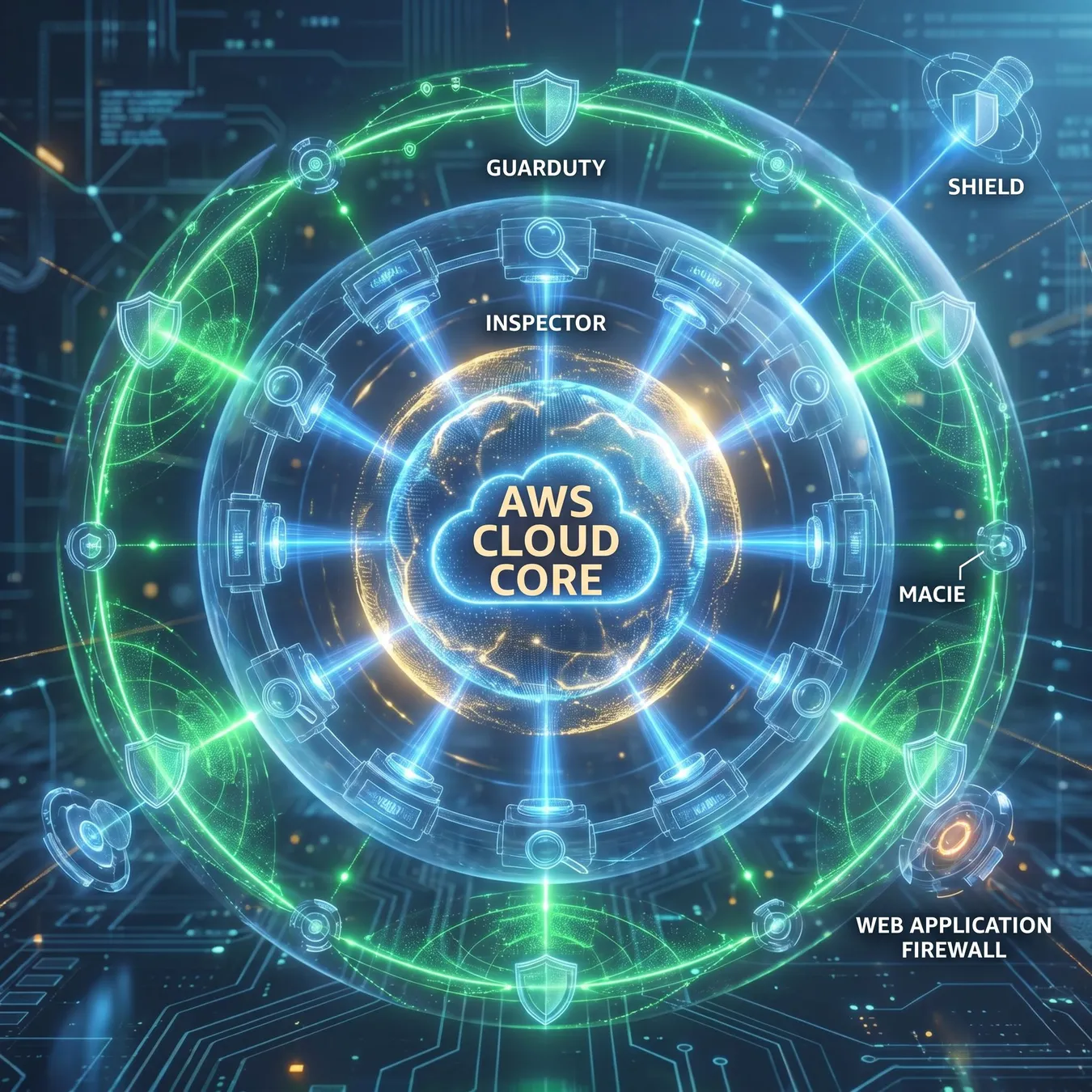
Visualizing AWS-native security layers.
The Role of AI in Modern Security
Artificial intelligence is transforming how we audit code. Implementing an aws ai code review process can help identify complex logic flaws that traditional scanners might miss, providing an extra layer of defense for production-ready systems.
Managing Infrastructure Technical Debt
Security risks are often hidden within infrastructure technical debt. Legacy configurations, unpatched instances, and 'temporary' fixes often become permanent vulnerabilities if not addressed through regular audits and refactoring.
Use short-lived credentials for CI/CD runners.
Enable VPC Flow Logs for network visibility.
Automate the rotation of encryption keys.
Hardcode API keys in application source code.
Use the root account for daily administrative tasks.
Leave unused security groups open to the public internet.
Securing Multi-Tenant SaaS Environments
For SaaS providers, tenant isolation is the primary security concern. Ensuring that data from one customer cannot be accessed by another requires strict logical separation at the database and application layers, reinforced by cloud-native IAM policies.
Database Isolation Strategies
Whether using row-level security or separate database instances, the goal is to ensure that a breach in one tenant's session does not lead to a cross-tenant data leak.
Compliance and Auditability
In regulated industries, security is synonymous with compliance. Automated logging and reporting are necessary to prove that your secure cloud environment meets standards like SOC2, HIPAA, or GDPR.
| Feature | Standard DevOps | SecDevOps |
|---|---|---|
| Security Checks | Manual / End of Cycle | Automated / Continuous |
| Feedback Loop | Days or Weeks | Minutes |
| Risk Profile | Reactive | Proactive |
Vulnerability Management Lifecycle
01 / 04
phase 01 / 04
Identification
phase 02 / 04
Triage
phase 03 / 04
Remediation
phase 04 / 04
Verification
Monitoring and Incident Response
Even with the best automation, incidents can happen. A mature security posture includes automated alerting and a well-defined incident response plan that can be executed the moment an anomaly is detected.

Rapid response is key to security.

Physical and logical security combined.
The Human Element in Cloud Security
Security is as much about culture as it is about tooling. Training engineering teams to write secure code and recognize social engineering threats is a vital component of any infrastructure hardening strategy.
Common Security Misconfigurations
Many of the largest cloud breaches in history were caused by simple misconfigurations, such as publicly accessible S3 buckets or overly permissive security groups.
Disable public access to all storage buckets by default.
Enforce MFA for all console and CLI access.
Remove all unused IAM users and roles.
Encrypt all sensitive data at rest using KMS.
Future Trends in SecDevOps
As we move further into 2026, we are seeing a shift toward 'Policy as Code,' where security policies are written in declarative languages and enforced automatically by the cloud platform itself.
Bridging to Production-Ready Security
If you are struggling with manual security gates or fragile infrastructure that feels like a liability, Studio 402 can help. We specialize in taking complex product requirements and building the secure, automated foundations they need to thrive.
Security isn't a feature you add at the end; it's the foundation you build on. If your infrastructure isn't secure, your product isn't ready for users.
Studio 402 Engineering Team
Frequently Asked Questions
Trusted by growth-stage startups to secure production environments.
Over 50+ cloud architectures hardened in 2026.
How Studio 402 Hardens Your Infrastructure
At Studio 402, we don't just give you a checklist. We design and implement the actual systems—from automated CI/CD pipelines to hardened AWS architectures—that protect your business and your customers.
Studio 402 transformed our fragile deployment process into a secure, automated machine. We finally have the confidence to scale without worrying about the next vulnerability.
Secure Your Infrastructure Today
Stop worrying about cloud vulnerabilities. Let us build a hardened, automated environment for your product.
Keep reading
More in Cloud & DevOps Engineering
- Cloud Security
- DevOps
- AWS
- Automation
- Hardening