
Hardening Low-Code Workflows for Production Scale
Many teams start with a low code workflow to automate simple tasks, but these systems often become fragile as complexity grows. Hardening these workflows is essential to prevent operational failure when your business scales.
- Production-Ready
- Workflow Engineering
- Scalability
- Security
The Limits of the Low Code Workflow Platform
While a low code workflow platform is excellent for rapid prototyping, it often lacks the robust error handling and observability required for critical business operations. Understanding the low code vs no code trade-offs is the first step in identifying where your system needs reinforcement.
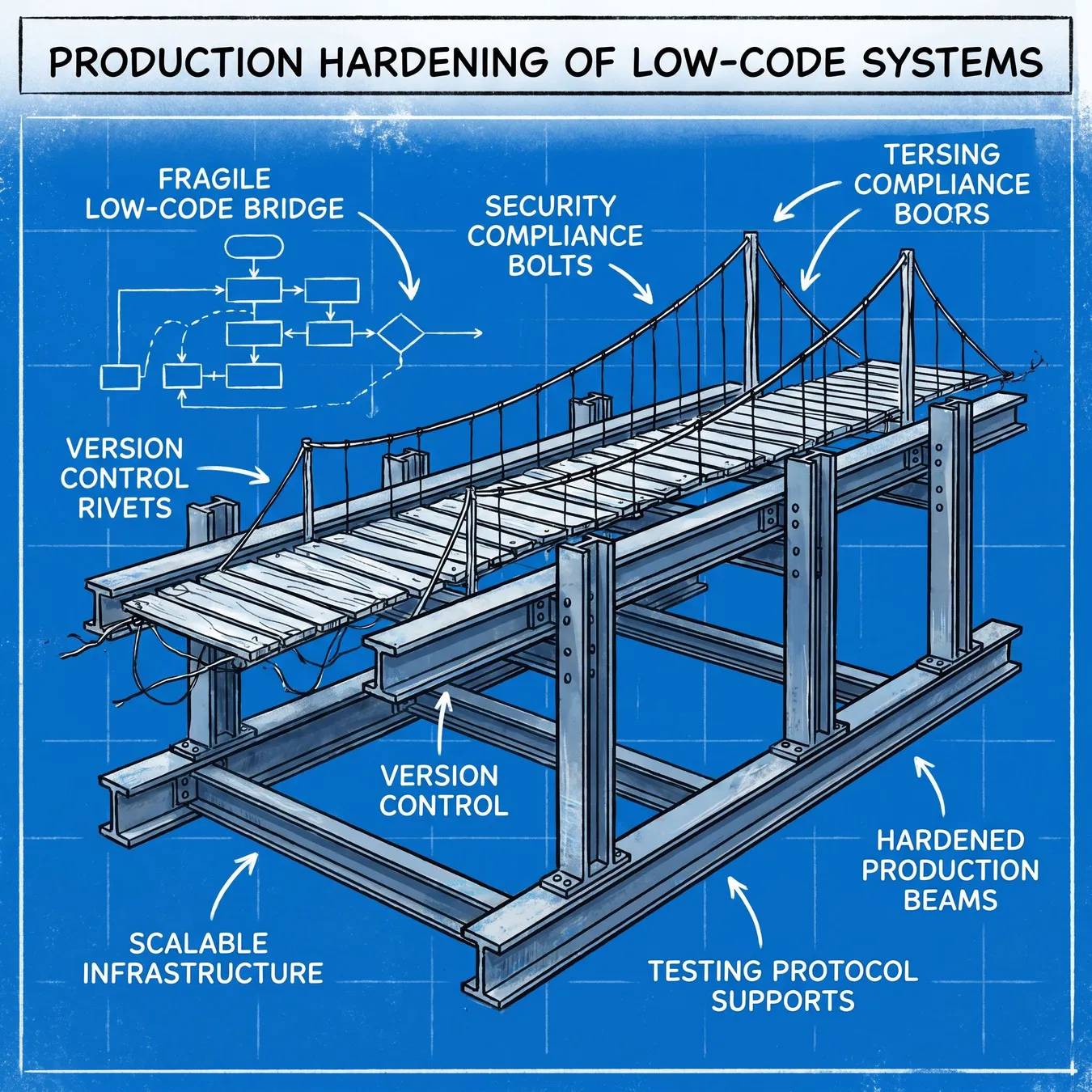
Bridging the gap between fragile prototypes and durable production systems.
Common Failure Points in Low-Code Systems
- Rate limits on third-party API connectors
- Lack of version control and rollback capabilities
- Opaque error logs that make debugging impossible
- Security vulnerabilities in shared execution environments
- Performance degradation during high-concurrency events
Strategies to Build Low Code Apps That Scale
To build low code apps that survive real-world use, you must implement engineering discipline. This includes externalizing complex logic to custom microservices while keeping the workflow orchestrator as a clean coordination layer.
99.9%
Uptime Target
10x
Throughput Increase
0
Manual Retries
Hardening the Infrastructure Layer
Scaling a workflow low code environment requires more than just logic updates; it requires securing cloud infrastructure to protect sensitive data and ensure high availability across regions.
Info.
// The Production Ceiling
Comparison: Prototype vs. Hardened Workflow
Trade-off
4 pros · 4 cons
Pros
Detailed error handling
Automated retry logic
Centralized logging
Scalable API endpoints
Cons
Silent failures
Manual intervention needed
No visibility into data flow
Vendor rate limit crashes
Steps to Harden Your App Low Code Setup
01 / 04
phase 01 / 04
Audit
phase 02 / 04
Decouple
phase 03 / 04
Secure
phase 04 / 04
Monitor
Managing Data Integrity at Scale
When you build low code apps, data consistency is often overlooked. Hardening involves implementing transactional integrity to ensure that if one step of a workflow fails, your database doesn't end up in a corrupted state.

Observability is the backbone of production scale.

Custom extensions provide the flexibility low-code lacks.
Hardening Best Practices
Use environment variables for secrets
Implement exponential backoff for retries
Write unit tests for custom code blocks
Monitor API usage against vendor limits
Hardcode credentials in the workflow
Ignore error branches in logic
Store sensitive data in plain text
Rely on a single point of failure
Workflow Hardening FAQ
Bridging the Gap with Studio 402
At Studio 402, we specialize in rescuing fragile prototypes and turning them into durable software. We don't just build; we engineer foundations that support your growth without the constant fear of system collapse.
The goal isn't just to make it work; the goal is to make it work when ten thousand users show up at once.
Studio 402 Engineering Lead
Our Hardening Checklist
End-to-end encryption for data in transit
Automated failover for critical services
Comprehensive audit logging for all actions
Load testing under peak traffic conditions
Ready to Scale Your Workflows?
If your current setup is hitting its limits, it is time to bring in senior engineering expertise to stabilize and scale your operations.
Harden Your Workflow Today
Stop fighting fragile systems. Let Studio 402 build the durable infrastructure your business deserves.
Keep reading