
Building Production-Ready Conversational AI Agents
Modern conversational AI has moved beyond simple scripts. Today, a production-ready conversational ai agent must handle complex logic, maintain context across sessions, and integrate deeply with your business data to provide actual value.
- AI Engineering
- Agentic Workflows
- LLM Integration
- Scalable Systems
What Defines a Production-Ready Conversational AI Solution?
Many teams start with a basic LLM wrapper, but scaling to thousands of users requires a robust conversational ai solution. This involves more than just a chat interface; it requires a foundation of artificial intelligence engineering to ensure reliability.
99.9%
Uptime for Agent APIs
<2s
Average Response Latency
100+
Tool Integrations Supported
Core Components of Modern Conversational AI Software
Building high-performance conversational ai software requires a multi-layered approach. It isn't just about the model; it's about the orchestration layer, memory management, and secure data access.
- Contextual Memory: Retaining user history and preferences across interactions.
- Tool Use (Function Calling): Allowing agents to interact with external APIs and databases.
- Guardrails: Ensuring safe, compliant, and accurate responses.
- Observability: Tracking agent performance and identifying failure points in real-time.
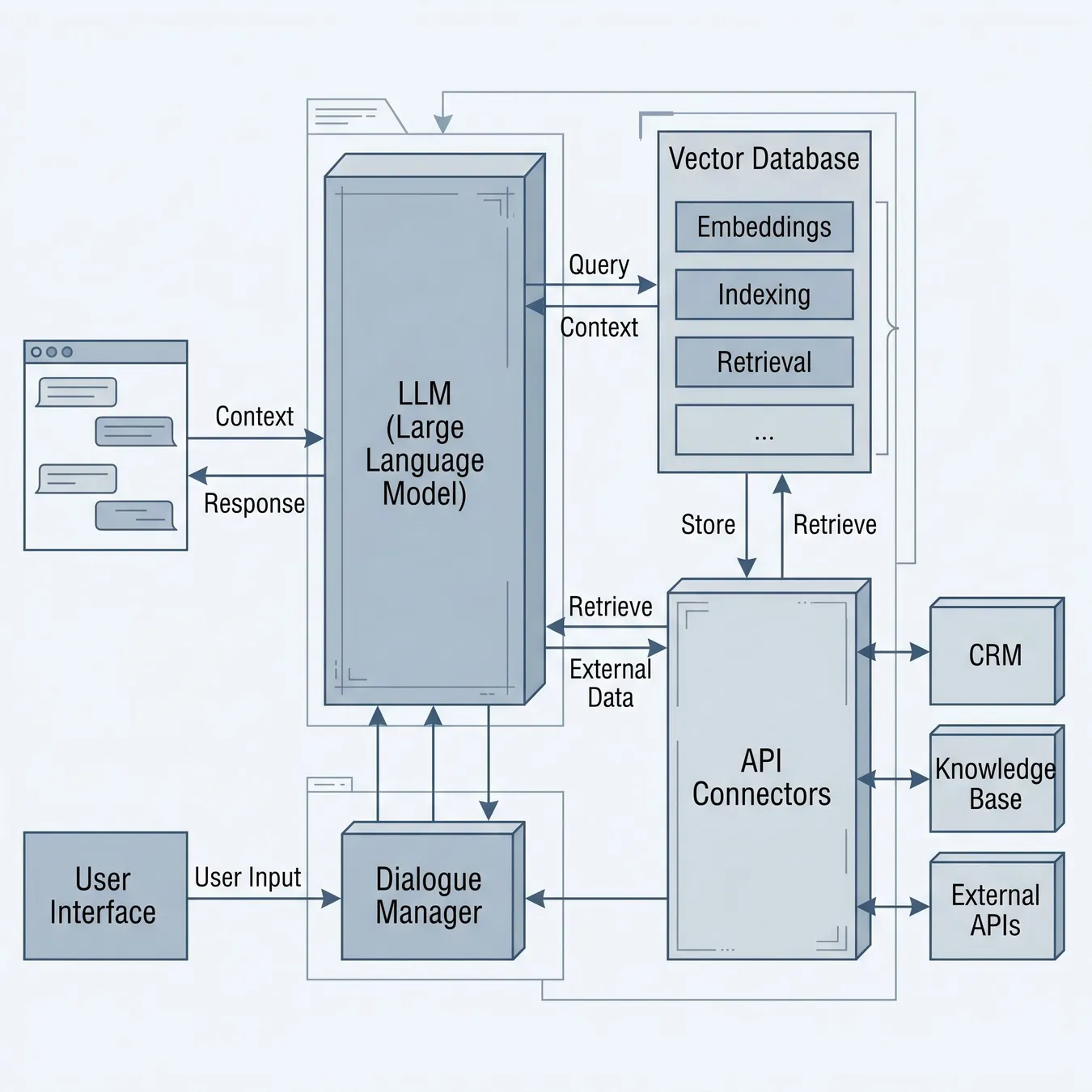
The architectural layers of a production-grade AI agent.
The Shift Toward Agentic Workflows
We are seeing a transition from simple chatbots to autonomous agents. These systems don't just talk; they execute tasks like scheduling, data entry, and multi-step reasoning.
Info.
// Agent vs. Chatbot
Implementing Conversational AI for Customer Service
One of the most immediate applications is deploying conversational ai for customer service. By automating routine inquiries, teams can focus on high-touch interactions that require human empathy.
Trade-off
4 pros · 4 cons
Pros
24/7 instant availability
Consistent brand voice
Seamless multi-language support
Instant data retrieval
Cons
High initial setup complexity
Requires ongoing monitoring
Risk of 'hallucinations' without RAG
Needs clear escalation paths
Technical Challenges in Scaling AI Agents
Scaling an agent from a demo to a production environment introduces significant engineering hurdles. You must account for rate limits, token costs, and state persistence.

Monitoring operational costs is vital for scaling.

RAG ensures agents stay grounded in your data.
Integrating Artificial Intelligence into Your Stack
Success depends on integrating artificial intelligence into your existing software ecosystem. Agents are most effective when they have read/write access to your CRM, ERP, or internal databases.
Step-by-Step: Building Your First Agent
01 / 04
phase 01 / 04
Define Scope
phase 02 / 04
Select the Stack
phase 03 / 04
Develop & Test
phase 04 / 04
Deploy & Monitor
Security and Compliance for AI Agents
When building for the enterprise, security is not optional. This is especially true for enterprise intelligent automation, where agents may handle sensitive customer or financial data.
Implement PII masking in prompts
Set up role-based access control (RBAC)
Enable comprehensive audit logging
Conduct regular adversarial testing
Evaluating Top Conversational AI Companies
When looking at top conversational ai companies, it is important to distinguish between those providing simple chat widgets and those offering deep product engineering. You need a partner who understands the full software lifecycle.
| Feature | Standard Chatbot | Production Agent |
|---|---|---|
| Logic | Fixed Decision Trees | Dynamic Reasoning |
| Data Access | Static FAQ | Real-time API/DB |
| Scalability | Limited | Cloud-Native |
The Role of Human-in-the-Loop
No agent should operate in a vacuum. A production system requires a 'human-in-the-loop' mechanism where high-confidence responses are automated, but complex cases are flagged for human review.
The goal of conversational AI isn't to replace humans, but to augment them by handling the 80% of routine tasks that currently drain productivity.
Studio 402 Engineering Team · Systems Architects
Future Trends in Conversational AI Services
As conversational ai services evolve, we expect to see more multi-modal capabilities—agents that can see, hear, and interact with screens just as a human would.

The future of multi-modal conversational interfaces.
Common Pitfalls in AI Development
Start with a narrow, high-value use case
Use RAG to ground responses in facts
Prioritize low-latency infrastructure
Log everything for continuous improvement
Don't give agents unrestricted database access
Don't ignore the cost of long context windows
Don't launch without a human fallback
Don't use AI for tasks requiring 100% deterministic logic
Why Studio 402 for Conversational AI Development?
As a conversational ai development company, Studio 402 specializes in moving beyond the 'vibe-code' phase. We build agents that are hardened for real-world use, integrated with your core systems, and designed to scale.
Studio 402 took our fragile AI prototype and turned it into a production-ready system that now handles 60% of our support volume without human intervention.
Frequently Asked Questions
Ready to Build Your AI Agent?
Whether you are starting from zero or need to rescue a prototype that isn't scaling, we can help. Our team combines product engineering with deep AI expertise to ship software that works.
Trusted by growth-stage startups and enterprise teams to ship production-ready AI.
Updated for 2026
Start Your AI Journey Today
Let's discuss how custom conversational AI can transform your operations and customer experience.
Explore More in AI Integration
Keep reading
More in AI Integration & Workflow Automation
Studio 402 is a premium remote product studio. We help ambitious teams build, fix, and scale custom software and AI systems that survive real-world use.
From MVP development to infrastructure hardening, we are your senior engineering partner for the long haul.
Contact us at studio@402.studio to begin scoping your next project.
Our approach ensures that your conversational AI is not just a demo, but a durable business asset.
We look forward to helping you build the future of intelligent business operations.
Building at scale requires more than code; it requires a vision for how AI and humans work together.
Thank you for exploring our guide on conversational AI development.