
Integrating Artificial Intelligence into Existing Software
Modernizing your software stack through the integration of ai is no longer a luxury but a requirement for operational scale. By embedding intelligent layers into legacy systems, businesses can unlock hidden data value and automate complex decision-making processes.
- Enterprise AI
- Systems Integration
- Legacy Modernization
- 2026 Tech Trends
The Strategic Value of Integrating Artificial Intelligence
When considering integrating artificial intelligence, the goal is to enhance existing workflows without disrupting the core stability of your production environment. This requires a deep understanding of both the target LLM and the underlying data architecture.
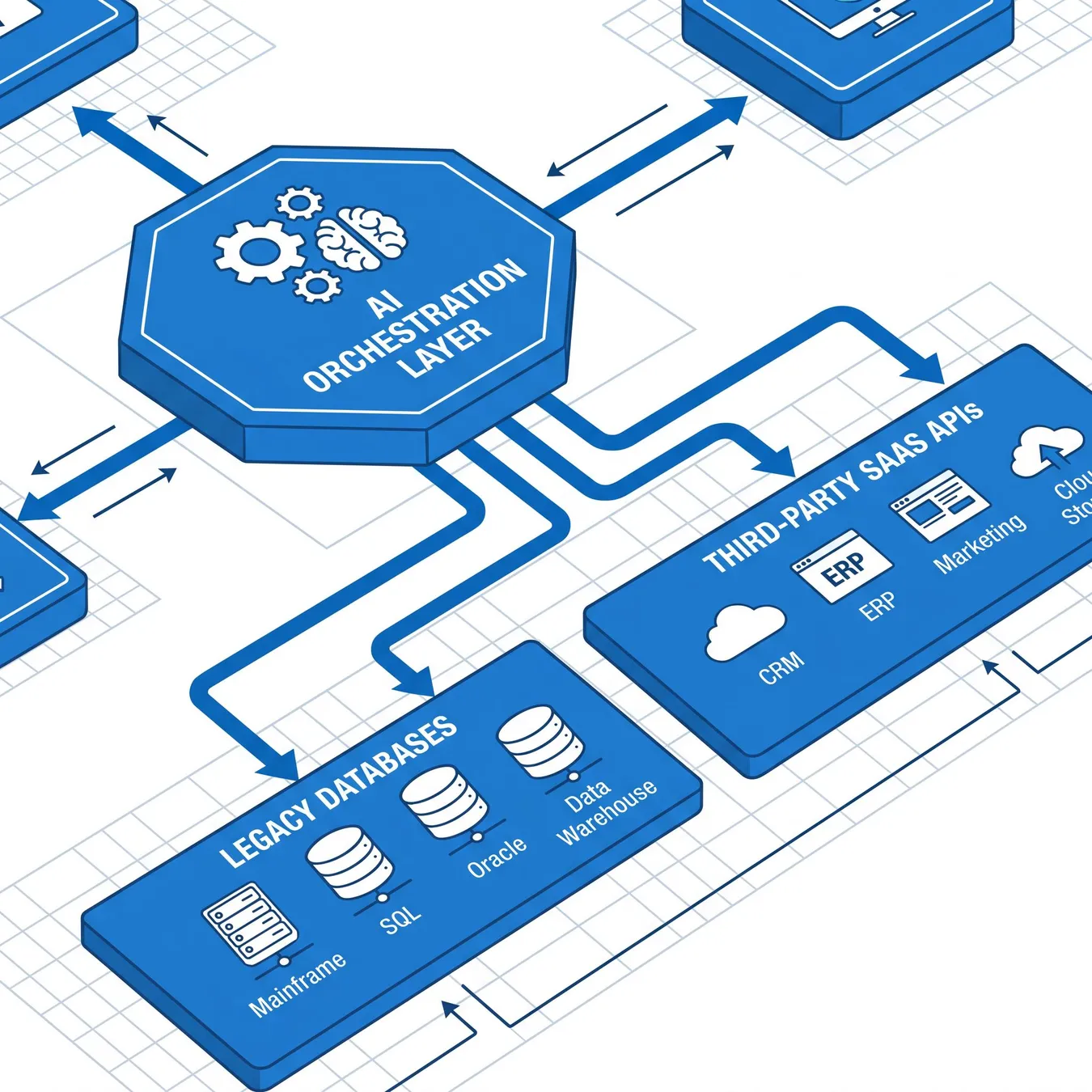
Visualizing the architecture of seamless ai integrations within a complex enterprise ecosystem.
Core Challenges in Artificial Intelligence Systems Integration
Successful artificial intelligence systems integration often hinges on data quality and API reliability. Many organizations struggle with siloed data that isn't ready for RAG (Retrieval-Augmented Generation) or agentic workflows.
- Data latency and synchronization issues
- Inconsistent API documentation in legacy modules
- Security and permission boundary management
- Cost management for high-volume LLM tokens
- Model hallucination in business-critical logic
Selecting Tools for AI Development and Integration
Choosing the right tools for ai development is critical for long-term maintainability. You must evaluate orchestration frameworks, vector databases, and monitoring suites that fit your existing cloud infrastructure.
40%
Reduction in manual data entry
2.5x
Faster customer response times
99.9%
System uptime for integrated agents
Step-by-Step Approach to Seamless AI Integrations
- 01
Audit existing data structures and API endpoints.
- 02
Define specific business logic for AI to handle.
- 03
Select appropriate LLMs or specialized models.
- 04
Build a secure middleware for model orchestration.
- 05
Implement human-in-the-loop oversight for critical tasks.
- 06
Monitor performance and iterate on prompt engineering.
The Impact on the Software Development Lifecycle
Understanding how integrating ai in software development changes your release cycles is vital. It introduces new testing requirements, such as model evaluation and regression testing for non-deterministic outputs.
Tip.
// Security Tip
Comparison: In-House vs. Specialized AI Agencies
Many firms search for the best software development agencies for ai integration projects because the specialized talent required for artificial intelligence engineering is difficult to source and retain internally.
Trade-off
3 pros · 3 cons
Pros
Deep domain expertise in LLM orchestration
Proven security patterns for data handling
Faster integration with legacy systems
Cons
Higher initial overhead for hiring
Slower time-to-market for first AI features
Risk of building non-scalable prototypes
Technical Requirements for Custom AI Logic
Deep artificial intelligence engineering is required to move beyond simple chat wrappers. This involves fine-tuning, RAG architecture, and building durable state management for long-running agents.

Engineering the logic layer for custom AI agents.

Monitoring the health of integrated AI systems.
Common Integration Anti-Patterns to Avoid
Start with a clear, narrow use case.
Validate data quality before building.
Use modular architecture for model swapping.
Don't ignore the cost of token scaling.
Don't build without a human-in-the-loop fallback.
Don't hardcode prompts into your core application.
Enterprise Data Layers and AI Compatibility
Custom software development agencies data ai expertise is most visible when handling complex data migrations. Ensuring your data layer is accessible to embedding models is the first step toward a functional AI ecosystem.
| Data Type | Integration Method | Use Case |
|---|---|---|
| Structured SQL | Text-to-SQL Agents | Dynamic Reporting |
| Unstructured PDF | Vector Embeddings | Knowledge Base Search |
| Real-time Streams | Event-driven Agents | Fraud Detection |
The Role of Outsourced AI Development
For teams under execution pressure, outsourced ai development provides the senior engineering leverage needed to ship production-ready features without the multi-month lead time of internal hiring.
Scalability and Maintenance of AI Systems
Integration is not a one-time event. As models evolve and API versions change, your integration layer must be architected for easy updates and regression testing to prevent service degradation.
Automated model evaluation suite
Token usage alerts and caps
Fallback logic for API downtime
Regular prompt versioning and audits
AI Integration FAQ
Bridging the Gap with Studio 402
At Studio 402, we specialize in turning experimental AI demos into durable software systems. We don't just wrap APIs; we architect the data pipelines and infrastructure required for real-world reliability.
Studio 402 took our fragile AI prototype and rebuilt it into a production-grade system that handles thousands of concurrent users without breaking.
Sarah Chen · CTO, Fintech Scaleup
Our AI Integration Process
01 / 04
phase 01 / 04
Audit & Strategy
phase 02 / 04
Architecture Design
phase 03 / 04
Build & Integrate
phase 04 / 04
Hardening & Launch
Ready to Modernize Your Software?
Whether you are looking to automate internal workflows or launch new AI-powered features for your customers, we provide the engineering depth to make it happen.
Trusted by 50+ companies to build and scale production software.
From seed-stage startups to enterprise operators.
Build Your AI Future Today
Let’s discuss your AI integration goals and build a roadmap for production-ready systems.
Explore More AI Solutions
Additional Resources
Deepen your knowledge on how AI is reshaping business operations and technical architecture through our related guides and category hubs.
Keep reading
More in AI Integration & Workflow Automation
Final Thoughts on AI Strategy
The most successful AI projects are those that solve real operational bottlenecks. Focus on value first, and the technology will follow.

Achieving operational excellence through intelligent software design.
Continuous Improvement
As we move further into 2026, the speed of AI advancement will only increase. Building a flexible integration layer today ensures you can adopt tomorrow's models without a total rebuild.
- Stay model-agnostic where possible.
- Invest in robust data observability.
- Prioritize user experience in AI interactions.
Contact Studio 402
Reach out to studio@402.studio to schedule a technical discovery session. We help you navigate the complexity of AI integration with honest scoping and senior engineering expertise.
This guide was developed to help technical leaders and founders understand the practical steps of embedding intelligence into their core products. For more insights, visit our main service pages.