
Venture Studio Fund Structures and Capital Models
A venture studio fund operates as the financial engine for a venture builder, providing the necessary capital to move from ideation to a production-ready startup. Unlike traditional VC firms, these funds are designed to cover both operational expenses and direct equity investments in the companies they create.
30-50%
Average Studio Equity Stake
$250k-750k
Typical Pre-Seed Capital Injection
6-9 Months
Average Time to First External Round
Core Components of a Venture Studio Fund
To understand a venture studio fund, one must look at how it differs from the traditional venture capital business model. While VCs primarily deploy capital into external teams, studio funds allocate resources to internal operations and shared services.
- Operating Capital: Funds the studio's core team (designers, engineers, recruiters).
- Investment Capital: Direct cash injections for the new entities.
- Management Fees: Typically higher than 2% to cover high-touch operational support.
- Carry Structure: Performance-based incentives for the studio partners.
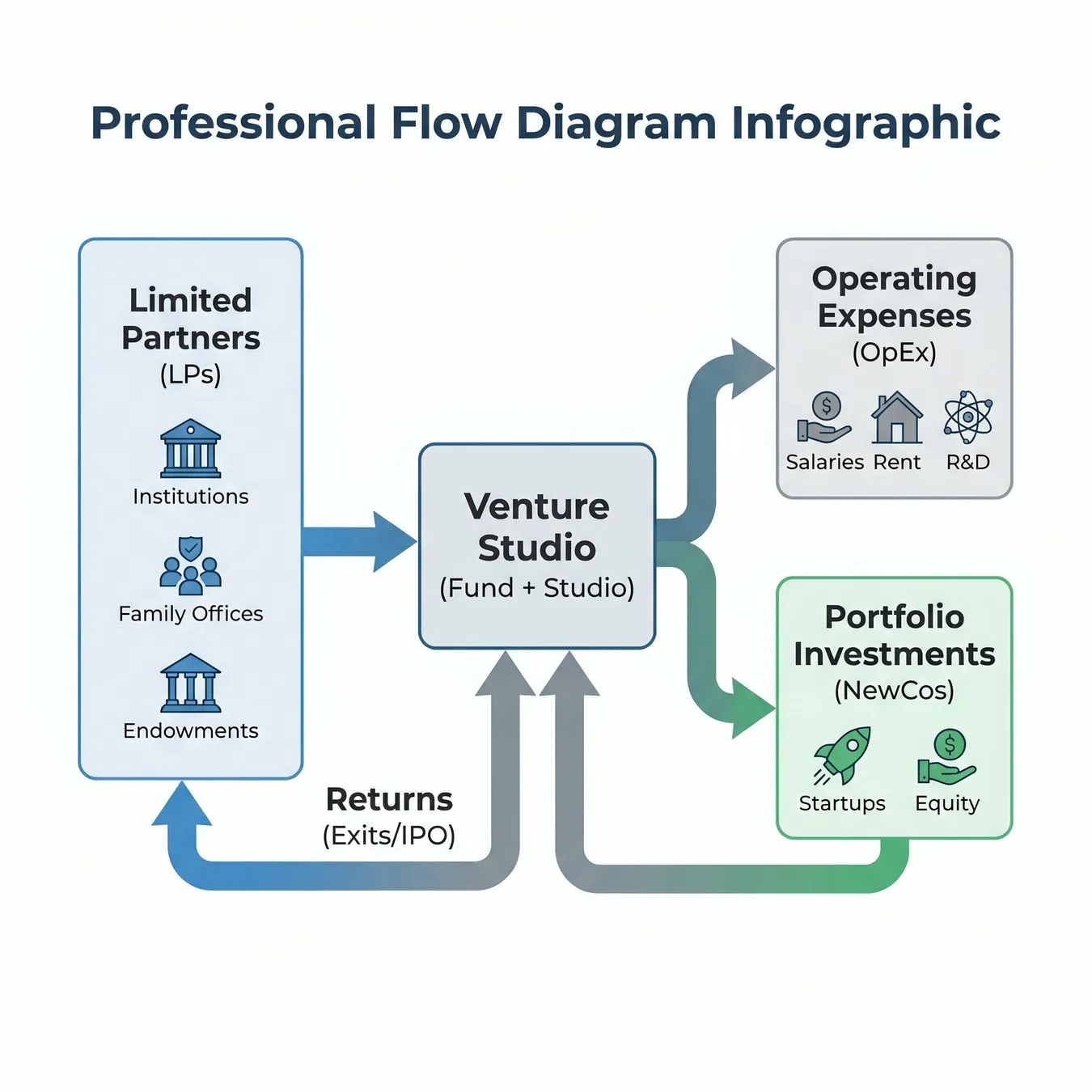
The dual-allocation model of venture studio capital.
Equity Splits and Founder Incentives
One of the most debated aspects of the studio model is the equity split between founders and the studio. Because the studio provides the initial idea, capital, and infrastructure, they typically take a larger share than a traditional seed investor.
It is critical for studios to maintain a fair equity split between founders to ensure long-term motivation and the ability to attract top-tier talent for the CEO and CTO roles.
| Stakeholder | Traditional Startup | Venture Studio Model |
|---|---|---|
| Founding Team | 80-90% | 30-60% |
| Lead Investor | 10-20% | 30-50% (Studio) |
| Option Pool | 10-15% | 10-20% |
Capital Allocation Strategies
Studios must be disciplined in how they deploy funds across different stages of the venture building lifecycle. This often involves a gated approach to funding.
- 01
Ideation Phase: Small stipends for market research and validation.
- 02
MVP Phase: Funding for engineering and initial product design.
- 03
Launch Phase: Larger capital injection for GTM and early hiring.
- 04
Spin-out Phase: Preparation for external Series A or Seed rounds.
Financing the Spin-Out Process
When a company is ready to leave the studio, the fund often leads the pre seed financing round to signal confidence to external investors.
Info.
// Investor Note
Operational Expense (OpEx) Management
A significant portion of a venture studio fund is dedicated to the 'Studio Team.' These are the shared resources that startups use, such as high-end product engineering and growth marketing.

Shared operational resources are the secret sauce of the studio model.
Comparing Studio Funds to Traditional VC
Trade-off
3 pros · 3 cons
Pros
Higher success rate for portfolio companies
Faster time to market with shared infra
Built-in technical and design expertise
Cons
Higher management fees for LPs
Significant dilution for founders early on
Heavy reliance on studio operational success
The Evolution of Venture Capital Stages
As startups move through various venture capital stages, the studio's role shifts from an active builder to a strategic board member and advisor.
Common Pitfalls in Studio Fund Design
Reserve enough capital for follow-on rounds
Clearly define the 'Services for Equity' agreement
Maintain a lean core team until validation
Over-capitalize companies before product-market fit
Take so much equity that founders can't raise a Series A
Neglect the legal separation between studio and startup
Governance and Decision Making
Who decides which ideas get funded? Most studio funds utilize an Investment Committee (IC) that includes both studio partners and occasionally external LPs or industry experts.
The Role of Limited Partners (LPs)
LPs in a venture studio fund are often looking for more than just financial returns; they may seek strategic insights into new technologies or a pipeline of acquisition targets.
Scaling the Studio Model
Scaling a studio requires a repeatable engineering engine. This is where the financial model meets technical execution—ensuring that the cost to build the next MVP is lower than the last.
Measuring Studio Fund Performance
Traditional metrics like IRR and TVPI still apply, but studios also track 'Time to Validation' and 'Efficiency of Capital' as leading indicators of fund health.
Legal and Tax Considerations
Structuring a studio fund involves complex tax considerations, particularly regarding the 'Qualified Small Business Stock' (QSBS) status for the spun-out entities.
Future Trends in Venture Building
In 2026, we are seeing a shift toward 'AI-Native Studios' where the fund structure is optimized for high-compute costs and rapid algorithmic iteration.
Bridging Finance and Engineering
A venture studio fund is only as strong as the products it builds. If the capital is there but the engineering is fragile, the fund will struggle to see exits. This is why many studios partner with specialized engineering firms to ensure production-grade outcomes.
At Studio 402, we act as the technical engine for venture platforms and studios. We don't just consult on the fund structure; we build the software that makes the fund's portfolio valuable. From MVP development to rescuing AI-generated prototypes, we provide the execution depth that venture builders need to scale.
Frequently Asked Questions
Ready to Build Your Venture Engine?
Whether you are launching a new venture studio fund or need to scale the engineering capacity of an existing platform, you need a partner who understands both the financial stakes and the technical requirements of production software.
Build Production-Ready Ventures
Let’s discuss how Studio 402 can provide the engineering infrastructure for your venture studio or startup portfolio.
Keep reading
More in Startup Studios & Venture Platforms
Managing a venture studio fund requires a delicate balance of financial oversight and creative freedom. By structuring the capital model correctly, studios can create a sustainable environment for repeatable innovation.
As the venture landscape continues to evolve in 2026, the studio model stands out as a high-conviction, high-support alternative to traditional early-stage investing.
For founders, joining a studio means trading equity for a significantly higher probability of success and a faster path to a production-grade product.
For investors, the studio fund offers a way to deploy capital into a diversified portfolio of companies that share a common, high-quality engineering and operational foundation.
Ultimately, the success of a venture studio fund is measured by the quality of the companies it leaves behind in the market.
We hope this guide has clarified the complex financial mechanics behind the venture builder model.
If you have further questions about technical execution within a studio, our team at Studio 402 is ready to help.
Thank you for reading our deep dive into venture studio fund structures.
Stay tuned for more insights on venture strategy and product engineering.
Building the future of startups requires both vision and a solid financial bedrock.
The venture studio fund is that bedrock.