
Building a Startup from Scratch: The Engineering-First Guide
Building a startup from scratch is a high-stakes journey where early technical decisions dictate long-term survival. Most founders focus on the pitch, but the real challenge lies in creating a production-ready foundation that doesn't crumble under the first wave of users.
- Engineering Strategy
- MVP Development
- Venture Building
- 2026 Roadmap
The Core Pillars of a Production-Ready Startup
Before writing a single line of code, you must define the architectural constraints that will govern your product. A startup isn't just an app; it is a system of data, workflows, and user permissions that must remain stable as you iterate.
- Scalable Data Modeling: Designing for future relationships, not just current features.
- Security by Design: Implementing robust authentication and authorization from day one.
- Observable Infrastructure: Ensuring you can see why a system fails before customers report it.
- Maintainable Codebase: Avoiding the 'vibe-code' trap of unreadable, AI-generated spaghetti.
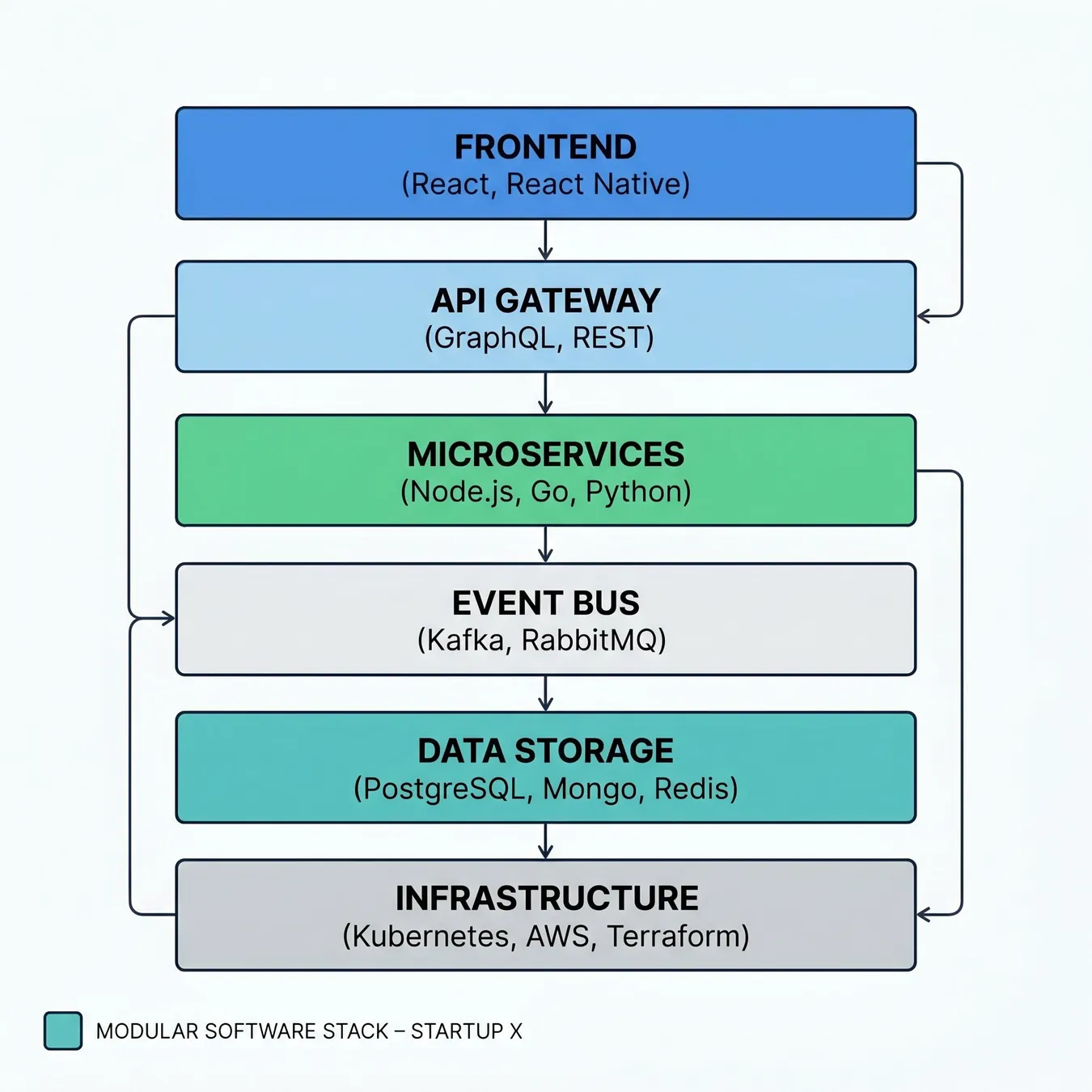
A production-grade architecture ensures your MVP can grow into a full-scale platform.
Phase 1: Discovery and Technical Feasibility
The first step in building a startup from scratch is validating that your technical vision is actually buildable within your budget and timeline. This requires a deep dive into the non technical founder guide to understand how to communicate requirements to engineers.
Defining the Minimum Viable Product (MVP)
An MVP is not a 'cheap' version of your product; it is the most concentrated version of your value proposition. Focus on the one problem you solve better than anyone else and build the engineering infrastructure to support that specific workflow.
Tip.
// Pro Tip
Phase 2: Architecting for Scale and Security
Your choice of stack—whether it's Next.js, Python, or Go—matters less than how you organize your data. If you are building saas mvp, you must consider multi-tenancy and data isolation early to prevent costly migrations later.
| Component | Startup Focus | Production Requirement |
|---|---|---|
| Database | Flexibility | ACID Compliance & Indexing |
| Auth | User Sign-up | RBAC & JWT Security |
| Hosting | Low Cost | Auto-scaling & Backups |
Cloud Infrastructure Foundations
Modern startups should leverage managed services to reduce operational overhead. However, avoid total vendor lock-in by using containerized environments and standard API protocols.

Infrastructure monitoring is essential for maintaining uptime during early growth.
Phase 3: The Engineering Build Cycle
Velocity is the lifeblood of a startup. To maintain speed without sacrificing quality, you need a product roadmap startup strategy that aligns engineering sprints with business milestones.
- 01
Set up CI/CD pipelines for automated testing and deployment.
- 02
Implement a 'feature flag' system to toggle new code safely.
- 03
Conduct weekly code reviews to ensure architectural consistency.
- 04
Build internal admin tools to manage users and data manually if needed.
Avoiding the Vibe-Code Trap
In 2026, AI-assisted coding is standard. However, 'vibe-coding'—relying on AI to generate logic you don't understand—leads to fragile products. Every piece of generated code must be audited for security and performance.
Write unit tests for core business logic.
Document your API endpoints clearly.
Use a consistent design system for the UI.
Hardcode secrets or API keys in the codebase.
Ignore database migrations and versioning.
Build custom auth if a proven library exists.
Phase 4: Launching and Hardening
As you prepare to launch mvp, the focus shifts from building to hardening. This involves stress testing your servers and ensuring your support workflows are ready for real users.
99.9%
Uptime Target
200ms
Max Latency
>80%
Test Coverage
Post-Launch Iteration
Once live, your engineering team must transition from 'build mode' to 'optimization mode.' Use real-world data to identify bottlenecks and prioritize the next set of features based on user behavior.

Peer reviews maintain high code quality.

Coordination is key to a successful startup launch.
Common Pitfalls When Building from Scratch
Many startups fail not because of a bad idea, but because of technical debt that becomes unmanageable. Building too much too soon is just as dangerous as building with poor quality.
The Venture Studio Advantage
For many founders, building a startup from scratch is more efficient within a venture studio framework. This model provides the shared infrastructure and senior engineering leadership that solo founders often lack.
01 / 04
phase 01 / 04
Week 1-2: Discovery
phase 02 / 04
Week 3-4: Foundation
phase 03 / 04
Week 5-10: Build
phase 04 / 04
Week 12: Launch
Engineering Your Success with Studio 402
At Studio 402, we don't just build prototypes; we engineer production-ready software systems. We help founders bridge the gap between a vision and a scalable business by providing the senior technical leadership required for venture-scale growth.
A startup's first codebase is its foundation. If it's built on 'vibe-code' and shortcuts, the business will eventually stall. We build for the long term.
Technical Lead · Studio 402
Why Partner with a Product Engineering Studio?
Whether you are rescuing a broken prototype or starting fresh, having a partner who understands architecture, cloud infrastructure, and AI integration ensures you ship faster and stay stable.
Trade-off
3 pros · 3 cons
Pros
Senior engineering leadership
Production-ready standards
Integrated AI and Cloud expertise
Cons
High coordination overhead
Variable code quality
Lack of architectural oversight
Ready to Build Your Startup?
Building from scratch is a massive undertaking. Don't leave your technical foundation to chance. Studio 402 provides the engineering engine you need to turn your idea into a durable, scalable product.
Build Your Startup the Right Way
Let's discuss your startup vision and how our engineering-first approach can help you launch a production-ready product.
Keep reading
More in Startup Studios & Venture Platforms
Trusted by venture-backed founders to ship production-grade software.
Updated for 2026 engineering standards.
Technical Checklist for New Startups
Select a scalable database (PostgreSQL or similar).
Implement secure authentication (OAuth/JWT).
Set up automated CI/CD pipelines.
Configure error monitoring and logging.
Define a clear API versioning strategy.
By following this roadmap, you ensure that your startup isn't just another prototype, but a durable business built on professional engineering standards.
Final Thoughts on Engineering Excellence
The difference between success and failure in the early stages often comes down to the quality of the first 10,000 lines of code. Choose quality, choose scale, and choose a partner who cares about the architecture as much as the vision.