
Integrating AI Agents into Marketing Workflow Systems
Modern marketing operations are often slowed by manual research and repetitive data entry. By implementing marketing ai tools, teams can automate complex research tasks and content operations at scale.
- AI Integration
- GTM Systems
- Workflow Automation
- Marketing Ops
The Evolution of the Marketing Workflow Tool
A traditional marketing workflow tool usually focuses on task management and static project tracking. However, the next generation of marketing workflow management tools incorporates autonomous agents that perform work, not just track it.
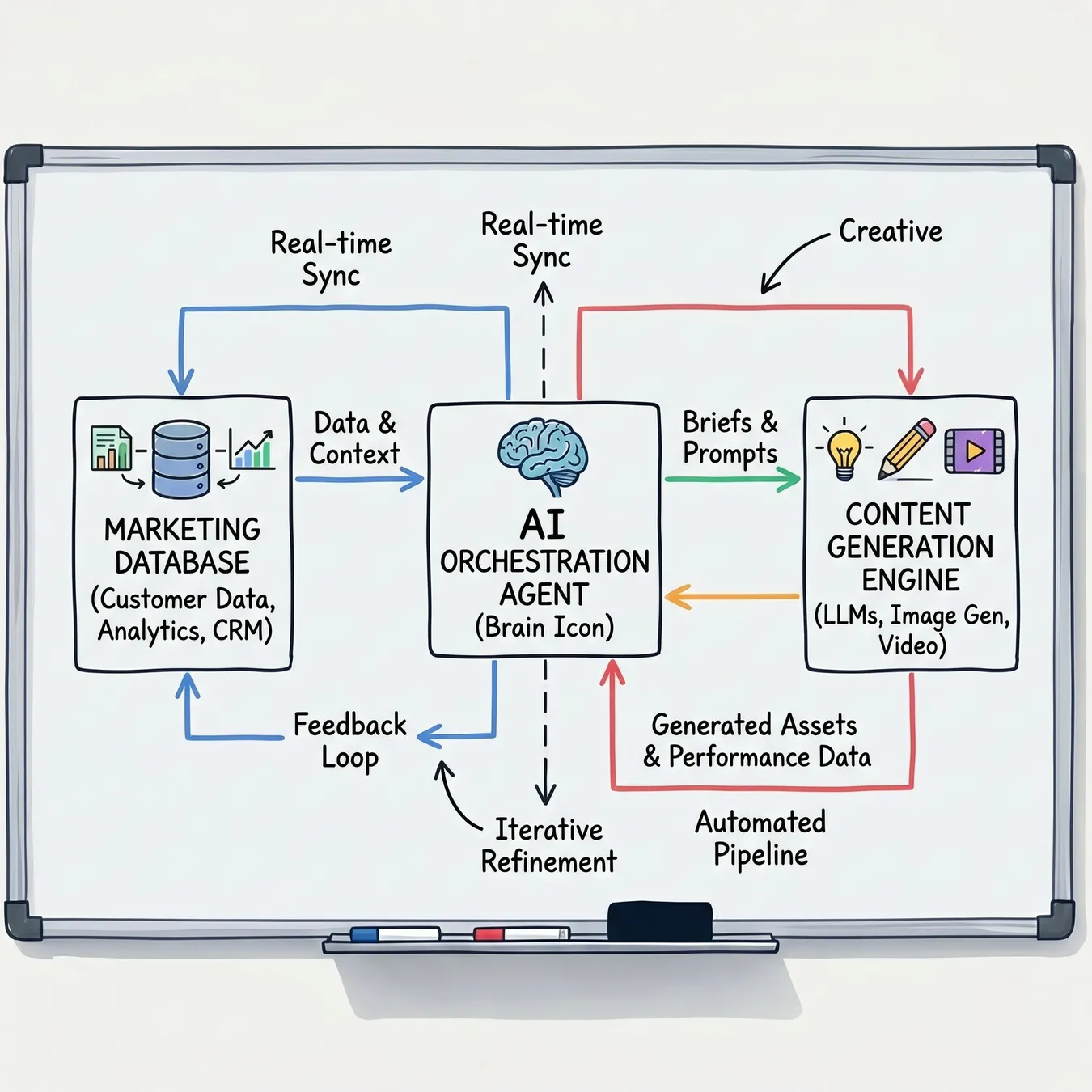
AI agents act as the connective tissue between disparate marketing data sources and execution platforms.
Core Components of Agentic Marketing Systems
To build a durable AI-powered marketing system, you need more than just a prompt. You need a structured environment where agents can access tools, memory, and clear objectives.
- LLM Orchestration Layer: The brain of the agent.
- Tool Access: APIs for CRM, CMS, and social platforms.
- Vector Memory: Long-term storage for brand voice and past performance.
- Human-in-the-Loop: Approval gates for high-stakes content.
Scaling Content Research with AI
AI agents excel at synthesizing vast amounts of competitor data and customer feedback. This allows teams to move from anecdotal evidence to data-driven content strategies in minutes.
Implementing AI in Your Marketing Stack
01 / 04
phase 01 / 04
Audit Manual Bottlenecks
phase 02 / 04
Design Agent Personas
phase 03 / 04
API Integration
phase 04 / 04
Pilot and Refine
Comparing Traditional vs. AI-Native Workflows
Trade-off
4 pros · 4 cons
Pros
Autonomous data collection
24/7 research capabilities
Instant brand voice alignment
Scalable without hiring
Cons
Requires technical setup
Needs ongoing monitoring
Initial cost of integration
Risk of hallucination
Technical Requirements for AI Agents
Building these systems requires a robust software foundation. Many teams start with ai marketing automation tools but eventually need custom code to handle complex logic.
Warning.
// Security Best Practice
Common Use Cases for Marketing Agents
85%
Reduction in research time
10x
Content output increase
0
Manual data entry errors
Automated Competitor Monitoring
Agents can scrape competitor pricing, feature updates, and messaging changes daily, feeding this intelligence directly into your CRM or Slack channels.
Personalized Email Sequencing
By integrating with your CRM, AI agents can draft hyper-personalized follow-ups based on a prospect's recent LinkedIn activity or website visits.
Overcoming Integration Challenges
Start with a single narrow use case
Implement rigorous testing protocols
Keep a human in the loop for approvals
Use structured data formats like JSON
Give agents full write access to production
Ignore token usage costs
Assume AI output is always accurate
Build without a clear fallback plan
The Role of Custom Software in Marketing
Off-the-shelf tools often fail when you need specific integrations. This is where marketing automation for tech companies becomes a competitive advantage.
Workflow Orchestration Patterns
| Pattern | Best For | Complexity |
|---|---|---|
| Linear Chain | Simple content drafting | Low |
| Self-Reflecting | High-quality research | Medium |
| Multi-Agent | Complex GTM campaigns | High |
Maintaining Data Integrity
AI systems are only as good as the data they consume. Integrating these agents requires a deep understanding of workflow automation software to prevent data silos.
Frequently Asked Questions
Future-Proofing Your Marketing Stack
As AI capabilities grow, the companies that have already built the infrastructure for agentic workflows will be the ones that scale most efficiently.
The Shift to AI-Native Operations
We are moving toward a world where marketing teams manage a fleet of agents rather than a list of tasks. This requires a shift in both mindset and technical architecture.
Building Durable AI Systems with Studio 402
If you are looking to move beyond simple prompts and build production-grade systems, workflow automation consulting can help you architect a scalable solution.
The goal isn't just to add AI to your marketing; it's to rebuild your workflows so that AI can actually do the heavy lifting.
Studio 402 Engineering Team
Ready to Automate Your Marketing Ops?
Studio 402 specializes in building the custom software and AI integrations that growth-stage companies need to eliminate technical debt and scale.
Build Your Marketing AI Infrastructure
Let's discuss how we can build custom AI agents and automated systems for your marketing team.
Keep reading
More in GTM & Revenue Operations Systems
Implementation Checklist
Define clear success metrics for the agent
Secure API access for all required platforms
Build a vector database for brand context
Establish a human-in-the-loop review process
Monitor token usage and performance daily

Monitoring agent output is critical for long-term reliability.

Custom software ensures AI outputs match your data schema.
Technical Deep Dive: Agent Memory
Without memory, agents treat every task as a new one. By implementing RAG (Retrieval-Augmented Generation), your marketing agents can remember past campaign results and brand guidelines.
The Importance of Context Windows
Managing what information is fed to the agent is an engineering challenge. Too much data leads to noise; too little leads to poor decisions.
Trusted by growth-stage teams to build production-ready AI systems.
Studio 402 helps you ship software that survives real-world use.
Final Thoughts on Marketing AI
The transition to AI-integrated marketing is not just about tools; it is about building a durable technical foundation that allows your team to focus on strategy while agents handle the execution.