
Reducing Technical Debt in Your Go-To-Market Stack
Technical debt in GTM systems is the silent killer of revenue velocity. It manifests as broken lead flows, inaccurate reporting, and manual workarounds that prevent your team from scaling. To restore performance, revenue operations reduce tech debt gtm systems by auditing core architectures and simplifying CRM processes and systems.
- Revenue Operations
- GTM Strategy
- Tech Debt Audit
- CRM Optimization
Understanding Technical Debt in Revenue Operations
In the context of growth, technical debt isn't just bad code; it is the accumulation of quick-fix integrations and outdated workflows. Understanding the impact of technical debt is the first step toward reclaiming engineering and operational speed.
30%
Average time lost to manual data cleanup
2.4x
Increase in lead response time with debt
15+
Disconnected tools in a typical GTM stack
Core Revenue Operations Responsibilities
Modern revenue operations responsibilities extend far beyond managing a CRM. They include maintaining the data integrity of the entire go-to-market technology stack and ensuring that every tool serves a measurable business outcome.
- System architecture and tool consolidation
- Data governance and lifecycle management
- Process automation and workflow engineering
- Performance reporting and pipeline visibility
- Cross-functional alignment between sales, marketing, and success
How RevOps Reduces Technical Debt in GTM Stacks
Effective remediation requires a systematic approach. By implementing technical debt reduction strategies, teams can move from reactive firefighting to proactive system design.
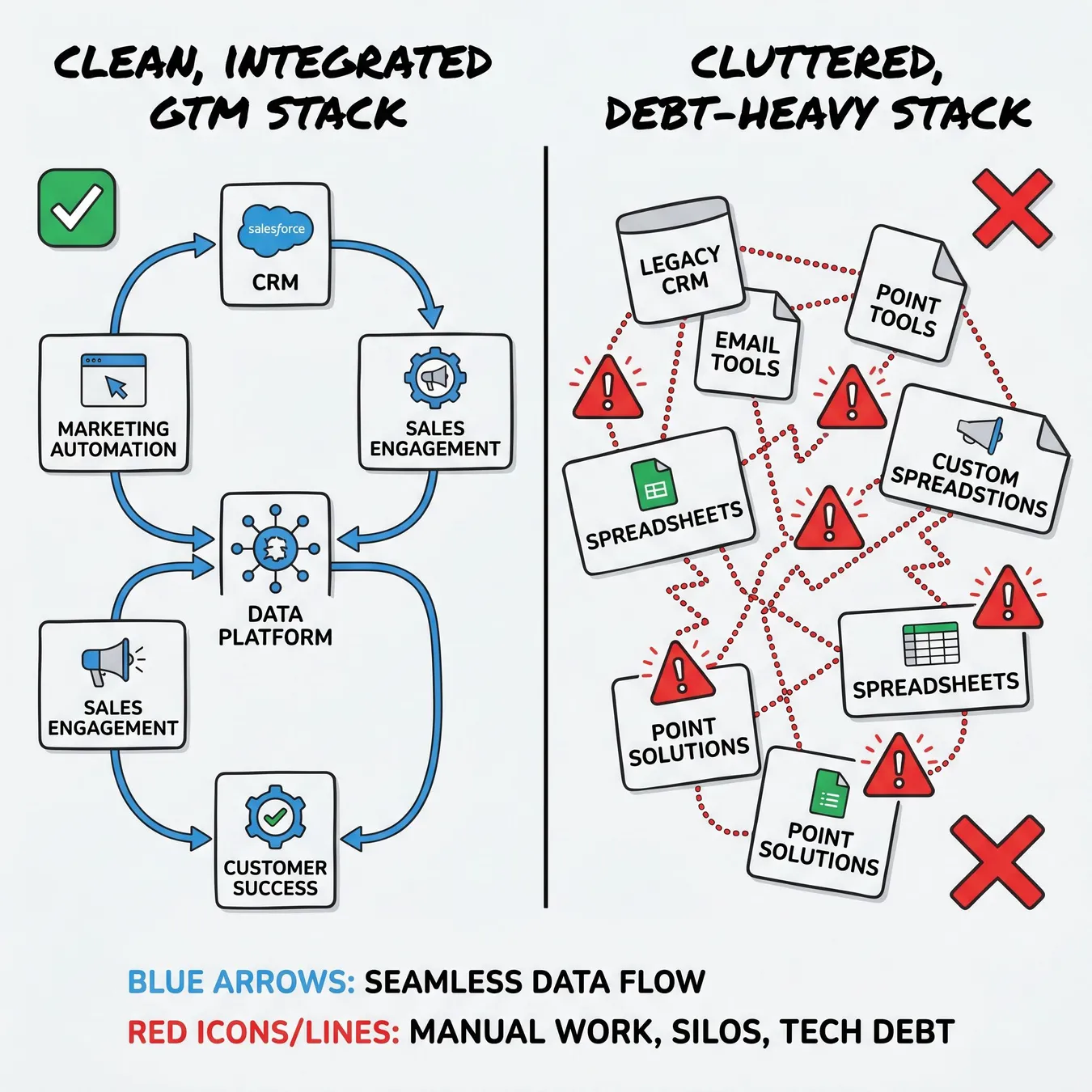
Visualizing the difference between a debt-heavy and an optimized GTM architecture.
The GTM Tech Debt Audit Checklist
Identify all unused or redundant SaaS licenses
Map all data flows between CRM and marketing automation
Audit custom fields and objects for duplication
Review API error logs for failing integrations
Evaluate manual spreadsheet dependencies
Quantifying the Cost of System Drag
To get executive buy-in for cleanup, you must speak the language of the business. This involves quantifying technical debt to show how it directly impacts the bottom line and team morale.
Info.
// The Hidden Cost
Addressing Infrastructure and Cloud Debt
Often, the root cause of GTM friction lies deeper than the CRM UI. You must also address infrastructure technical debt, such as poorly configured cloud databases or fragile serverless functions that handle lead routing.
Common Debt Sources in CRM Processes
| Source | Symptoms | Remedy |
|---|---|---|
| Point-to-Point Syncs | Data collisions, duplicates | Middleware or Hub-Spoke |
| Legacy Workflows | Slow record saving, errors | Consolidation into Code |
| Shadow IT | Security risks, siloed data | Centralized GTM Governance |
Step-by-Step: Eliminating GTM Debt
01 / 04
phase 01 / 04
Inventory
phase 02 / 04
Prioritize
phase 03 / 04
Refactor
phase 04 / 04
Automate
Do's and Don'ts for GTM Cleanup
Standardize data schemas across all platforms
Document every custom automation and its purpose
Use version control for CRM configurations
Apply 'quick fixes' to fundamental data issues
Ignore the underlying infrastructure performance
Build custom solutions when native features suffice
The Role of AI in Debt Reduction
AI can be a powerful ally in identifying anomalies and mapping complex data relationships. However, AI-generated code must be audited carefully to ensure it doesn't introduce a new layer of 'vibe-coded' debt into your stack.

Leveraging AI for data cleansing and system audits.
Measuring Success After Remediation
Success isn't just a 'clean' CRM. It is measured by the increased speed at which your marketing and sales teams can execute new campaigns and close deals without system interference.
- 01
Reduced time-to-launch for new GTM programs
- 02
Higher confidence in revenue reporting accuracy
- 03
Lower maintenance overhead for the RevOps team
- 04
Improved lead-to-opportunity conversion rates
Expert Perspectives on GTM Systems
Technical debt is the interest you pay on moving too fast without a plan. In GTM, that interest is paid in lost revenue.
Senior Systems Architect · Studio 402
Frequently Asked Questions
Bridging the Gap: From Debt to Durable Systems
At Studio 402, we don't just patch broken workflows. We treat your GTM stack as a production-grade software product. Whether you are scaling a SaaS platform or managing a complex global sales motion, we help you build the technical foundations that grow with your business.

Durable reporting systems.

Engineering-led GTM systems.
If your growth is stalled by fragile tools and manual processes, it’s time to move beyond prototypes. We specialize in auditing, refactoring, and engineering GTM systems that survive real-world scale.
Eliminate Your GTM Technical Debt
Ready to restore your engineering velocity and data integrity? Let's build a durable foundation for your revenue operations.
Explore Related GTM Solutions
Comparison: In-House vs. Studio-Led Cleanup
Trade-off
3 pros · 3 cons
Pros
Deep architectural expertise
Faster time to remediation
Production-grade engineering standards
Cons
Requires initial discovery time
Requires stakeholder alignment
Higher upfront investment than 'patching'
Helping growth teams reclaim 20+ hours a week in manual ops.
Based on recent GTM system refactoring projects.
The Future of Revenue Systems
As GTM stacks become more complex, the need for engineering-led RevOps will only grow. Companies that invest in reducing debt today will be the ones capable of integrating AI and new technologies tomorrow without breaking their core engine.

The vision of a frictionless, automated revenue engine.
Final Thoughts on System Integrity
Technical debt is not an inevitability; it is a choice. By prioritizing system health and data integrity, RevOps leaders can transform their technology stack from a bottleneck into a competitive advantage.
- Audit early and often
- Prioritize durability over speed
- Partner with engineering experts
- Focus on the end-to-end customer journey
Keep reading
More in GTM & Revenue Operations Systems
Key Takeaways for Revenue Leaders
Reducing debt requires a cultural shift toward quality. It means saying no to 'quick' integrations that don't scale and yes to the hard work of building durable infrastructure.
Studio 402 transformed our messy CRM into a streamlined engine. We finally have data we can trust for our board meetings.
Don't let legacy debt hold back your next phase of growth. Start your audit today and reclaim your revenue velocity.