
Structuring Co-Founder Agreements and Equity Splits
A co-founder agreement is the most critical document you will sign in the early days of your startup. It defines the equity split between founders and sets the rules for how the partnership will evolve as you scale toward future startup funding stages.
- Equity Strategy
- Founder Dynamics
- Venture Ready
- Legal Framework
The Logic of the Equity Split Between Founders
Determining the right equity split between founders is rarely as simple as a 50/50 divide. It requires an honest assessment of contribution, risk, and long-term commitment to the vision.
43%
Startups that fail due to founder conflict
4 Years
Standard vesting cliff period
10-20%
Typical employee option pool size
Essential Components of a Co-Founder Agreement
Beyond the percentage of ownership, your agreement must cover decision-making authority, intellectual property assignment, and what happens if a partner leaves the business early.
- Equity ownership and share classes
- Vesting schedules and cliff periods
- Roles and responsibilities of each founder
- Intellectual property (IP) assignment to the company
- Decision-making and tie-breaking mechanisms
- Exit and buyout clauses
Understanding Vesting for Founders
Vesting for founders is a protective measure that ensures equity is earned over time. This prevents a scenario where a founder leaves after six months while retaining a massive chunk of the cap table.
Info.
// The Golden Standard
How to Calculate a Fair Equity Split
When weighing contributions, consider the technical complexity of the build. For those following a non technical founder guide, understanding the value of engineering execution is vital for a fair split.
| Factor | Weight | Description |
|---|---|---|
| Idea & IP | Low | Ideas are cheap; execution is everything. |
| Capital | Medium | Initial cash injection into the business. |
| Technical Build | High | Designing and shipping the actual product. |
| Full-time Commitment | Critical | Founders quitting jobs to build full-time. |
Vesting Mechanics and Acceleration
Acceleration clauses protect founders during an acquisition. Single-trigger acceleration triggers on a change of control, while double-trigger requires both a sale and a termination.
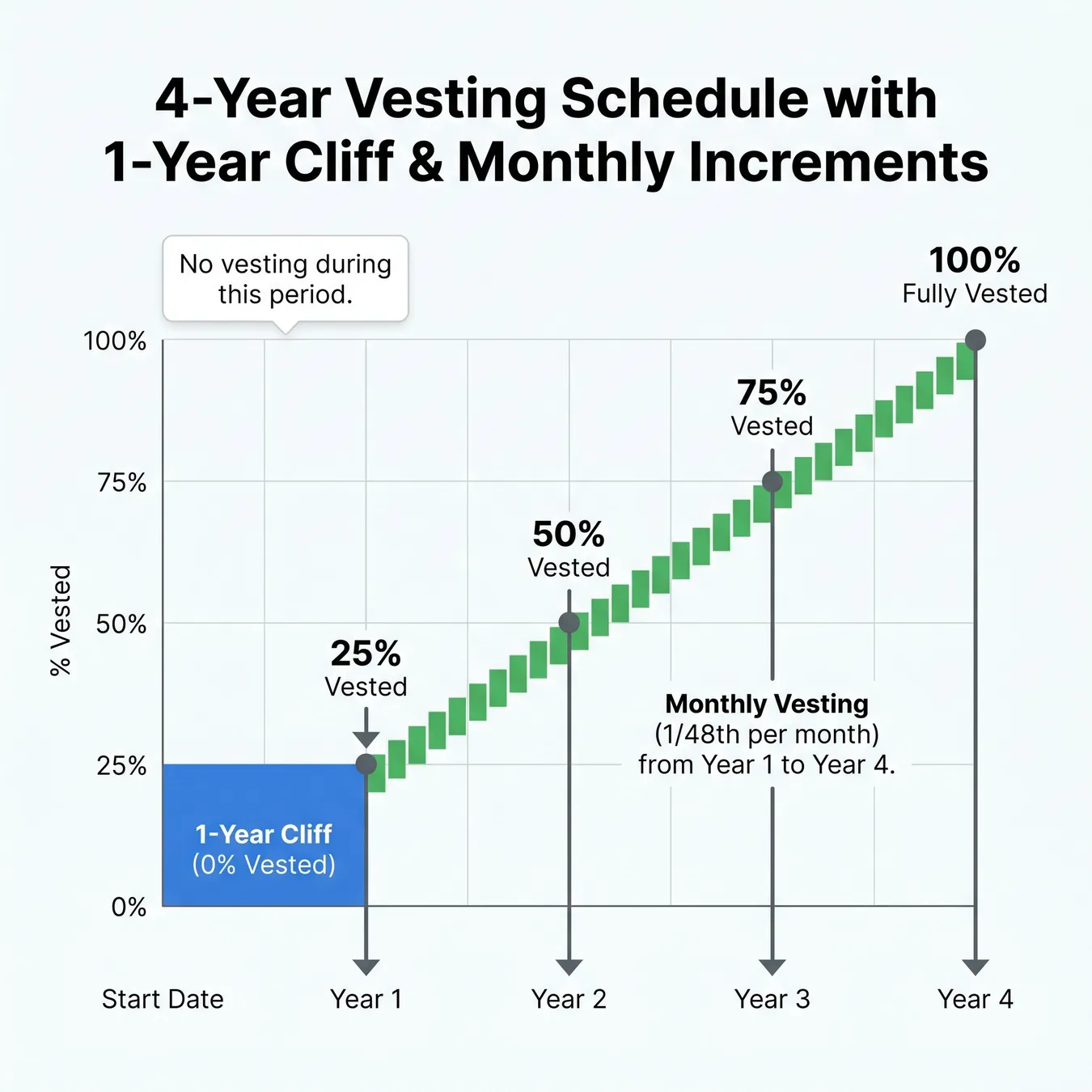
Visualizing the standard founder vesting schedule.
IP Assignment: Protecting the Company Assets
Investors will not fund a startup if the founders personally own the code or patents. Your agreement must explicitly transfer all work product to the corporate entity.
Decision Making and Governance
Who has the final say on hiring? Who can authorize a pivot? Defining these roles early prevents the operational drag that kills momentum during rapid growth.
Equity and Future Fundraising
Your initial split affects how you handle pre seed funding equity. Investors look for a cap table that leaves enough room for future hires and subsequent dilution.
Common Mistakes in Founder Agreements
Use a standard 4-year vesting schedule
Assign all IP to the company immediately
Discuss 'what-if' exit scenarios early
Keep a reserve for the employee option pool
Give 50% to a part-time founder
Skip the written agreement because you are friends
Forget to include a buy-back provision
Issue all shares upfront without vesting
The Role of the Board of Directors
Even in a two-person startup, you should establish a board structure. This provides a formal layer for high-level governance and prepares the company for institutional investment.
Handling Founder Departures
If a founder leaves, the company usually has the right to repurchase unvested shares. This is vital to keep the cap table 'clean' for future investors.
Scaling the Team After the Split
Once the founders are aligned, your focus shifts to the engineering team structure. How you allocate the remaining equity pool will determine the caliber of talent you can attract.
Tax Implications: Section 83(b) Elections
In the US, filing an 83(b) election within 30 days of share issuance is non-negotiable. It allows you to pay taxes on the value of the shares today rather than as they vest.
Warning.
// Critical Deadline
Step-by-Step: Finalizing Your Agreement
01 / 04
phase 01 / 04
Contribution Audit
phase 02 / 04
Drafting Terms
phase 03 / 04
Legal Review
phase 04 / 04
Execution & Filing
Frequently Asked Questions
Bridging Strategy to Execution
Structuring your agreement is the first step in building a durable company. At Studio 402, we help founders move from these initial legal frameworks to high-performance product engineering.
If you are navigating the complexities of a technical partnership or need a senior partner to help architect your first production-ready build, we provide the advisory and engineering depth to scale safely.

Building the foundation for long-term scale.

Formalizing the partnership.
How Studio 402 Supports Founders
We don't just write code; we act as a fractional engineering leadership partner. We help you make the right stack decisions and build systems that protect the equity value you've worked so hard to structure.
Technical architecture review
MVP development and launch
Post-vibe-code rescue and hardening
Cloud infrastructure scaling
Build Your Foundation with Studio 402
Ready to turn your partnership into a production-ready product? Let's discuss your technical roadmap.
Further Reading for Founders
Keep reading
More in Founder & Peer Networks
Trusted by venture-backed founders across the US and Europe.
Updated for July 2026
Ensuring your cap table is stable today allows you to focus on what matters: shipping a product that users love and investors want to back.
Final Thoughts on Founder Equity
The best agreements are the ones you never have to look at again because they were built on a foundation of trust, clarity, and fair market principles.
For more peer-led insights, explore our founder network resources or contact our team for a direct technical consultation.