
Defining the Scope of Mobile App Development
Defining the scope of mobile app development is the most critical phase of any product journey. It transforms a vague vision into a structured execution plan, ensuring that every line of code serves a business objective.

Strategic scoping is the foundation of every successful mobile product.
Understanding the Core Components of Project Scope
A comprehensive scope document acts as the single source of truth for founders and engineering teams. It outlines what will be built, how it will function, and where the boundaries of the project lie.
- Functional Requirements: What the user can actually do.
- Technical Constraints: Platform choices and integration limits.
- Business Logic: How data flows and rules are applied.
- User Experience (UX) Standards: Navigation and interaction patterns.
- Security and Compliance: Data protection and regulatory needs.
Identifying Functional Requirements and User Stories
Start by mapping out the user journey. For a non technical founder app, this means translating high-level goals into specific user stories that developers can estimate and build.
Prioritizing Features for Launch
Not every feature belongs in version one. Use the MoSCoW method (Must have, Should have, Could have, Won't have) to filter your backlog and focus on the core value proposition.
User Authentication (Social, Email, or Biometric)
Core Workflow (The primary action of the app)
Push Notifications (Engagement triggers)
Profile Management
In-App Search and Filtering
Technical Constraints and Platform Strategy
Your choice of technologies to develop mobile apps will dictate your project's scope, budget, and timeline. Deciding between native and cross-platform early prevents costly pivots later.
Trade-off
3 pros · 3 cons
Pros
Lower development costs for two platforms
Single codebase for easier maintenance
Faster time-to-market for MVPs
Cons
Limited access to niche hardware features
Slightly larger app bundle sizes
Dependence on third-party framework updates
Defining Delivery Milestones and Timelines
Scope is meaningless without a timeline. Break your project into logical phases that allow for testing, feedback, and iteration before the final production release.
01 / 05
phase 01 / 05
Discovery & Architecture
phase 02 / 05
UI/UX Design
phase 03 / 05
Core Development
phase 04 / 05
Hardening & QA
phase 05 / 05
Deployment
The Role of Mobile App Engineering in Scoping
Professional mobile app engineering goes beyond UI. It involves designing for offline sync, local caching, and efficient API communication to ensure a smooth user experience.
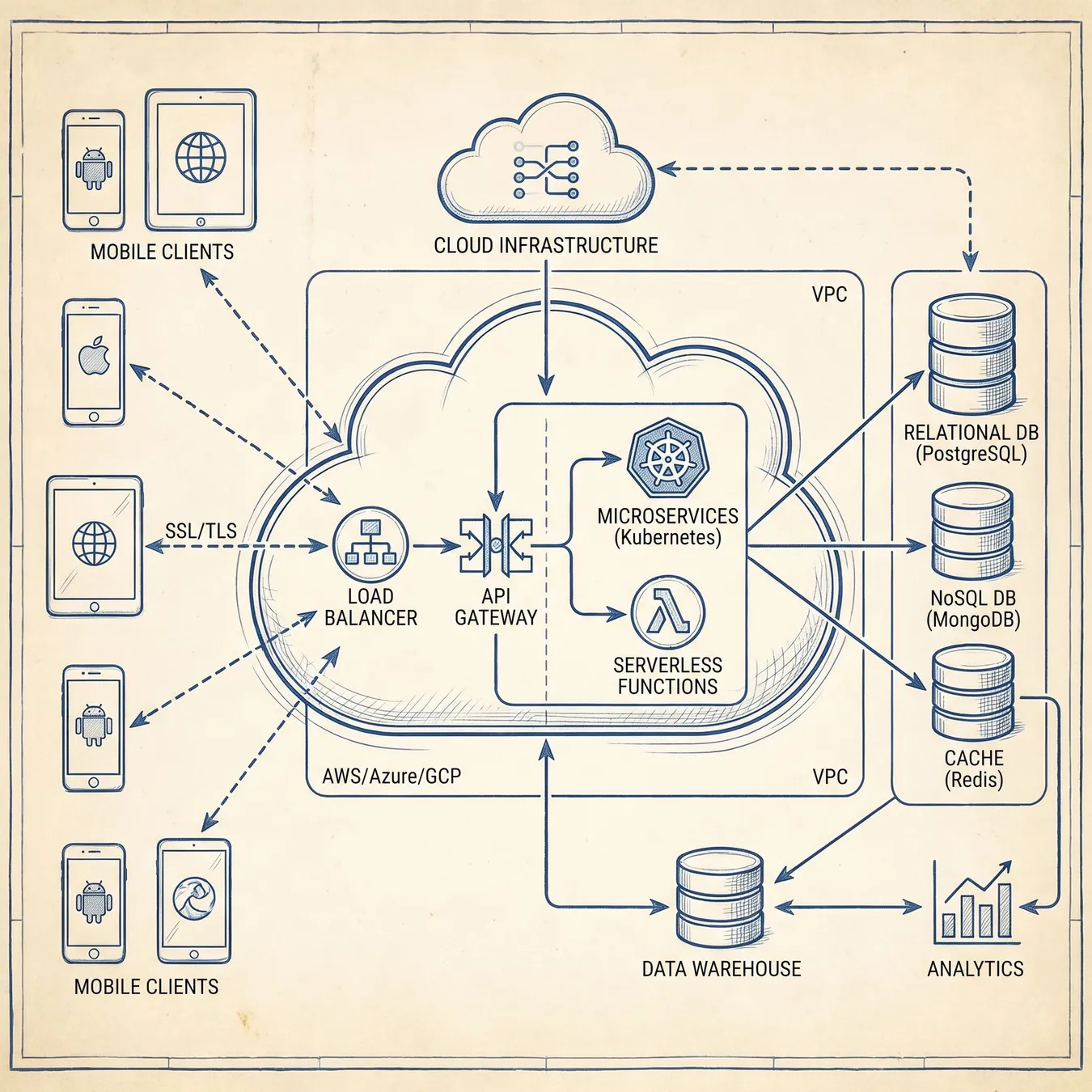
Engineering depth ensures your scope accounts for scalability and security.
Common Scoping Pitfalls to Avoid
Define clear acceptance criteria for every feature
Account for third-party API costs and limits
Include time for App Store review cycles
Assume 'simple' features are easy to build
Ignore the backend infrastructure requirements
Skip the documentation phase to save time
Organizing Your Team for Execution
The success of your scope depends on your mobile app development team structure. You need a mix of product, design, and engineering talent to cover all bases.
40%
Reduction in rework with clear scope
2x
Faster launch with prioritized MVPs
100%
Alignment between founders and devs
Managing Scope Creep Post-Launch
Scope creep is the gradual expansion of project requirements. While iteration is healthy, uncontrolled changes can lead to missed deadlines and budget overruns.
Tip.
// Pro Tip
Technical Debt and Scoping Decisions
Every scoping decision involves a tradeoff. Choosing a faster path today might create technical debt that requires a refactor tomorrow. Document these choices clearly.
Scalability Considerations
Will your app support 100 users or 100,000? Your scope must define the expected load so the architecture can be built to handle growth without crashing.
Budgeting for Mobile Development Scope
A well-defined scope allows for accurate budgeting. Without it, you are essentially signing a blank check. Ensure your scope includes maintenance and hosting costs.
| Phase | Focus | Typical Duration |
|---|---|---|
| Discovery | Requirements & Logic | 2-4 Weeks |
| MVP Build | Core Features | 3-5 Months |
| Hardening | Security & QA | 3-6 Weeks |
Frequently Asked Questions About Mobile Scoping
Bridging Strategy and Execution with Studio 402
At Studio 402, we don't just take orders; we partner with you to refine your scope for production-ready outcomes. We help you navigate the complex decisions that separate a prototype from a scalable product.
Whether you are starting from zero or rescuing a project that has lost its way, our senior engineering team ensures your mobile app is built on a foundation of clarity and technical excellence.
The most expensive code is the code you have to write twice because the scope wasn't defined the first time.
Studio 402 Engineering Team
Next Steps for Your Mobile Project
Ready to Scope Your Mobile App?
Let's turn your requirements into a production-ready roadmap. Start a conversation with our senior engineering team today.
Explore More in Mobile Development
Keep reading
More in Mobile App Development
Trusted by founders to build scalable mobile products.
Studio 402 | Production-Ready Engineering
Defining the scope of mobile app development is an ongoing process of refinement. As you learn more about your users, your scope will evolve, but a strong start is non-negotiable.
Final Takeaways
- Focus on the core problem first.
- Be explicit about technical constraints.
- Plan for the long-term, build for the short-term.
- Communicate early and often with your build partner.
If you are ready to move from 'vibe-coding' to professional engineering, we are here to help you build software that survives real-world use.

Precision in scoping leads to excellence in execution.
Thank you for reading our guide on defining the scope of mobile app development. We hope this helps you launch a successful product in 2026.