
Overview
Agentic AI for Financial Operations
Deploy production-grade platforms with full agentic AI support for financial ops. Automate complex reconciliation, audit trails, and compliance workflows at scale.

Platforms with Full Agentic AI Support for Financial Ops
Modern financial institutions are moving beyond simple automation toward autonomous systems. By leveraging agentic ai in finance, teams can deploy intelligent agents that don't just follow scripts, but reason through complex exceptions and regulatory requirements.
90%
Reduction in manual reconciliation time
100%
Audit trail coverage for AI decisions
24/7
Continuous compliance monitoring
The Shift to Autonomous Financial Systems
Traditional automation often breaks when encountering non-standard data or shifting regulations. Platforms with full agentic AI support for financial operations solve this by utilizing Large Language Models (LLMs) capable of understanding context and intent.
- Self-correcting reconciliation workflows
- Dynamic audit trail generation
- Automated regulatory reporting and filing
- Intelligent exception handling for cross-border payments
Core Capabilities of Agentic Financial Platforms
Autonomous Reconciliation and Ledger Management
Agents can now match millions of transactions across disparate systems, identifying discrepancies that rule-based engines miss. This is a critical component of modern fintech ops, ensuring that data integrity is maintained without human intervention.
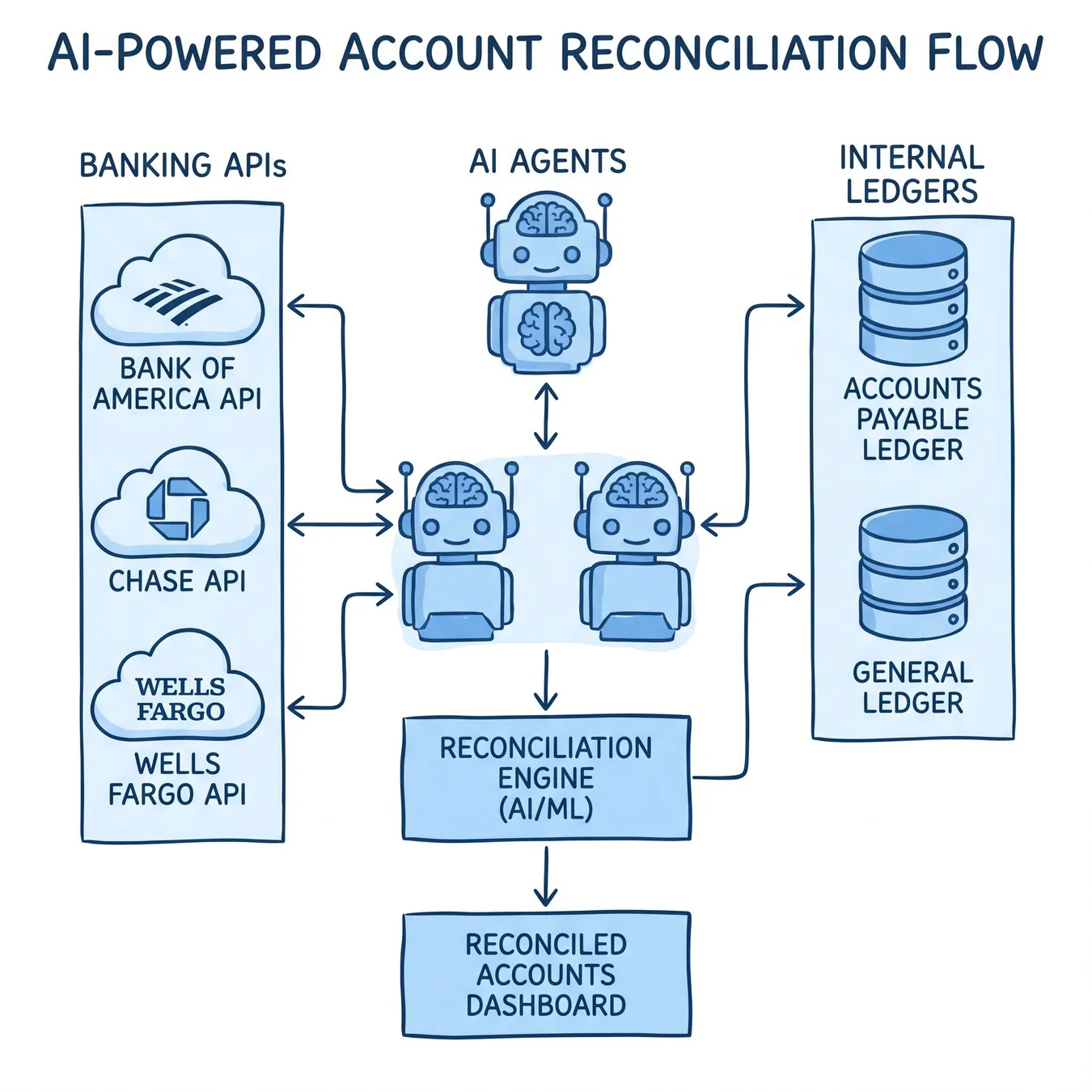
AI-driven multi-source reconciliation architecture.
Regulatory Compliance and Auditability
Every action taken by an autonomous agent must be logged and explainable. Production-grade systems build these audit trails natively, ensuring that every decision can be traced back to specific data points and logic gates.
Info.
// Compliance First
Implementing Agentic AI in Banking Environments
Security is the primary hurdle for automation in banking. Systems must adhere to SOC2, GDPR, and industry-specific data residency requirements while maintaining high availability for transaction processing.
End-to-end data encryption in transit and at rest
Role-based access control (RBAC) for agent permissions
Real-time monitoring and anomaly detection
Immutable audit logging for all AI interactions
Data-Driven Insights and Operational Analytics
Beyond execution, agentic systems provide deep visibility into business health. By integrating operational analytics in finance, leaders can see not just what happened, but why specific trends are emerging in their cash flow.
Predictive Cash Flow Management
Autonomous agents analyze historical patterns to predict future liquidity needs, allowing finance teams to optimize capital allocation without manual spreadsheet modeling.
Trade-off
4 pros · 4 cons
Pros
Real-time exception handling
Scalable without adding headcount
Reduced human error in data entry
Proactive compliance monitoring
Cons
Higher initial implementation cost
Requires high-quality source data
Complex initial configuration
Ongoing monitoring of LLM drift
How to Build Production-Grade AI for Finance
01 / 05
phase 01 / 05
Discovery & Architecture
phase 02 / 05
Data Hardening
phase 03 / 05
Agent Orchestration
phase 04 / 05
Compliance Guardrails
phase 05 / 05
Scale & Optimization
Common Challenges in Autonomous Financial Ops
The transition from vibe-coded prototypes to production-ready systems is where most projects fail. Financial operations require a level of precision that generic AI wrappers cannot provide.
Use deterministic logic for final calculations
Implement multi-agent verification for high-risk tasks
Maintain a comprehensive data dictionary
Rely solely on LLMs for mathematical accuracy
Bypass human approval for large transfers
Use unencrypted channels for financial data
The Future of Financial Operations
As platforms with full agentic ai support for financial operations become standard, the role of the finance professional will shift from data processor to strategic orchestrator.
Autonomous systems aren't about replacing the finance team; they're about giving that team the infrastructure to operate at a scale previously impossible.
Studio 402 Engineering Lead · Systems Architect
Frequently Asked Questions
Bridging the Gap: From Prototype to Production
Many teams start with a 'vibe-coded' demo that works in a controlled environment but fails when faced with real-world financial complexity. Studio 402 specializes in taking these concepts and hardening them into durable, scalable software.
Whether you are building a new fintech platform or modernizing internal operations, we provide the engineering depth required to ship systems that survive real users and strict audits.
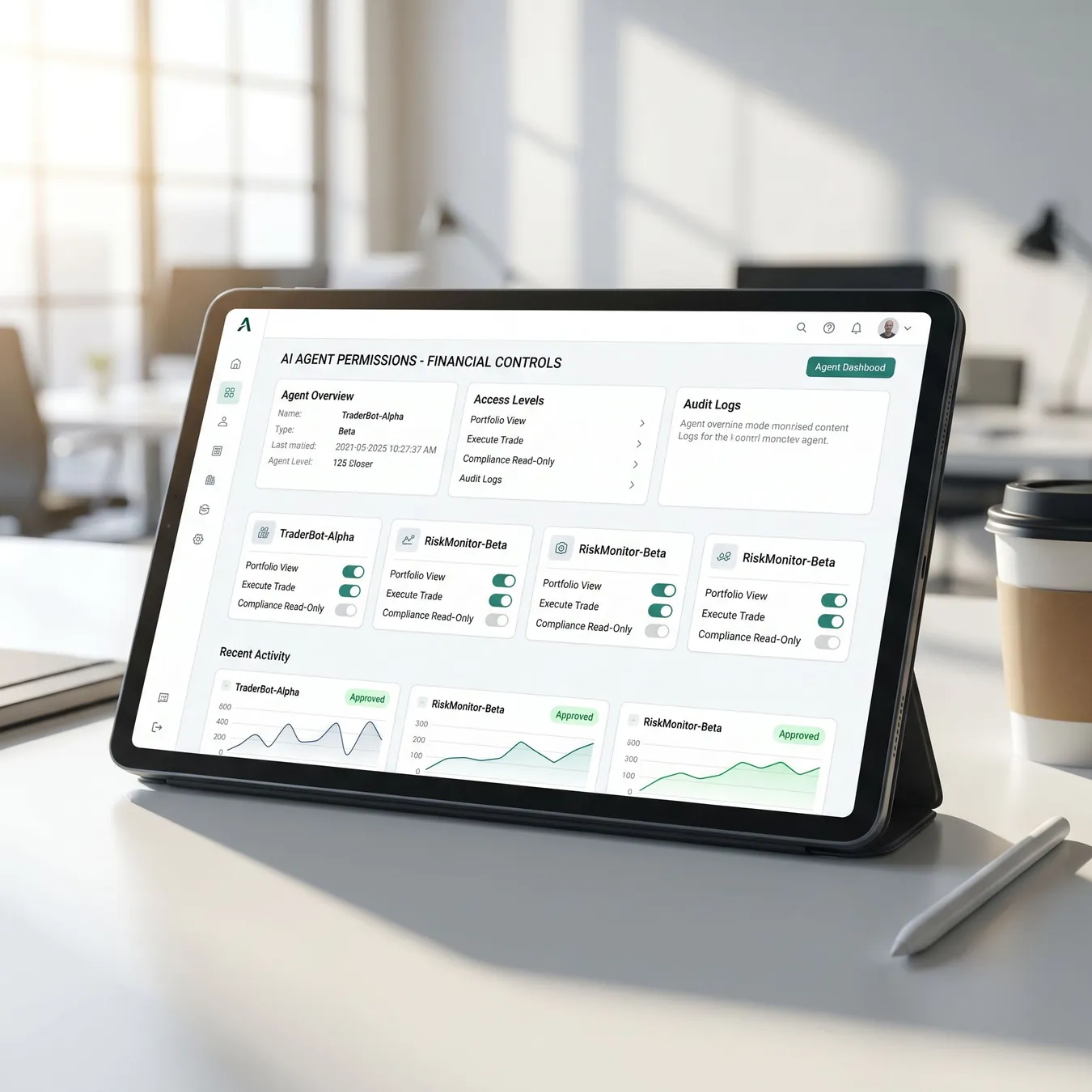
Agent permission management UI.

Workflow execution visualization.
Why Partner with Studio 402 for Financial AI?
We don't just build chatbots. We engineer the underlying infrastructure, data pipelines, and security layers that make autonomous financial operations possible.
- Deep expertise in financial compliance and security
- Proven track record of rescuing fragile AI prototypes
- Full-stack capability from UI design to cloud infrastructure
- Outcome-oriented delivery focused on operational ROI
Studio 402 took our manual reconciliation process and turned it into a fully autonomous system in months. The auditability they built in was a game-changer for our compliance team.
Ready to Automate Your Financial Operations?
The path to autonomous finance starts with a conversation about your specific bottlenecks and goals. Let's build a system that scales with your business.
Build Your Autonomous Finance Platform
Stop managing spreadsheets and start scaling with agentic AI. Contact us to discuss your project.
Explore Related Solutions
Keep reading
More in Specialized Industry Software
Our approach to financial software development is rooted in production-first engineering. We ensure that every line of code contributes to a stable, maintainable, and secure platform.
Custom Integration Capabilities
We specialize in connecting disparate data sources—from legacy banking cores to modern SaaS tools—into a unified intelligence layer for your agents.
| Feature | Traditional Automation | Agentic AI Support |
|---|---|---|
| Logic | Static/Rule-based | Dynamic/Reasoning-based |
| Exception Handling | Manual intervention | Autonomous resolution |
| Adaptability | Requires code changes | Learns from context |
Security and Data Privacy
In the financial sector, there is no room for error. We implement multi-layered security protocols to protect sensitive PII and financial records at every stage of the AI lifecycle.
- Production-Ready
- Fintech
- Agentic AI
- Compliance
- Scalable
Continuous Improvement
Autonomous systems are not 'set and forget.' We provide ongoing support to monitor agent performance, update models, and ensure your system evolves with the market.
Studio 402 is your partner in navigating the complex landscape of AI-native financial engineering. We bridge the gap between ambitious ideas and durable software.
Next Steps for Your Team
- 01
Identify your most time-consuming manual financial task.
- 02
Audit your current data quality and accessibility.
- 03
Schedule a discovery call with Studio 402 to map out a pilot.
- 04
Define success metrics for your first autonomous agent.
- 05
Deploy a production-grade MVP and iterate based on results.
The future of finance is autonomous. By deploying platforms with full agentic AI support for financial ops today, you position your business for the next decade of growth.
Trusted by leading fintech innovators and growth-stage companies.
Updated July 2026